

World News
Argentine Judge Charges 7 Iranians, Hezbollah Member Over 1994 AMIA Bombing
Eight suspects accused of involvement in the attack that killed 85 people could face trial in absentia after a major step in a decades-long investigation
- Shlomo Hodges
- | Updated
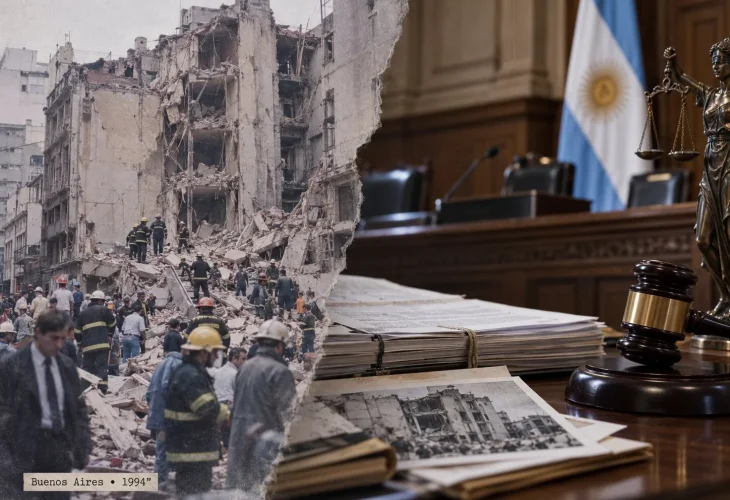 Illustration
An Argentine judge has formally charged seven Iranians and a Lebanese Hezbollah member over their alleged involvement in the 1994 bombing of the AMIA Jewish community center in Buenos Aires.
Federal Judge Daniel Rafecas issued the charges as part of Argentina's newly established system allowing suspects accused of serious crimes to be tried in absentia.
The bombing, on July 18, 1994, killed 85 people and wounded more than 150 others. A vehicle packed with explosives detonated outside the Argentine Israelite Mutual Association, known as AMIA.
Argentine investigators have long accused senior Iranian officials of ordering the attack and Hezbollah of carrying it out. An Argentine court ruled in 2024 that Iran and Hezbollah were responsible for the bombing.
Rafecas said the decision to carry out the attack was made in August 1993 by senior members of the Iranian government and that Hezbollah was entrusted with its execution.
Rafecas charged four former senior Iranian officials as indirect perpetrators: former Intelligence Minister Ali Fallahijan, former Foreign Minister Ali Akbar Velayati, former Islamic Revolutionary Guard Corps commander Mohsen Rezaei and Ahmad Vahidi, who headed the IRGC's Quds Force at the time.
In addition, Rafecas charged three other Iranians with providing essential assistance to the attack: former Iranian ambassador to Argentina Hadi Soleimanpour, former Iranian Embassy cultural adviser Mohsen Rabbani and alleged intelligence agent Ahmad Reza Asghari.
Lebanese Hezbollah member Salman Raouf Salman, also known as Samuel El Reda, was charged over his alleged role in coordinating the final stages of the attack.
Rezaei currently serves as secretary of Iran's Supreme National Security Council.
The judge also ordered authorities to freeze $500 million in assets belonging to each of the eight defendants.
None of the suspects are currently in Argentine custody. Most have been sought internationally for years, with several appearing on Interpol wanted-person notices following requests from Argentina.
The charges bring Argentina closer to holding its first trial in absentia over the bombing. Rafecas cautioned, however, that further legal steps are required before a trial can begin and that the defendants can appeal the decision.
The judge also asked Argentina's Supreme Court to consider whether the AMIA investigation should be connected with the case surrounding the 1992 bombing of the Israeli Embassy in Buenos Aires, which killed 29 people.
Both attacks have remained central to Argentina's investigations into Iranian and Hezbollah activity in the country.
The AMIA investigation has been marked by decades of legal disputes, accusations of political interference and allegations of efforts to conceal responsibility for the attack.

