

Israel News
IDF Probe Into October 7 Battle at Paga Base: “The Military Failed Its Defense Mission”
Three years later, the IDF has released its investigation into the battle at the “Paga” outpost. Eighteen soldiers were killed, 22 were wounded, and two were abducted to Gaza. The probe found that, alongside extraordinary heroism, failures in equipment, preparedness, and coordination with the Air Force enabled terrorists to capture the base and infiltrate Be’eri.
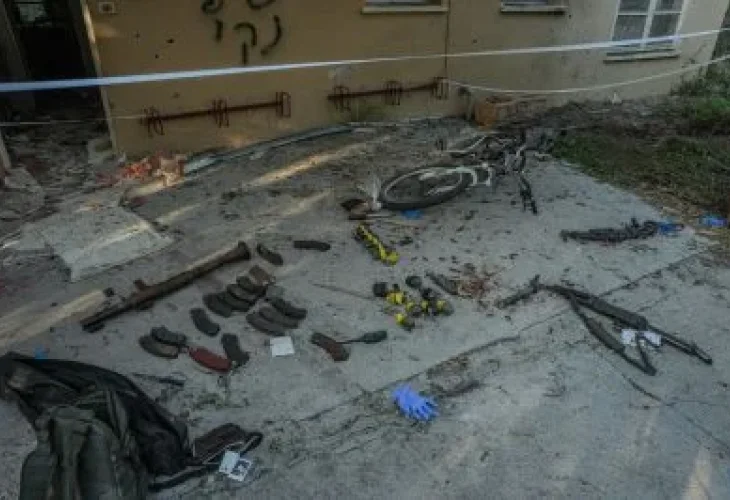 Weapons belonging to terrorists in the Be’eri area (Photo: Erik Marmor, Flash90)
Three years after the battle, the IDF today (Thursday) released the conclusions of its operational investigation into the fighting in the area of the “Paga” outpost, near Nahal Oz. The investigation, led by Col. Uri Ron, found that the military failed in its defense mission and did not prevent the fall of areas in its sector, the terrorists’ infiltration into Kibbutz Be’eri, and the capture of the outpost. In the intense fighting in the area, 18 soldiers were killed and 22 were wounded; two were abducted to the Gaza Strip.
The investigation noted that “there were displays of heroism and independent actions worthy of recognition among junior commanders and soldiers in the company sector and at the outposts. According to the investigation, these actions reflect the values of comradeship and engagement with the enemy shown by the company combat team’s soldiers, who operated in an operational reality that was complex to the point of being nearly impossible.”
The “Paga” outpost, known as the “Be’eri Shield,” was staffed on the morning of October 7 by soldiers from Company 13 of the Golani Brigade. It is located south of Nahal Oz, about 300 meters from the Gaza Strip border, opposite the village of Juhor ad-Dik.
According to the investigation, the Company 13 Golani combat team was not prepared for its mission in terms of equipment, the readiness of its fighting positions, and the base’s infrastructure. The investigative team determined that the enemy neutralized the sector’s “force multipliers,” including intelligence-gathering capabilities and firepower, enabling the infiltration of dozens, if not hundreds, of terrorists into the outpost and Kibbutz Be’eri.
According to the investigation, when the infiltration began, the soldiers at Paga Base entered protected areas, and the dining hall was designated as the company’s assembly point. At 6:33 a.m., an additional standby force traveled to Paga Base to take shelter. At 6:49 a.m., terrorists fired for the first time at the base walls from the Givat Sachif area. At the same time, at the nearby Sahaf outpost, tracker Master Sgt. Mohammed al-Atrash was hit. Al-Atrash was declared a fallen soldier whose body was held hostage, and his body was returned to Israel last year as part of the hostage deal.
At 6:55 a.m., the first terrorists entered the base through the armored-vehicle gate. In the first barrage, three soldiers from the mortar platoon were killed: Cpl. Ido Binenstock, Staff Sgt. Tomer Barak, and Cpl. Habib Kiyan, of blessed memory. The mortar force, commanded by platoon sergeant Itamar Ben Yehuda, killed four terrorists. Ben Yehuda and another soldier, Haim Meir Eden, were wounded. Ben Yehuda died of his wounds several hours later; Eden died after about two months of hospitalization.
At 7:01 a.m., another armored personnel carrier was hit by an anti-tank missile, and terrorists entered the perimeter of the base through “Upper Paga.” At 7:49 a.m., a terrorist was identified inside the pillbox at the rear gate, and the force moved to eliminate him using a LAW missile. But Cpl. Itamar Cohen, who launched it, was killed by terrorist fire as he came down from the position.
The platoon commander, Lt. Dekel Suissa, was the only officer at the base and was therefore its acting commander. He gathered the soldiers in the fortified dining hall. At 10:35 a.m., Suissa went out with Roi Perry, of blessed memory, and they killed several terrorists at the gate, but both were killed later in the encounter.
Inside the base, the soldiers who remained in the dining hall blocked the entrances with tables and fought fiercely against terrorists trying to break in and throw grenades. At 1:00 p.m., the terrorists set fires on both sides of the dining hall. The soldiers inside the building began to suffocate, and their consciousness became clouded. At 1:13 p.m., five soldiers, Itai Galisko, Lior Azizov, Idan Raz, Yakir Levi, and Shalev Barnes, decided to go outside and fight the terrorists. All of them were killed during the charge.
Only at approximately 1:19 p.m. did an attack helicopter already in the air fire at the terrorists’ pickup truck moving through the base, but it did not hit it, and the truck left the base. Rescue forces from the LOTAR unit and Golani officers arrived at the base only at 4:20 p.m., cleared the compound, and evacuated the wounded and the dead. In the evening, as another rescue force arrived, an anti-tank missile was fired at the convoy from Gaza’s Shuja’iyya neighborhood, killing another soldier, Staff Sgt. Dolev Amoyal.
Alongside the fighting at the base, a tank commanded by First Sgt. Shai Levinson moved to engage the enemy and killed 10 terrorists at 6:45 a.m. At 6:56 a.m., the tank was hit by an anti-tank missile. Levinson was killed in the explosion, and his body was abducted to Gaza; in June 2025, it was returned to Israel in a special operation by the IDF and the Shin Bet. Gunner Cpl. Ariel Eliyahu was critically wounded and later died of his injuries, while loader Cpl. Ofir Testa was also wounded.
Tank driver Ido Somekh continued driving, navigating by the sun. At 8:20 a.m., the tank reached the site of the Nova festival, where Somekh used it as a barrier to protect police officers and festivalgoers. There, Somekh discovered that the loader, whom he had believed was dead, was still alive. Testa exited the tank to help with the fighting, but was hit by terrorist fire and killed at the festival grounds. Somekh remained alone inside the tank, repelled terrorists who tried to enter it, and killed one of them, until he managed to escape and hide with festivalgoers.
The Investigation’s Conclusions: A Systemic Failure in Readiness
The battle was part of a broad assault in which hundreds of terrorists caught the company’s forces by surprise. The prevailing mindset before the attack was mistaken, as the force dealt mainly with disturbances at the border fence, and its training did not match a raid scenario. No preparations or drills were conducted for a scenario involving an enemy raid on the sector and Kibbutz Be’eri.
The company combat team was found to be insufficiently prepared in terms of combat equipment, the readiness of fighting positions, and the base’s infrastructure. The enemy’s neutralization of the sector’s “force multipliers” enabled the infiltration into the base and the kibbutz. Air Force strikes were not sufficiently effective because of gaps in coordination with ground forces. The loss of senior commanders in the field affected decision-making and battle management. The investigative team concluded that “the IDF forces were expected to create a different reality,” and that the soldiers and commanders were not properly prepared for their mission.

