

Faith (Emunah)
When Money Is Tight: Finding Faith and Joy Before the Holidays
When money is tight and holiday expenses feel overwhelming, Jewish wisdom offers a path of responsibility, bitachon, gratitude, and knowing when to ask for help
- Shira Dabush
- | Updated
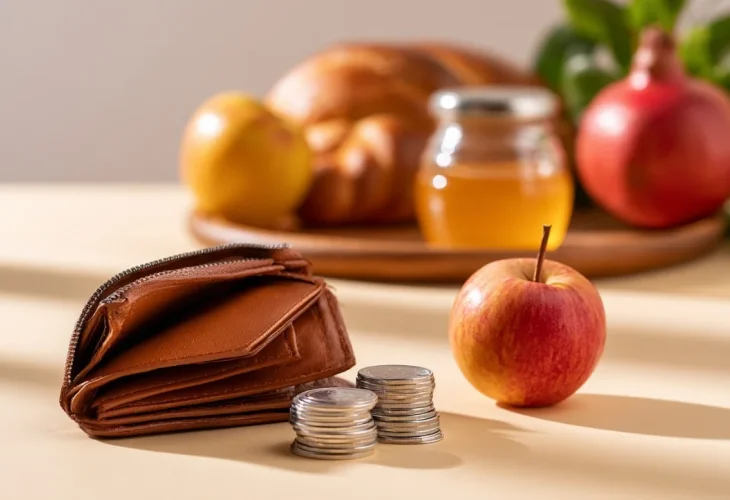
Just days before the holiday, the gap can feel especially painful. Everywhere you look there are sales, recipes, new clothes, and store windows inviting you to come closer and buy. But instead of feeling excited, you may find yourself shrinking back. Perhaps you simply cannot afford everything you would like to buy, or everything you are used to purchasing for the holiday.
It can hurt even more when it seems that everyone else has already shopped, decorated, and bought something new, while in your home everything feels as though it is still waiting. And not very patiently, either, because there are so many things you genuinely need.
Precisely when we are staring at a bank account that cannot stretch any further and wondering where the money for one more purchase is supposed to come from, we have an opportunity to face the situation with greater faith.
At a moment like this, it is important to separate our financial situation from our worth as human beings. A modest holiday table does not mean that we have failed or that we are not good enough, and our children need to know that too. The fact that we cannot currently afford everything we want does not mean there is something lacking in our faith, and it certainly does not mean, God forbid, that Hashem has forgotten us.
This is a test, like the many other tests we encounter in life, and we can try to face it with faith and even with a smile. How? Following are several ideas that may help.
What Does True Trust in Hashem Mean?
When we are under financial pressure, the mind immediately races ahead: What will happen tomorrow? What if next month is just as difficult? What if another unexpected holiday expense appears? How will we explain to the children that this year we simply cannot afford certain things?
Tehillim offers a different response: “Cast your way upon Hashem and trust in Him.” Alongside the practical steps we are required to take, there is also a limit to how much weight a person can carry alone.
Bitachon, trust in Hashem, does not mean telling ourselves, “Money will definitely come in tomorrow.” No one can promise that. Rather, it means saying: I will do what I can today, but I do not have to solve everything entirely on my own, because I have Hashem.
There is an enormous difference between responsibility and anxiety. Responsibility asks: How much money do I have? What do I truly need? Where can I cut back? Whom can I ask for help? Anxiety says: Everything is lost.
The spiritual work is to pause, take genuine responsibility, and at the same time refuse to be consumed by fear of what may happen.
Why Fill the Shopping Cart Beyond Our Means?
One of the well-known teachings in Tractate Beitzah states that a person’s livelihood is allotted from Rosh Hashanah until Yom Kippur, with the exception of expenses for Shabbat, festivals, and the Torah education of one’s children. Our Sages describe a special status for money spent on mitzvot.
This can be especially encouraging for someone approaching a holiday with very limited funds, because it reminds us that holiday expenses are not merely another meaningless shopping spree.
At the same time, these teachings must be approached responsibly. They are not an instruction to fill a shopping cart beyond our means, enter dangerous debt, or take out a loan when we have no idea how we will repay it.
Jewish sources also teach us to live according to our financial circumstances. So yes, when it is affordable, honoring the holiday may include fine meat. But when it is not, chicken can make a beautiful holiday meal too.
Do Not Compete With Someone Else’s Holiday Table
Much of the pressure before the holidays does not come from halachah, but from comparison.
Nowhere in our sources does it say that the joy of the holiday is measured by the number of salads on the table or by how many new things were purchased for the home.
If there is no money for new clothes, we can wear what we already have. We can forgo expensive gifts, prepare one special festive dish instead of four, and tell the children honestly that this year the holiday will still be beautiful, just a little more modest.
Pray, Even in Your Own Words
When it comes to livelihood, we sometimes have a tendency to ask others to pray for us while forgetting that we can, and should, pray for ourselves as well.
“Master of the Universe, I am under pressure. I want to bring joy to my family, and right now I do not know how. Help me see what I should do. Open the right path for me. Grant me an honorable livelihood, and give me calm and faith while I wait for that blessing to arrive.”
Prayer does not need to be complicated. We can simply speak honestly to Hashem.
If You Need Help, It Is Okay to Ask
Some people are willing to go an entire week with almost nothing simply so that nobody will know they are struggling.
However, if the situation is truly difficult, it is permissible to reach out to a community rabbi, social services, a charitable organization, or a relative whom you can ask for help without shame.
There is no need to tell the entire world about your financial situation, but sometimes faith itself means allowing ourselves to accept that the help Hashem sends may come through another person.
We call that person a shaliach, a messenger.
Gratitude Even in a Difficult Situation
There is the shortage of money itself, and then there is everything we add to it in our minds.
“What kind of holiday are we going to have?” “What will the children think?” “Everyone will see that we have less.” “Is this how we are entering a new year?”
It is possible to be worried and still celebrate. It is possible for the situation to be difficult and still be grateful for what we do have.
We can pray for greater abundance while also noticing the abundance that is already in the room: family, health, children, a roof over our heads, basic food, and the opportunity to sit together around the same table.

