

Sukkot
Why Do the Ushpizin Come on Sukkot? The Deeper Meaning of Their Visit
Discover why Sukkot is uniquely connected to the Ushpizin, and how their spiritual qualities help us begin again with renewed closeness to Hashem
- Yosef Yaavetz
- | Updated
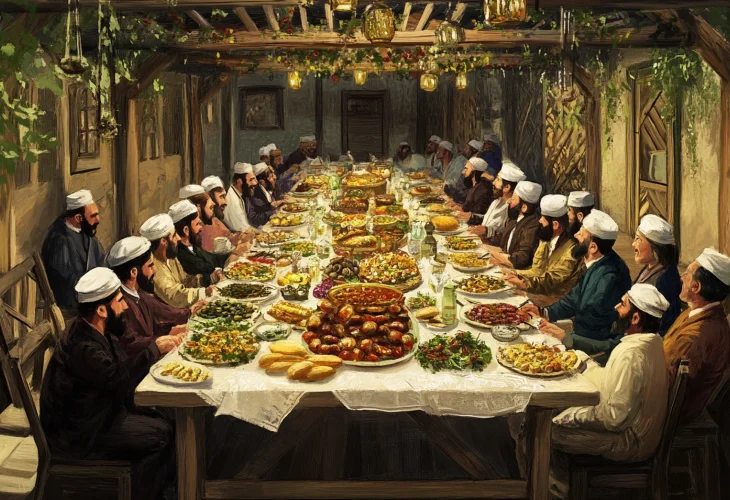
Why is it specifically on Sukkot that the Ushpizin, our spiritual ancestors, come to visit us? Why not on Passover, at the Seder?
The answer lies in the unique nature of the sukkah itself.
The Sukkah: Hashem’s Home Among Us
The sukkah represents Hashem’s presence among the Jewish people. The Torah tells us that Hashem caused the Children of Israel to dwell in sukkot, and Kabbalah describes the sukkah as the tzila d’meheimnuta, the “shade of faith.” It represents the Clouds of Glory and the idea that Hashem Himself comes close to us and allows His presence to dwell among us.
Usually, we go to Hashem’s house. On Sukkot, in a sense, He creates a dwelling for us within our own surroundings.
That is also why the sukkah is a temporary dwelling. We live in it for only seven days. It is not meant to become a permanent structure, but rather a unique space in which we experience Hashem’s presence during the festival.
This awareness that “Hashem is among us” gives the Jewish people strength. Sukkot comes after the Days of Judgment and Yom Kippur, when we have undergone a process of cleansing and renewal. We enter the festival spiritually renewed and prepared for a new beginning.
Two Different Spiritual Seasons
The long winter can be compared to a journey through the desert. During the winter months, there are no Torah-mandated festivals, and many agricultural mitzvot are not practiced. There is no harvesting, grape gathering, or the separation of agricultural tithes. People traditionally spent less time traveling and working outdoors, and making the journey to offer sacrifices was also more difficult.
In a sense, Sukkot provides the spiritual strength that a person carries into the quieter winter months.
Passover begins a very different season. It ushers in an intense period of activity: the harvest, the counting of the Omer, Shavuot, followed later by the grape harvest and olive harvest. Building, commerce, and much of the work performed outdoors traditionally took place during the summer.
Before entering that active season, a person absorbs lessons of submission, humility, and awe. The spiritual experience of Passover is therefore different from that of Sukkot.
Why the Ushpizin Come to Us
The Ushpizin are part of the special experience of Sukkot in which Hashem comes close to us. Our forefathers, who represent the beginning and development of the Jewish people, come to us as well.
After the Day of Judgment, we begin again. We have been cleansed, and each person has the opportunity to rebuild Torah within his own home and personality. In a sense, we begin again as Avraham Avinu once began.
Each day of joy and closeness to Hashem brings us another step higher, while the seven Ushpizin represent different stages and spiritual qualities that shaped the Jewish people.
Every Person Has a Unique Mission
One of the central ideas of Kabbalah is that every person possesses a unique identity and purpose. People may appear broadly similar from the outside, but just as their faces differ, so do their minds and personalities. Kabbalah takes this idea a step further and explains that their spiritual missions are different as well.
Every person has something unique that only he or she can contribute to humanity. According to Kabbalistic thought, if that mission is not completed, another soul may eventually return to fulfill what remains unfinished through the process of gilgul neshamot, reincarnation.
Tikkun, spiritual rectification, is made up of all these individual contributions. When every person contributes what he or she is intended to bring into the world, creation moves toward its ultimate state of perfection. In Kabbalah, this process is connected to the coming of Mashiach, a gradual spiritual development moving toward the tikkun haklali, the ultimate rectification.
The Ushpizin Represent Different Spiritual Qualities
The great leaders of the Jewish people were therefore not simply extraordinary individuals who accomplished extraordinary things. Each represented a particular spiritual quality and a unique contribution to Judaism and to humanity.
There may be others who possess qualities reminiscent of King David, for example, with similar personality traits or abilities. Yet David reached such an elevated spiritual level that he fully expressed the particular spiritual quality associated with him, making him the model for others who share something of that character.
Similarly, Kabbalistic teachings speak of a “Moshe in every generation,” a leader who reflects certain qualities associated with Moshe Rabbeinu.
The Ushpizin therefore represent essential spiritual qualities through which the Jewish people were built. It is difficult to imagine the development of Jewish faith, Torah, and spirituality without the unique contributions of these towering figures.
Sukkot: The Gifts Are Waiting for Us
On Sukkot, we are given the opportunity to stand before Hashem as He comes close to us. Once again, He offers us the great spiritual gifts embodied by Avraham, Yitzchak, Yaakov, Yosef, Moshe, Aharon, David, and Shlomo. This spiritual bestowal is described as a “visit.”
Sukkot is a festival in which everything seems to come toward us. We do not need to cleanse our homes of chametz; that process of purification has already taken place. All that remains is to build a simple temporary sukkah, a mitzvah the Talmud itself calls an “easy mitzvah,” and rejoice there before Hashem. The spiritual abundance is already waiting.
Sukkot is therefore far more than simply a beautiful holiday or a meaningful tradition. It is an opportunity to receive something profound. We need only reach out and take hold of it.

