

Sukkot
Sukkot Explained: 15 Key Terms and Customs You Need to Know
From the sukkah and Four Species to Ushpizin, Hoshanot, Hoshana Rabbah, and Simchat Torah, this simple guide explains the essential concepts and traditions of Sukkot
- Yonatan HaLevi
- | Updated
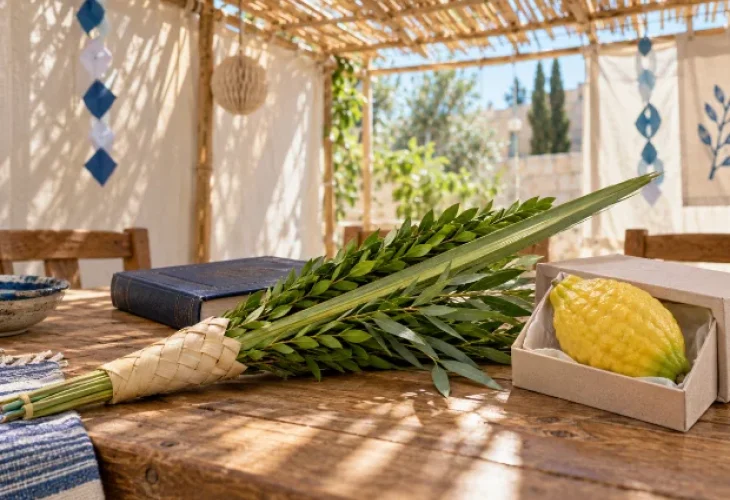
If it ever feels as though Sukkot comes with a secret dictionary that everyone else received except you, this guide is for you. Following are the key terms and customs to know, from the sukkah itself all the way through Simchat Torah.
1. Sukkot, Chag HaAsif, Zman Simchateinu
The holiday has three primary names. Sukkot refers to the booths in which Hashem caused the Jewish people to dwell after the Exodus from Egypt. Chag HaAsif, the Festival of Ingathering, reflects the agricultural season in which the harvest was gathered. Zman Simchateinu, the Season of Our Rejoicing, emphasizes the special mitzvah of joy associated with the holiday (Leviticus 23:42–43; Exodus 23:16; Deuteronomy 16:14–15).
2. Sukkah
The sukkah is the temporary structure in which we fulfill the mitzvah of dwelling during the seven days of Sukkot.
The Talmud records a dispute over the Torah’s statement, “I caused the Children of Israel to dwell in sukkot.” Rabbi Eliezer explains that this refers to the Clouds of Glory, while Rabbi Akiva understands it as referring to actual booths (Sukkah 11b).
3. A Temporary Dwelling and “Dwell as You Live”
The Talmud describes the sukkah as a temporary dwelling, but the Sages also derive from the word teshvu, “you shall dwell,” that we should use the sukkah much as we use our homes: eating, drinking, learning, and spending time there.
During the holiday, the house becomes secondary and the sukkah becomes our primary living space (Sukkah 2a; 28b; Shulchan Aruch, Orach Chaim 639:1).
4. Walls of the Sukkah
The defanot are the walls of the sukkah. Halachically, a sukkah does not necessarily require four complete walls. Under certain conditions, two full walls and part of a third may be sufficient.
Because the laws are detailed, it is advisable to clarify the requirements before building a sukkah (Sukkah 6b; Shulchan Aruch, Orach Chaim 630).
5. Schach and “More Shade Than Sun”
Schach is the roofing of the sukkah. It must be made from material that grew from the ground, has been detached from its source, and is not susceptible to ritual impurity.
In addition, the schach must provide more shade than sunlight inside the sukkah (Mishnah Sukkah 1:1, 1:4).
6. “Leishev BaSukkah” and a Proper Meal
The blessing leishev baSukkah literally refers to dwelling in the sukkah, not merely sitting on a chair.
The common practice is to recite the blessing when eating a meal that requires eating in the sukkah. A substantial meal must be eaten in the sukkah, while casual snacking is, according to the basic law, permitted outside it (Mishnah Sukkah 2:4; Shulchan Aruch, Orach Chaim 639).
7. One Who Is Distressed Is Exempt From the Sukkah
A person who experiences significant discomfort specifically because of remaining in the sukkah, and whose discomfort would be relieved by leaving it, may be exempt from the mitzvah in that situation.
This may apply in cases of rain, extreme cold or heat, or another serious disturbance (Sukkah 26a; Shulchan Aruch, Orach Chaim 640:4).
8. The Four Species
The Four Species are the etrog, lulav, three hadassim, and two aravot. The Torah commands us to take them on Sukkot and rejoice before Hashem (Leviticus 23:40).
The Midrash explains that the Four Species symbolize different types of Jews. When they are bound together, each completes the others, teaching that no member of the Jewish people is unnecessary (Vayikra Rabbah 30:12).
The mitzvah of taking the Four Species applies throughout Sukkot, except on Shabbat.
To perform the mitzvah, hold the lulav, hadassim, and aravot in the right hand and the etrog in the left. Recite the blessing al netilat lulav. On the first day of the holiday, or the first time fulfilling the mitzvah that year, Shehecheyanu is also recited.
When reciting the blessing, the etrog is traditionally held upside down, with the pitom facing downward, because the blessing should be recited before completing the mitzvah. Some have the custom not to hold the etrog at all until after the blessing.
After the blessing, the etrog is turned upright, held alongside the lulav, and the Four Species are waved three times in each prescribed direction.
Customs differ for a left-handed person. According to Sephardic practice, a left-handed person still holds the lulav in the right hand and the etrog in the left. According to Ashkenazi practice, a left-handed person generally holds the lulav in the left hand and the etrog in the right.
9. Etrog
The etrog is the fruit identified by the Sages as the Torah’s “fruit of a beautiful tree” (Sukkah 35a).
A high price or an elegant protective box does not guarantee that an etrog is halachically valid, so it is worthwhile to consult someone knowledgeable before purchasing one.
10. Binding and Waving the Lulav
Three hadassim and two aravot are placed together with the lulav and bound as a unit.
During the mitzvah of the Four Species, they are moved outward and brought back in several directions (Mishnah Sukkah 3:9; Sukkah 37b).
11. Ushpizin
The word Ushpizin means “guests” in Aramaic.
According to the Zohar, on each day of Sukkot we welcome one of the seven spiritual guests, the shepherds of the Jewish people: Avraham, Yitzchak, Yaakov, Moshe, Aharon, Yosef, and David.
Alongside these spiritual guests, Sukkot is also a time to remember real guests and open our homes to people who need a place at the table (Zohar III, 103b–104a).
12. Hoshanot and Hoshana Rabbah
Hoshanot are special prayers recited on each day of Sukkot.
On days when the Four Species are taken, the congregation circles the bimah while holding them. On Shabbat, the procession is not performed. On Hoshana Rabbah, the bimah is circled seven times with the Four Species. Later, the special bundle of aravot is struck according to custom.
These practices recall the processions and the willow ceremony that took place in the Beit HaMikdash (Mishnah Sukkah 4:5; Sukkah 44a; Shulchan Aruch, Orach Chaim 664).
13. The Water Libation and Simchat Beit HaShoeva
Throughout Sukkot, water was poured on the altar in the Beit HaMikdash as part of the special water-libation ceremony.
The water was drawn from the Shiloach spring, accompanied by extraordinary celebrations. The Mishnah famously states: “Whoever did not see the rejoicing of the Simchat Beit HaShoeva never saw true rejoicing in his life” (Mishnah Sukkah 4:9; 5:1).
14. Chol HaMoed Sukkot
Chol HaMoed refers to the intermediate days between the first day of Sukkot and Shemini Atzeret. Outside Israel, it begins after the first two days of Yom Tov.
These days are neither ordinary weekdays nor full Yom Tov. They retain the sanctity and joy of the festival, while certain types of work are restricted. The laws of Chol HaMoed are detailed and require separate study.
15. Shemini Atzeret and Simchat Torah
Shemini Atzeret is a separate Yom Tov that immediately follows Sukkot, as the Torah states: “On the eighth day, there shall be a sacred occasion for you” (Leviticus 23:36).
In Israel, Shemini Atzeret and Simchat Torah are celebrated on the same day. Outside Israel, Simchat Torah is celebrated on the second day of Shemini Atzeret.
On Simchat Torah, we complete the annual Torah-reading cycle and immediately begin again with Bereishit, reminding us that Torah learning never truly ends.

