

Magazine
Shot Three Times at Point-Blank Range: “Only You Can Save Me”
Pinchas Attia was shot at point-blank range in a case of mistaken identity. Lying wounded on the road, he turned to Hashem and began reciting Mizmor L’Todah.
- Michal Arieli
- | Updated
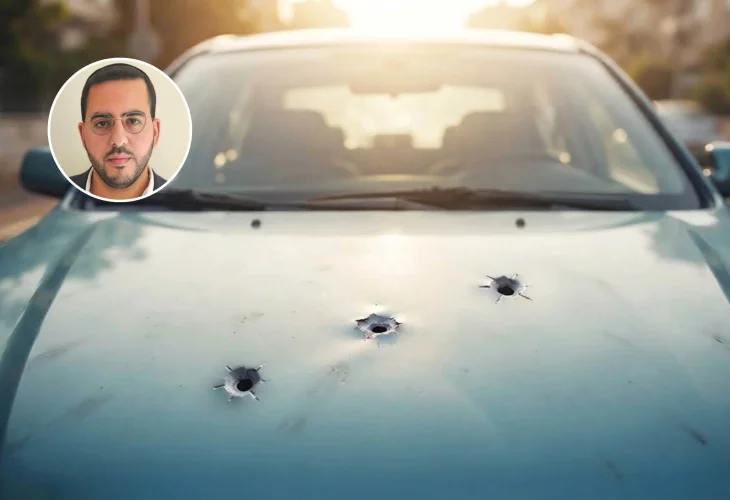 Illustration (inset: Pinchas Attia)
Nothing could have prepared Pinchas Attia, a kollel student and father of two young daughters from Bnei Brak, for the morning when his completely ordinary life changed in seconds.
“Until that day, my life was completely routine,” he begins. “I learned in kollel for half the day, did some emotional therapy work, had certification as an NLP practitioner, devoted time to my family, and tried to help wherever I could. Everything was normal.”
The morning of the attack began that way too. It was the day after Lag BaOmer. Attia got ready to leave home, but his wife was delayed with their older daughter, so he went downstairs with their younger daughter and drove her to her caregiver.
“After I dropped her off, I returned to the car,” he recalls. “That’s when I discovered that something terrifying was waiting for me. Even now, when I think about it, I realize just how completely unexpected it was.”
Mistaken Identity
“I was approaching the front of the car when, out of the corner of my eye, I suddenly saw a figure dressed in black, wearing gloves and a helmet, pointing a gun at me,” Attia recalls.
What went through your mind at that moment?
“I don’t remember exactly. But because the car was still running, the dashboard camera recorded everything. You can see that my first instinct was to put my hands over my head and crouch beside the car. One bullet was fired and struck the vehicle. Then I lay down on the ground, and the attacker and another person approached from the side. They came within point-blank range and fired what, according to the assessment at Tel Hashomer, were another two or three bullets.
“In those seconds, I was literally begging Hashem to save me. I understood that He was the only One who knew the situation I was in. No one else knew what was happening or could possibly have imagined it.
“I’m not a complicated person, and I’m not involved in conflicts with anyone. I’m as far from that world as possible. Later, the police determined that I had been the victim of mistaken identity. They hurt me for no reason at all.”
After the attackers fled, Attia was left lying wounded on the road, crying out for help.
“The pain was terrible,” he says. “But the greatest miracle is that I am alive.”
“A Psalm of Thanksgiving”
Attia pauses before sharing another part of the story that remains especially meaningful to him. In the period before the shooting, he had been regularly studying She’arav B’Todah by Rabbi Shalom Arush, a book centered on gratitude and recognizing Hashem’s presence even during difficult circumstances.
“I felt the book was changing my outlook on life,” he says. “And that affected me even in the moments after I was wounded. It may sound unbelievable, but after the attackers left, the first thing I did was recite Mizmor L’Todah, ‘A Psalm of Thanksgiving.’
“I’m not sure I was on the level of reciting it from a place of gratitude,” he adds. “But Rabbi Arush explains that there is also an idea of recognizing that Hashem is behind what happens to us. When I realized I was still alive, that was the feeling that filled me.”
After reciting the psalm, Attia began speaking directly to Hashem. “I said, ‘Only You can save me. I have a wife and two little girls. They need me. Watch over me.’”
The physical pain was overwhelming, but he remained conscious and managed to call loudly enough for help. Passersby contacted emergency services, and Attia handed his phone to a woman nearby and asked her to call his wife.
What was your wife going through at that time?
“She had just dropped our daughter off at daycare and had stayed there for a little while. When she saw my phone calling, she answered and said, ‘I’ll call you back,’ without realizing that it wasn’t me speaking. They called again, and again she said she would call back. Only on the third attempt did she really hear what they were saying.
“They told her I had been injured. She asked, ‘What do you mean injured? Was he in an accident?’ And then they told her, ‘He was shot.’
“My wife managed to arrive before the ambulance. Amid all the pain and confusion, I held out the car keys to her and said, ‘I don’t know why they shot me, but in the meantime, please lock the car.’ Somehow, Hashem helped me keep my composure.
“After that, they evacuated me to Tel Hashomer. The pain was on a level I can’t describe. The body is screaming for help, while at the same time the soul feels like it is fighting not to break.”
“Remember Us for Life”
When Attia arrived at the hospital, a team of specialist doctors was waiting for him. Within minutes, he was sedated and taken into an operation that lasted eight and a half hours. Meanwhile, his family was only beginning to comprehend what had happened.
“Everyone was in complete shock,” he says. “They couldn’t stop crying and praying.”
His next clear memory is waking in the recovery room and seeing his wife. Despite being connected to tubes and medical equipment, he was alert from the moment he woke up.
“That reassured my wife tremendously, because she had also gone through a trauma,” he says. “Then more family members came in. Even though I was connected to all kinds of machines and tubes, I threw in a few jokes, which helped lighten the atmosphere a little.”
How did the doctors describe your condition?
“I understood from them that I had arrived at the hospital in serious condition and that there was a significant risk of injuries that could affect my future. I also have to say that I received incredibly professional and devoted care throughout.”
The road back was long. Attia remained hospitalized for approximately a month, underwent another operation, and for a period could barely get out of bed.
“I went from being a healthy, independent person to being completely dependent on other people,” he says. “I saw with my own eyes how everything can change in a single moment.”
After approximately a month, he was discharged to continue recovering at home. Slowly, his condition improved. Four and a half months after the shooting, Attia says he had largely returned to the life he had before.
“I still live in the same building. I take my daughters to their programs every morning. I learn in kollel as usual, and I drive the same car in which I was injured. To this day, there is still a hole in the hood from the bullet that struck it.”
Honestly, don’t you feel afraid?
“There are moments when I get frightened and think that maybe someone could, G-d forbid, hurt me,” he admits. “But I don’t let fear paralyze me. I truly believe that our entire lives are an enormous kindness from the Creator of the world, and if I am in His hands, I have nothing to fear.
“Chovot HaLevavot teaches that no person can independently benefit or harm another person. I deliberately returned to my routine because I know that this is the best way for me to continue living and giving thanks.”
Did you hold a thanksgiving celebration?
“Of course. I held a large seudat hoda’ah with the goal of sanctifying Hashem’s name. After being shot at point-blank range and having my life saved, I feel that Hashem did not leave me in this world for no reason. I have a responsibility to sanctify His name.
“On a personal level, I also feel that I have changed. Suddenly, all of life looks different. When I say in the High Holiday prayers Zochreinu L’Chaim, ‘Remember us for life,’ and Av HaRachamim, ‘Father of mercy,’ the request is real and tangible now.
“In previous years, my prayers often focused on things that now seem much less important, like a bigger apartment, a better job, upgrades and bonuses. This year, after what happened, I say Zochreinu L’Chaim and stop there.
“I feel that life itself is such an enormous request. It cannot be taken for granted. Only after asking for that basic gift do I allow myself to continue and ask for anything else.”
Months after the attack, Attia is back in the ordinary life he once barely thought about: taking his daughters out in the morning, learning in kollel, driving his car, and returning home to his family.
The routine looks much the same. To him, it no longer feels ordinary at all.

