

World News
Germany Sends a Firm Message to Moscow as It Prepares for Possible Russian Attacks
German Chancellor Friedrich Merz warned that his country is preparing for possible hybrid attacks by Russia, as Moscow and NATO exchange nuclear threats over the war in Ukraine.
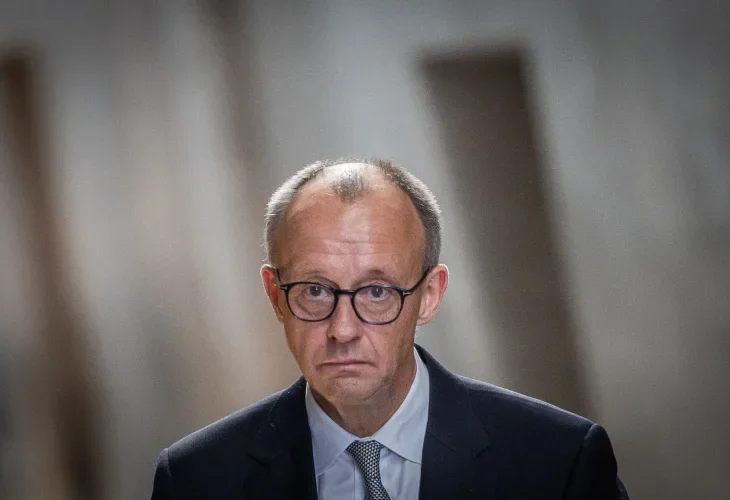 Merz (archive photo: Oren Ben Hakoon, Pool)
German Chancellor Friedrich Merz said today (Thursday) that Germany is preparing for the possibility of hybrid attacks by Russia. The German news agency DPA reported that the chancellor made it "very clear and unequivocal" that Berlin is preparing for these threats, and that "in the event of any attack, the country will respond quickly and with unmistakable clarity."
Merz made the remarks during a ceremony awarding the Westphalian Peace Prize to the NATO alliance, held in the city of Münster. In his remarks, he delivered an especially firm message to Moscow, making clear that Germany would not be intimidated by the threats. Russian threats, he added, would not prevent Germany from continuing to provide extensive assistance to Ukraine.
It should be noted that Russian President Vladimir Putin said earlier today that "we cannot be sure that weapons of mass destruction will never be used." In a speech at the Valdai Forum in Moscow, which brings together international experts on Russia, he added: "Can we be sure that these weapons will never be used in an attack? Of course not. We must remember this and prevent such a situation."
As a reminder, yesterday Russia warned NATO that it would be prepared to take measures including the use of nuclear weapons if the Western alliance attempts to cut off Kaliningrad, a Russian enclave bordering the Baltic Sea. This was according to a document sent to NATO and published by the Reuters news agency.
"Russia will be prepared to use its entire arsenal of forces and capabilities, including nuclear weapons, to defend its territory," the diplomatic message said. The document also noted that this includes the possibility of "Russian strikes against decision-making centers in member states of the alliance from the very first stage."
In the document sent to NATO, Moscow accused the alliance of taking a "dangerous and reckless step" involving "high risks of a direct armed confrontation breaking out."
NATO Secretary General Mark Rutte said the alliance responded to the Russian message with a statement: "We are a defensive alliance. And enough with the nuclear threats. These are entirely unnecessary and unhelpful. We call on the Russian Federation to end its full-scale, unprovoked invasion of Ukraine. We urge the Russian Federation to refrain from increasingly reckless behavior toward allies and to stop its irresponsible nuclear rhetoric," the statement said.

