

Torah Personalities
The Prophet Who Hid 100 Men From Jezebel: 9 Facts About Obadiah
He worked inside King Ahab’s palace yet secretly saved 100 prophets from Jezebel. Discover the remarkable story of the prophet Obadiah.
- יונתן הלוי
- | Updated
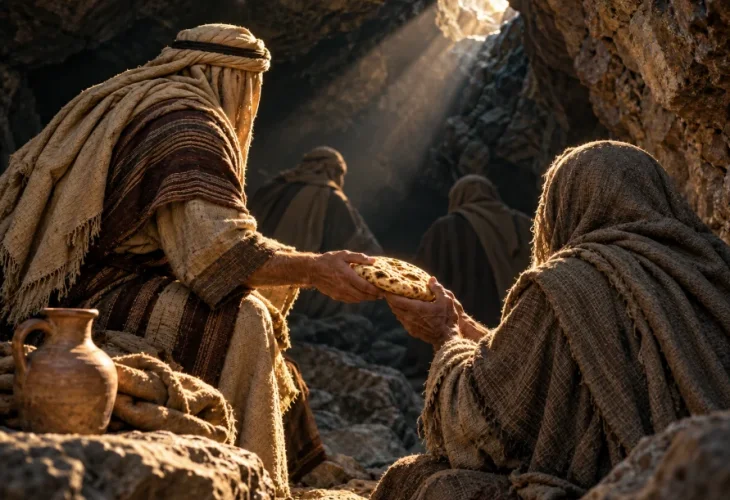
While Queen Jezebel, the wife of King Ahab of Israel, was hunting down the prophets of Hashem, one man risked everything to save them. Obadiah hid 100 prophets in caves and secretly provided them with bread and water, all while serving as the administrator of Ahab’s household, at the very heart of the government from which the danger came.
Chazal identify this courageous man with the prophet Obadiah, whose book is the shortest in the Tanakh. Who was the man who remained faithful to Hashem inside Ahab and Jezebel’s palace, and why was he specifically chosen to prophesy about Edom? Here are nine fascinating facts.
1. He Was King Ahab’s Trusted Administrator
In the Book of Kings, Obadiah is described as being “over the household,” meaning he held a senior position overseeing King Ahab’s palace.
Chazal identify him with the prophet whose book begins with the words, “The vision of Obadiah.” The Book of Obadiah itself does not provide details about the prophet’s family or when he lived. The identification with the Obadiah who served during Ahab’s reign appears in Tractate Sanhedrin (39b).
2. He “Feared Hashem Greatly”
The Bible emphasizes an extraordinary quality of Obadiah: “Obadiah feared Hashem greatly” (I Kings 18:3).
Rabbi Abba focuses on the word “greatly,” contrasting this description with the words said about Abraham: “Now I know that you are a fearer of Hashem” (Genesis 22:12).
Obadiah’s fear of Heaven is especially striking considering the environment in which he lived and worked: the household of Ahab and Jezebel.
3. He Saved 100 Prophets From Jezebel
When Jezebel sought to kill the prophets of Hashem, Obadiah secretly took 100 of them and hid them in two caves, 50 in each. He then supplied them with bread and water (I Kings 18:4).
The Gemara connects this courageous act with Obadiah’s merit to receive prophecy. Rather than using his influential position merely to protect himself, he used his access and resources to save those being persecuted.
4. He Spent His Fortune Supporting Them
According to Shemot Rabbah (31:4), Obadiah was a wealthy man who spent his fortune supporting the prophets he had hidden.
When his own money ran out, he did not abandon them. The Midrash relates that he borrowed money at interest from Jehoram, Ahab’s son, in order to continue providing for them.
His sacrifice, therefore, went far beyond hiding the prophets. He was willing to exhaust his own resources and take on debt to keep them alive.
5. He Was an Edomite Convert Who Prophesied About Edom
Tractate Sanhedrin teaches that Obadiah was an Edomite convert and connects his background to the fact that his prophecy concerned Edom.
The Gemara offers another striking explanation. Obadiah lived among Ahab and Jezebel yet did not learn from their wicked ways, while Esau lived with the righteous Isaac and Rebecca yet did not learn from their good ways. Obadiah, who remained righteous despite his corrupt surroundings, was therefore chosen to prophesy against Edom (Sanhedrin 39b).
6. His Family Is Connected to the Miracle of the Oil
In II Kings, a widow cries out to the prophet Elisha after a creditor threatens to take her two children as slaves. Rashi identifies this woman as Obadiah’s wife and the creditor as Jehoram, Ahab’s son, from whom Obadiah had borrowed money to support the prophets.
Elisha instructed the widow to borrow empty vessels from her neighbors and begin pouring into them from the small amount of oil she still had at home. Miraculously, the oil continued to flow until every vessel was full, stopping only when there were no empty vessels left.
Elisha then told her to sell the oil, repay her debt, and live with her children on the remainder (II Kings 4:1–7).
Neither the woman nor her late husband is named in the verses themselves. The identification of the family with Obadiah is brought by Rashi in his commentary.
7. His Is the Shortest Book in the Tanakh
The Book of Obadiah consists of just one chapter containing 21 verses, making it the shortest book in the Tanakh. It is the fourth of the Twelve Minor Prophets, following Hosea, Joel, and Amos.
Despite its brevity, the book addresses enormous themes, including Edom’s pride, its violence against the house of Jacob, the judgment that awaits it, and the eventual salvation of Israel.
8. A Tradition Places His Tomb in the Galilee
In the village of Biram in the Upper Galilee is a site traditionally identified as the tomb of the prophet Obadiah.
The tradition associating the site with Obadiah’s burial appears in accounts written by Jewish travelers during the Middle Ages.
9. His Prophecy Ends With Hashem’s Kingship
Obadiah’s rebuke of Edom includes the direct accusation: “For the violence done to your brother Jacob” (Obadiah 1:10). He condemns Edom for its behavior during the suffering of the house of Jacob, including rejoicing over its misfortune.
Yet the book does not end with destruction. Obadiah also foretells salvation on Mount Zion and the restoration of Israel.
The shortest book in the Tanakh concludes with a powerful declaration of just three words in Hebrew: “And the kingship shall be Hashem’s.”

