

Facts You Didn't Know
Why Are Soap Bubbles Rainbow-Colored? The Science Behind Their Changing Colors
Discover why soap bubbles shimmer with rainbow colors, how light creates their constantly shifting patterns through thin-film interference, and what happens just before a bubble pops
- Tehila Cohen
- | Updated
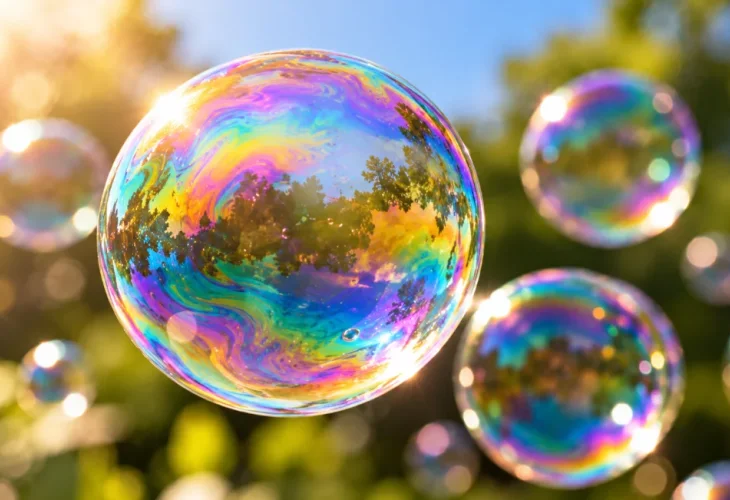
A soap bubble may look like a simple, transparent sphere, but its delicate surface holds a fascinating scientific secret. The bubble's outer layer is actually an incredibly thin film of water trapped between layers of surfactant molecules, the same types of molecules found in soap. These molecules reduce the surface tension of water, helping it spread out and form a thin, flexible film rather than pulling together into droplets.
When light strikes this delicate film, something remarkable happens. Some of the light reflects off the bubble's outer surface, while the rest passes through the thin layer and reflects off its inner surface.
The two reflected light waves then meet again, creating a fascinating optical effect. Depending on the thickness of the soap film and the angle from which it is viewed, certain wavelengths of light reinforce one another, while others weaken or nearly cancel each other out.
This phenomenon is known as thin-film interference.
Because white light contains many different wavelengths, which our eyes perceive as different colors, the interference produces the beautiful patches and swirling bands of rainbow colors that shimmer across the surface of a soap bubble.
Why Do the Colors Keep Moving?
If you watch a soap bubble closely, you'll notice that its colors are constantly shifting and changing. The colorful patterns seem to flow across the surface, sometimes blending together and sometimes separating into distinct bands.
This happens because the bubble's thin film does not have a uniform or constant thickness.
The water within the film is continuously moving under the influence of gravity, air currents, and evaporation. As the water shifts, the thickness of the bubble's surface changes from one area to another and from one moment to the next.
These tiny variations affect which wavelengths of light reinforce one another and which cancel out. As a result, the colors visible to our eyes continually change, creating the mesmerizing, swirling patterns that make soap bubbles so beautiful.
What Happens Just Before a Soap Bubble Pops?
As a soap bubble gradually loses water, certain areas of its surface become thinner and thinner. When the film becomes extremely thin, the interference patterns can change dramatically, sometimes causing the familiar rainbow colors to fade or disappear in particular areas.
Eventually, the film becomes too thin and unstable to hold together. A tiny tear forms in the surface, rapidly spreads, and causes the bubble to collapse almost instantly.
Interestingly, the same scientific principle responsible for the shimmering colors of soap bubbles can also be observed in other everyday situations. The rainbow-like patterns that appear in thin layers of oil floating on water, for example, are also caused by thin-film interference. Similar effects can occur in other extremely thin coatings.
So the next time you see a soap bubble floating through the air, take a moment to appreciate the science behind its beauty. Those constantly changing rainbow colors are not produced by pigments or dyes. They are the result of light interacting with an extraordinarily thin layer of water and soap, transforming something as simple as a bubble into a dazzling display of color.

