

Behind the News
Is Another War With Iran Inevitable? Expert Warns of a Growing Threat to Israel
Veteran Iran analyst Menashe Amir warns that Tehran’s nuclear ambitions, ballistic missile arsenal, and regional proxies remain a serious danger, arguing that a brief military operation will not be enough to end the threat
- Michal Arieli
- | Updated
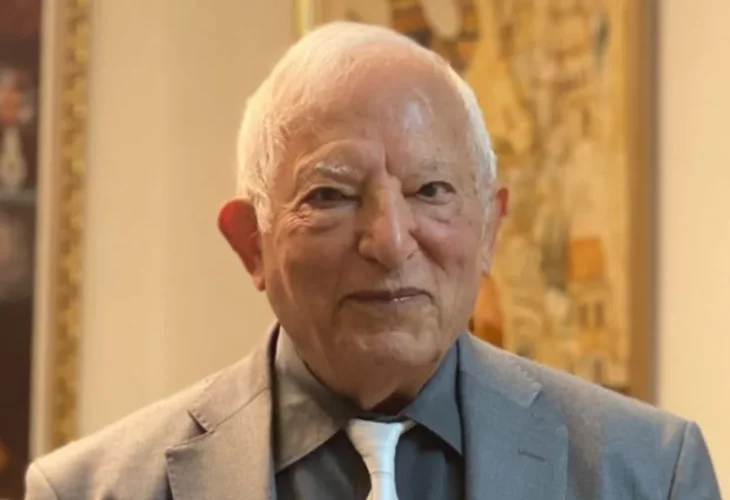 Menashe Amir
Anyone who has recently tried to keep track of the headlines about a renewed war with Iran and the possibility of a wider regional escalation has likely found themselves overwhelmed. Reports of military deployments, increasingly aggressive statements from Tehran, and simultaneous assurances that negotiations are underway and that no immediate attack is planned have created an atmosphere of confusion and uncertainty.
“No one can say exactly what will happen,” explains Menashe Amir, a veteran Iran analyst widely regarded as one of the most experienced and respected voices on the subject. “The situation depends on numerous factors that could change at any moment. But there is one thing we must understand: Iran continues to threaten the world and endanger global security.”
According to Amir, the greatest danger lies in underestimating the scale of the threat. “We have good reason to be concerned. The most dangerous statements are those suggesting that the war can be brought to an end through a brief, relatively easy military operation. It is clearer today than ever that this will not be the case.”
“The Threat Will Only Grow”
“To understand the magnitude of the danger, we must begin with the ideological motivation driving the regime in Tehran,” Amir explains. “Its determination to fight Israel and call for its destruction is not merely a political tactic. It is rooted in a deeply held Shiite Islamic ideology.”
According to Amir, the Iranian leadership views Shiite Islam as the authentic and legitimate expression of the faith, destined ultimately to lead the entire Muslim world. This ambition is intertwined with a longstanding historical rivalry between Shiite and Sunni Islam.
“To justify its claim that Iran's Shiite regime deserves to lead the Muslim world, and eventually the world at large, the regime adopted an extremely powerful strategic tool: the Palestinian issue,” Amir says. “The Iranians tell the Muslim world that while the Sunnis have abandoned the Palestinians, Iran is defending them, supporting them, calling for Israel's destruction, and preparing for a confrontation.”
He emphasizes that this strategy is far from new. Its origins, he explains, predate Ayatollah Ruhollah Khomeini's rise to power in 1979, and the Iranian regime has continued to promote the same message for decades. “Unfortunately, Israel and the West neglected this issue and failed to recognize the danger of this destructive ideology in time,” he says. “Today, however, everyone understands that Iran's leadership is entirely serious about its declarations regarding the destruction of Israel.”
Amir points to Iran's nuclear ambitions, its extensive ballistic missile program, and its efforts to expand its influence throughout the Middle East as evidence of the regime's long-term objectives. He describes Iran's role in building Hezbollah in Lebanon, extending its influence into Syria, and supporting armed groups in Gaza and Yemen, including Hamas and the Houthis.
“The Iranian regime poses an extremely serious threat to Israel's security,” he warns. “The sooner Israel, the United States, and the international community act to eliminate this danger at its roots, the better. The longer we wait, the greater the threat will become, and the more difficult it will be to neutralize.”
But we have been told that the Israeli and American air forces severely damaged Iran's defense systems and that Tehran no longer has the capability to pose a serious threat.
“Trump and Western leaders have exaggerated their victories, partly for domestic political reasons,” Amir responds. “But the facts on the ground tell a very different story.”
Iran currently possesses approximately 470 kilograms of uranium enriched to 60%. According to Amir, this material could be further enriched to 90%, a level generally associated with weapons-grade uranium, within a relatively short period. He estimates that the quantity could potentially provide enough material for approximately ten nuclear weapons.
His second concern is Iran's missile capabilities. “Iran's missile industry has barely been damaged,” he argues. “Although some launchers were destroyed during various operations, the Iranians have already manufactured replacements. Iran possesses thousands of missiles, including hundreds of ballistic missiles capable of reaching virtually any location in Israel.” Amir points to Iran's previous direct attacks on Israel as evidence of the danger posed by its missile arsenal.
His third concern is Iran's network of regional proxies, which he believes remains operational despite significant military setbacks. “The threat from Iran's proxy organizations has not disappeared,” he says. “Hamas, for example, is still alive, active, and dangerous.”
But we were also told that Hamas was close to collapse and no longer functioning. How can it still pose a threat as part of Iran's regional network?
“The claim that Hamas no longer exists is simply incorrect,” Amir warns. “It has certainly suffered devastating blows, but it still possesses some of its weapons, maintains effective control over significant parts of Gaza, and, above all, is looking for every opportunity to renew its war against Israel.”
Amir asserts that Israel's mission in Gaza remains unfinished and as long as Hamas continues to operate, Iran's regional network has not been fully dismantled.
Recent reports have raised concerns about the possibility of Iran using chemical weapons. Do you believe that threat is credible?
“I don't know,” Amir answers candidly.
He recalls that during the Iran-Iraq War approximately four decades ago, Saddam Hussein's forces used chemical weapons against Iranian soldiers, leaving a lasting national trauma.
“Even then, there were voices inside Iran calling for the development of chemical weapons in response,” he explains. “Khomeini opposed the idea at the time on religious grounds and declared that Iran would not produce such weapons. It is possible that circumstances have changed since then, but as I said, I do not know what is happening in that area today.”
Taking everything into account—Iran's nuclear program, ballistic missiles, regional proxies, and increasingly hardline leadership—do you believe a direct military confrontation is only a matter of time?
“It is inevitable,” Amir replies.
He argues that Tehran has not softened its position but has instead adopted increasingly uncompromising demands that threaten not only neighboring countries and their civilian infrastructure, but potentially European nations as well.
“Iranian missiles could also reach Europe,” he warns. “At present, Tehran has presented the United States with seven extreme demands that no American administration could realistically accept. It is easy to understand that the purpose of these demands is not to reach an agreement, but to maintain a constant state of confrontation and intimidation.”
Why would the Iranian leadership pursue such a strategy if doing so risks reigniting a war it may not have the military capability to win?
“They are not foolish,” Amir insists. “These are highly intelligent people. But according to their worldview and strategic calculations, they believe that remaining steadfast and refusing to compromise will ultimately lead to the enemy's collapse and their own victory.”
He explains that Iranian leaders measure success differently from Western governments. In their view, the decisive achievement is not necessarily a battlefield victory, but the survival of the regime itself. “From their perspective, they have prevailed throughout their confrontations with the West because Israel and the United States have failed to overthrow the regime in Tehran,” he says.
“Their entire strategy is built around the same principle: never surrender, continually harden their positions, and trust that the Western enemy will eventually retreat or lose its resolve.”
If that is how Iran's leadership thinks, neither diplomatic agreements nor limited military strikes are likely to deter it. What would it take to end the confrontation once and for all?
“The only certain solution is to bring down the Iranian regime, or create the conditions that would allow the Iranian people to rise up and take control of their own future,” Amir says. He argues that achieving this objective would require dismantling the regime's principal sources of power and mechanisms of repression.
“This is an enormous and extremely difficult undertaking,” he acknowledges. “There are at least 15,000 centers of power and repression throughout the country. But if the main strategic centers, particularly those located in the provincial capitals, were eliminated, it could significantly reduce the regime's ability to suppress its own population and open the way for a popular uprising.”
Amir stresses that the challenges involved should not be underestimated. “The Iranian people are terrified,” he explains. “They understand that if they rise up before the regime's machinery of repression has been dismantled, the authorities will respond without mercy.”
He points to recent protests in Iran, claiming that security forces killed more than 30,000 people over two days, according to estimates he cites.
Amir also warns that the regime is preparing for future unrest and may mobilize allied militias, both domestic and foreign, to suppress demonstrations. “People know that if they take to the streets without protection, the regime could unleash these forces against them,” he says.
President Trump has spoken about the possibility of a swift, decisive military operation. Do you believe the confrontation could really be resolved so quickly?
“Absolutely not,” Amir responds. “And that is precisely the heart of the disagreement between Israel and the United States.”
He argues that Trump believes the conflict can be resolved through a short military campaign lasting only minutes or a few days, while the realities of the Iranian regime make such an outcome highly unlikely.
“Suppose the United States and Israel launch an enormous three-day aerial operation, dropping thousands of bombs on 15,000 targets,” he says. “The Iranian regime will not surrender. It will not raise a white flag after three days. It will continue fighting, potentially drawing the United States into a prolonged war of attrition.”
According to Amir, Israeli officials recognize this danger and therefore favor comprehensive cooperation aimed at eliminating Iran's core strategic military capabilities. He argues that previous operations were halted before their objectives had been fully achieved, leaving significant elements of Iran's military infrastructure intact.
“Israel understands that the mission must be completed,” he says. “What is needed now is a comprehensive effort to neutralize Iran's strategic capabilities, with the hope that such an operation would ultimately contribute to the regime's collapse.”
On a personal level, are you optimistic? Do you genuinely believe Israel and the international community can prevail in this confrontation?
“We have no other choice,” Amir concludes.
He cautions that military operations carry inherent uncertainty and that no one can guarantee the outcome of a future war.
“I cannot promise a 100% victory, because there are no guarantees in war,” he says. “But there is one thing I know with certainty: the longer we postpone confronting this threat, the greater and more dangerous it will become. Within just a few years, we could find ourselves facing a challenge far more serious and difficult than the one before us today.”

