

Jewish Law
Daily Halacha: When Does Cake Require Hamotzi? Plus the Life-Saving Power of Charity
Learn when eating cake requires Birkat Hamazon, what to do if you are unsure whether you recited it, and how the mitzvah of tzedakah can transform lives through the remarkable story of Binyamin HaTzaddik
- Hidabroot
- | Updated
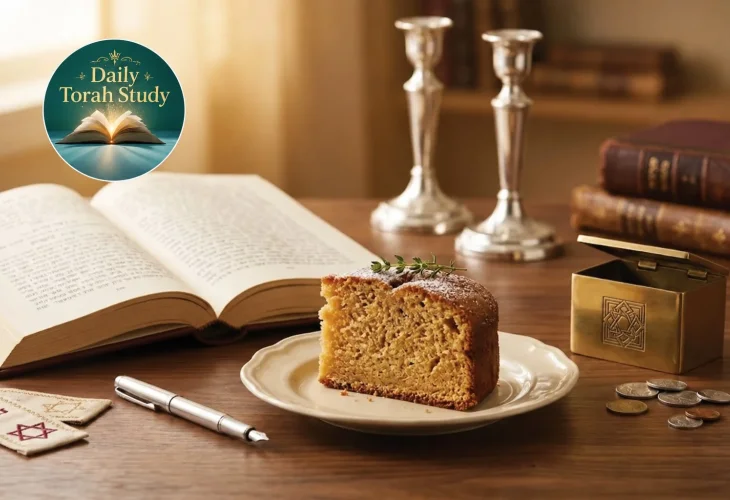
Two daily halachot from the book Behalacha UveAggadah, based on the rulings of Rabbi Ovadia Yosef, of blessed memory.
When Does Eating Cake Constitute a Meal?
Someone who eats 216 grams of cake, equivalent to the weight of four eggs at 54 grams each, must wash their hands, recite Hamotzi before eating, and Birkat Hamazon afterward. This is because consuming such a quantity is considered equivalent to establishing a meal.
If a person initially intended to eat only a small piece of cake but continued eating until reaching 216 grams, they do not need to recite Hamotzi at that point. However, upon finishing, they must recite Birkat Hamazon.
This ruling applies specifically when a person consumes 216 grams of cake alone. If someone eats 100 grams of cake together with other foods, bringing the total quantity consumed to 216 grams, they do not recite Hamotzi or Birkat Hamazon. Instead, they recite Mezonot before eating the cake and Al Hamichya afterward.
What If You Are Unsure Whether You Recited Birkat Hamazon?
If someone eats 216 grams of baked goods, feels satisfied, and is uncertain whether they recited Birkat Hamazon, they must recite it again, just as someone who has eaten bread would. This is because the obligation to recite Birkat Hamazon after eating to satisfaction is a Torah commandment. In cases of uncertainty involving a Torah-level obligation, halacha requires taking the stringent approach.
The Daily Mitzvah: Tzedakah (Charity)
The mitzvah of tzedakah is among the most important and elevated commandments in Judaism. The Torah instructs us to care for those in need, as it states: "If there will be among you a needy person... you shall not harden your heart, nor close your hand against your needy brother" (Deuteronomy 15:7–8). Tzedakah is not merely a personal responsibility but a social obligation that embodies the fundamental Jewish values of compassion, kindness, and love for others.
The Importance of Tzedakah
Our Sages emphasize the extraordinary significance of giving charity, teaching that "Tzedakah is equal to all the commandments" (Bava Batra 9a). Through acts of generosity, we emulate Hashem, who sustains and provides for all His creations. Just as He cares for the needs of His world, we are called upon to extend compassion and support to those around us.
Tzedakah also possesses the power to protect and preserve life. As King Solomon teaches, "Charity saves from death" (Proverbs 10:2). The Mishnah further emphasizes the immeasurable value of every human life, declaring that whoever saves a single life from Israel is considered as though they have saved an entire world (Sanhedrin 4:5).
Beyond its impact on individuals, charity also has profound spiritual significance for the Jewish people as a whole. The Talmud teaches that tzedakah brings the redemption closer, citing the verse: "Thus says Hashem: Observe justice and practice righteousness, for My salvation is near to come, and My righteousness to be revealed" (Isaiah 56:1; Bava Batra 10a).
The mitzvah of tzedakah is not optional. It is an obligation imposed by the Torah on every individual and on society as a whole. Its purpose is to provide assistance and support to those who cannot sustain themselves, including the sick, the elderly, orphans, and widows. Through charity, we help ensure that vulnerable members of society receive the care and dignity they deserve.
The Remarkable Story of Binyamin HaTzaddik
The Talmud recounts a remarkable incident illustrating how giving charity can save a person's life. Binyamin HaTzaddik was responsible for managing a communal charity fund. During a year of famine, a desperate woman approached him and pleaded, "Rabbi, please provide for me."
Binyamin replied that the charity fund was completely empty and that he had nothing left to distribute. The woman then told him, "Rabbi, if you do not provide for me, my seven children and I will die." Deeply moved by her plight, Binyamin gave her money from his own resources, providing enough assistance to sustain her and her children.
Some time later, Binyamin became gravely ill and was close to death. The ministering angels appeared before Hashem and pleaded on his behalf. They argued that Hashem had declared that whoever saves a single life from Israel is considered as though he has saved an entire world. How, then, could Binyamin HaTzaddik, who had saved a woman and her seven children, die after so few years?
In response, the heavenly decree against Binyamin was annulled, and 22 years were added to his life. His extraordinary act of generosity had not only saved the lives of others but had ultimately brought additional years to his own.
The Transformative Power of Giving
The mitzvah of tzedakah offers us an opportunity to make a meaningful difference in the world, restore hope to those facing hardship, and strengthen our own capacity for compassion. Giving charity is not simply about providing financial assistance; it is about recognizing the struggles of others and accepting responsibility for their well-being.
As the story of Binyamin HaTzaddik demonstrates, a single act of generosity can have consequences far beyond what we can imagine. By opening our hearts and extending a helping hand to those in need, we have the power to save lives, bring comfort to others, and create lasting positive change. Even the smallest act of kindness can make an extraordinary difference.

