

Parashat Toldot
Does Hashem Love Us for Who We Are? A Powerful Lesson from the Haftarah of Toldot
The Metzudat David reveals the deeper meaning behind Hashem’s declaration of love for the Jewish people, explaining why His love goes beyond the merits of our ancestors and endures even when we fall short
- Yonatan HaLevi
- | Updated
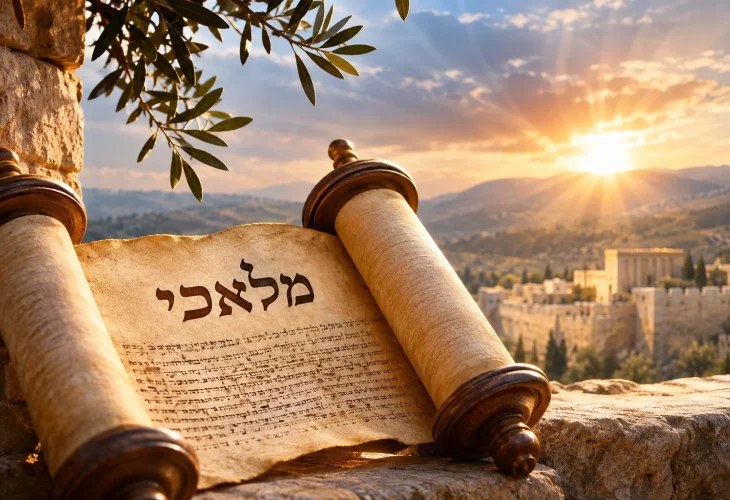
The Haftarah for Parashat Toldot is taken from the Book of Malachi, one of the Twelve Minor Prophets (Trei Asar). It begins with the first verse of the book and concludes at chapter 2, verse 7. According to Yemenite Jewish custom, the reading continues through chapter 3, verse 4.
The connection between the Haftarah and the weekly Torah portion lies in the relationship between Jacob and Esau, whose birth and early lives are described in Parashat Toldot. The prophet Malachi declares in Hashem’s name: “Was not Esau Jacob’s brother? Yet I loved Jacob, but Esau I hated” (Malachi 1:2–3).
The prophecy was delivered during the Second Temple period and contains a powerful message of rebuke directed toward the priests and the Jewish people, particularly concerning their disregard for the sanctity of Hashem’s offerings. Yet before addressing their shortcomings, the prophet begins with a declaration of Hashem’s enduring love for Israel.
Little is known with certainty about the prophet Malachi himself. The Tanach does not explicitly identify his father or place of origin. The Talmud associates him with the Men of the Great Assembly (Anshei Knesset HaGedolah), and one opinion identifies him as Ezra the Scribe.
Why Did the Jewish People Question Hashem’s Love?
The prophecy opens with a remarkable exchange. Hashem declares, “I have loved you,” but instead of responding with gratitude or expressing their love in return, the Jewish people ask, “In what way have You loved us?”
Hashem responds by drawing a comparison between Jacob and Esau. Although the two were brothers, their descendants experienced very different destinies. Hashem chose Jacob and his descendants, while Esau and the nation of Edom faced destruction.
The prophet describes how Edom’s land was devastated and declares that even if its inhabitants attempted to rebuild their ruins, their efforts would ultimately fail. The Jewish people, by contrast, retained the promise of restoration. Despite experiencing destruction and exile, they would eventually rise again and rebuild.
This contrast serves as evidence of Hashem’s special relationship with Israel. His love is not merely an abstract declaration but is reflected in the enduring existence and ultimate restoration of the Jewish people.
And yet, the question remains: Why did the Jewish people challenge Hashem’s declaration of love in the first place? Were they truly unaware of the kindness He had shown them throughout their history?
Are We Loved for Ourselves or Because of Our Ancestors?
The Metzudat David offers a profound explanation of the Jewish people’s response. According to his interpretation, they were not denying that Hashem had bestowed tremendous kindness upon them. Rather, they were questioning the reason for that kindness.
Their question, “In what way have You loved us?” expressed a deeper concern: Perhaps Hashem’s kindness toward them was not rooted in love for who they were, but solely in His love for their righteous ancestors.
After all, the Jewish people were descendants of Abraham, Isaac, and Jacob, whose extraordinary righteousness had established an enduring spiritual legacy. Perhaps the blessings they continued to receive were simply the result of the merits of the Patriarchs and Matriarchs, rather than an expression of Hashem’s love for them personally.
Hashem’s response directly addresses this concern. By declaring, “But Esau I hated,” Hashem demonstrates that His love for Israel cannot be attributed exclusively to their ancestry. Esau was also a descendant of Abraham and Isaac. If the Jewish people were loved solely because of the merits of their forefathers, Esau and his descendants should have been equally entitled to that love. Yet Hashem distinguishes between them.
As the Metzudat David explains, if His love were based entirely on the merits of the Patriarchs and Matriarchs, He would have loved Esau as well. The fact that He did not reveals that His love for the Jewish people is not merely inherited. Rather, Hashem loves them both because of their connection to their righteous ancestors and because of their own inherent worth.
A Love That Remains Even Through Rebuke
This interpretation reveals an especially meaningful dimension of the Haftarah. Hashem’s declaration of love is not simply a reminder of the Jewish people’s illustrious heritage, but is an assurance that their relationship with Him possesses a value of its own.
The timing of this message is particularly significant. The prophecy goes on to rebuke the priests for bringing improper sacrifices and treating the service of the Beit HaMikdash with disrespect. They are reminded that Hashem deserves honor and reverence, just as a father deserves respect from his children and a master from his servants.
The priests are criticized for presenting blemished offerings that they would never consider appropriate gifts for an earthly ruler. Through these examples, Malachi emphasizes that serving Hashem requires sincerity, reverence, and a recognition of the holiness of the Divine service.
Yet before delivering these stern words, Hashem first reassures the Jewish people of His love. This order carries a powerful lesson. Divine rebuke does not necessarily signify rejection. On the contrary, the very fact that Hashem calls upon His people to improve their ways reflects the significance of their relationship with Him.
The Haftarah concludes its traditional reading by describing the ideal spiritual role of the priest, whose lips should preserve knowledge and from whom people should seek Torah. The priest is meant to serve as a messenger of Hashem, guiding others toward truth and righteousness.
The prophecy thus moves from a declaration of Divine love to a call for greater spiritual responsibility. The Jewish people are beloved, but that love also calls upon them to live in a manner worthy of their unique relationship with Hashem.
Ultimately, the Haftarah of Parashat Toldot offers a profound message of reassurance. Our connection to Hashem is strengthened by the extraordinary merits of our ancestors, but it does not depend on their righteousness alone. As the Metzudat David explains, Hashem’s love is also directed toward the Jewish people themselves.
Even when we fall short of our spiritual responsibilities, that love remains the foundation of our relationship with Him. The challenge is to recognize its depth and respond by strengthening our commitment to Torah, holiness, and the values that give expression to that enduring bond.

