

Personal Stories
Former Hostages Elkana Bohbot and Rom Braslavski Share Remarkable Stories of Faith in Gaza Captivity
In an emotional conversation, the two former hostages recount prayers answered in captivity, their unwavering faith in Hashem, and the powerful moments of reconnecting with Jewish traditions after their release
- Naama Green
- | Updated
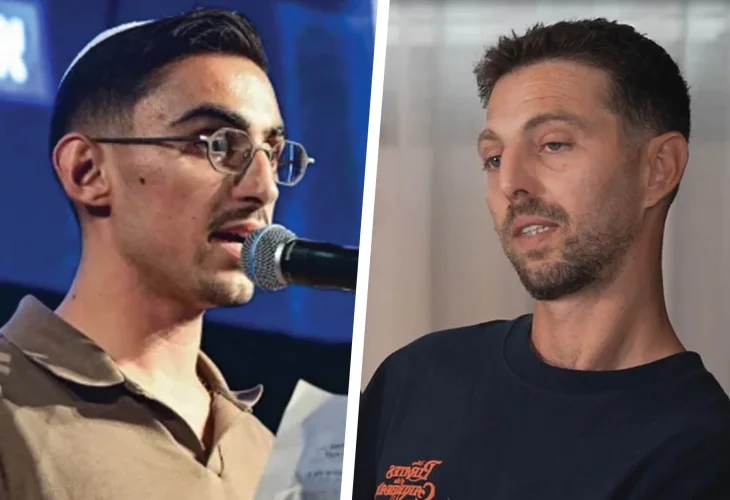 Elkana Bohbot (Photo: IDF Spokesperson's Unit) and Rom Braslavski (Photo: Avshalom Sassoni/Flash90)
Former hostage Elkana Bohbot appeared last week on Rom Braslavski's program on Channel 2000, where the two discussed the prayers they offered during their captivity in Gaza. Braslavski recalled a day when he prayed to Hashem for a piece of chocolate, prompting Bohbot to share a similar experience involving his son Re'em's birthday.
"I'll tell you a short story from my personal experience during that terrible captivity. I'll never forget it," Braslavski began. "One day, I spent the entire day thinking, 'I just want some good chocolate.' I sat there praying, 'Father, please give me some chocolate.'"
"I hadn't eaten chocolate for an entire year," he continued. "Usually, I don't ask G-d for anything. I just thank Him that I'm still alive. But that day, I prayed, 'G-d, give me something small and sweet. A cup of tea, some chocolate, a date, anything.' I prayed with all my heart, and on that very day, someone suddenly came in and handed me a piece of chocolate. That was the moment I said to myself, 'Wow, G-d really hears me when I speak to Him.'"
Bohbot responded with a remarkably similar experience. "Something like that happened to me, too. On Re'em's first birthday that I spent in captivity, I prayed to G-d, 'Please, just let me have something sweet to celebrate with.' Suddenly, the terrorists called me, Ohad, and Bar over and handed us a bag filled with halva candies that had gone bad and that they were planning to throw away. Then they said, 'Why throw them out? Let's give them to the Jews.' We ended up eating about 18 or 19 of those candies on Re'em's birthday. To me, it was a gift from Heaven."
"G-d was with us every single moment of every day. It's unbelievable," Braslavski reflected. "Every moment. Every single moment," Bohbot agreed.
The Mitzvah He Longed to Fulfill Again
Later in the conversation, Bohbot spoke about the mitzvah that had been part of his daily life for years before his abduction. "I was putting on tefillin long before October 7," he explained. "For me, tefillin are my telephone to the Creator. I started putting on tefillin consistently again when I was 23. Today I'm 38. The only interruption was during my time in the tunnels."
Throughout his captivity, Bohbot longed to fulfill the mitzvah once again. "Every day in captivity, I prayed to G-d to grant me the privilege of feeling those tefillin wrapped around my arm again, to give me the opportunity to speak to Him. So every morning, I would get up and pretend to put on tefillin. Since my release, I've been putting them on every day again, and I encourage every Jew to do the same, with love."
Bohbot described the overwhelming emotions he experienced upon returning to the mitzvah after his release. "The day I was freed, I immediately put on my tefillin and tallit. It was the best feeling of my life. I immersed myself in a mikveh. It's a feeling I can't even describe."
He also vividly recalled the experience of holding a proper Kiddush cup again. "To hold a real Kiddush cup filled with wine, instead of the disposable cup I used for Kiddush with water. I kept that disposable cup for more than two years so I would have something to use for Kiddush and Havdalah."
Bohbot went on to describe how he observed Shabbat under the harsh conditions of captivity. "I kept Shabbat inside the tunnels. That meant not turning on a flashlight when I needed to go to the bathroom. There wasn't even a proper bathroom, just a hole in the ground, and you couldn't see anything. It also meant not going to the terrorist to get food. During the last six months, I made a firm commitment to keep Shabbat no matter what. I wasn't going to go get food. I was keeping Shabbat."
"Blessed are You, Hashem, Who frees the imprisoned," Braslavski responded, referring to the words of the morning blessings. He added that reciting the prayers acknowledging Hashem as the One who frees prisoners and redeems captives had taken on an entirely new meaning. "Every morning when I say those words, and every evening when I pray, it's an overwhelming feeling all over again."
Holding On to Faith Through Unimaginable Suffering
When Braslavski asked Bohbot whether he had ever felt angry with Hashem during captivity, his response was unequivocal. "No. I'm not angry. When a person believes, he believes completely. It's not a matter of saying, 'I believe halfway,' or 'Today I'm going to be angry with Him.' I had many moments of personal prayer and conversation with Him there."
Bohbot explained that his faith helped him find meaning even in the most difficult circumstances. "I hold on to the belief that if I went through this, then it was something I needed to go through. I thank G-d that I'm here and alive, and I'm filled with tremendous gratitude that I was able to return to my family."
Braslavski also shared the deeply personal conversations he had with Hashem during his captivity. "I sat there in those terrible places in Gaza and said, 'G-d, I'm sorry for the sins I've committed.' I thanked G-d for bringing me through such an immense ordeal of suffering, and I said thank You for everything I had endured."

