

Parashat Toldot
Two Nations, One Struggle
The struggle between Jacob and Esau was written into their very beginnings. Its implications reach far beyond the lives of two brothers.
- Rachel Wigman
- | Updated
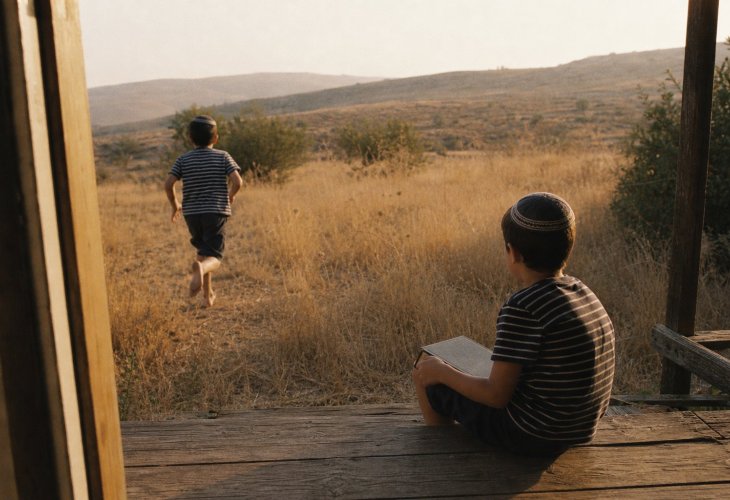 Illustrative image: twin brothers, one running into the open field and one sitting with a book
When I was about four years old, my mother got a phone call one day from my grandmother who had heard some news and was surprised to be hearing it through the grapevine. “Hi,” said my grandmother, “do you want to tell me something about a baby? Or maybe about two babies?”
As it turns out, my teacher in school that year was the daughter of a very close friend of my grandmother’s. And when I told my teacher that my mother was expecting twins, she was surprised, as a close family friend, that she hadn’t heard already. She immediately called her mother, who called my grandmother, who called my mother, who was not, in fact, expecting twins.
To be clear, my mother wasn’t expecting at all. But when we were learning about the birth of Jacob and Esau, which appears in this week’s Torah portion, four-year-old me took the story to heart and decided that it meant that in addition to Rebecca in the Torah, my mother, too, was having twins.
Unlike my mother, though, Rebecca really did have twins. In fact, the verse relates that when she was expecting them, she felt that something was off: “The children struggled inside her and she said, ‘If this is so, why me?’ And she went to seek God” (Genesis 25:22). Nachmanides explains that the agitation that Rebecca was feeling was so abnormal, and so painful, that she almost wished to die. This may have been her first pregnancy, so she didn’t have any other experience by which to compare, but she consulted with the women around her who assured her that her situation was not the norm. And so she sought an answer from God.
The response was, at least in part, reassuring, because Rivka did not know that she was carrying twins: “And God said to her, ‘There are two nations in your womb, and two kingdoms will separate from your innards. One kingdom will be stronger than the other, and the greater will serve the younger” (25:23).
The final clause in the verse is oddly cryptic in the original Hebrew, and it is actually not clear if it’s saying that the greater will serve the younger or that the greater will enslave the younger. Rabbi Naftali Tzvi Yehuda Berlin, a prominent nineteenth century Lithuanian scholar known more commonly by the acronym Netziv, says that this ambiguity is deliberate. Both meanings, he explains, are now embedded in this phrase, which means that both possibilities exist as eventual realities. One will serve the other. But which will serve and which will be enslaved? That, says the Netziv, is a question of timing.
What makes this ambiguity even more fascinating is the word choice. The opposite of younger is elder, not greater, and the fact that the verse deliberately eschews the word elder in favor of greater tells us more about the dynamic that will play out in the eventual, existential fight between Jacob and Esau. Rabbi Samson Raphael Hirsch, a master linguist who was very carefully attuned to word choice, explains that the word used in this verse indicates a greatness in power and number.
Rabbi Chaim ibn Attar, a Moroccan scholar from the early eighteenth century who is referred to as the Ohr HaChaim, explains that when the verse refers to the greater and the younger, it’s not referring to one as Esau and one as Jacob, as we might think. The Ohr HaChaim explains that at any given point, one of these brothers will be greater and one will be “younger,” weaker and subservient. That is the nature of the relationship between the two.
I don’t know if Rebecca knew, when she agreed to marry Isaac, just what she was signing up for. Her marriage contract probably didn’t detail the fact that her descendants would have the power to shape the world. Yet we have to imagine that as she digested this prophecy, as she mulled over this cryptic language with all of its implications, she knew that she was carrying the future within her.
Jacob and Esau continued to struggle throughout their lives. Following in the theme that Nachmanides laid out for us at the beginning of Genesis, in which the actions of our forefathers become signs for their children, the fight that began in the womb is one that continues to play out today, as the descendants of Jacob, the children of the book, continue to struggle against the legacy of Esau, the man dominated by his passions and who lived for nothing other than this material world. And it often feels like a Sisyphean struggle, where try as we might to prevail against the Esau-like culture, we can never seem to win.
There is comfort to be found. Rabbi Hirsch says that in the end, the greater, Esau, the one who until now appeared mightier in power and in number, will see that all he did was pave the way for the eventual triumph of the seemingly weaker one, Jacob. The one who carries the spirit and culture, who prevails against trends and ideologies and who stands by his morals and principles, will emerge as the ultimate victor.
And so we will continue in the path of our forefather Jacob, struggling mightily against his brother Esau, until the words of the prophecy to Rebecca do come true, and the greater finally does serve the younger.
 Parashat ToldotDoes Hashem Love Us for Who We Are? A Powerful Lesson from the Haftarah of Toldot
 Parashat ToldotWhen Life Feels Unfair: The Hidden Message Behind Jacob, Esau, and the Blessings
 Parashat ToldotIs It Really Our Effort or Hashem’s Help? A Lesson from Parashat Toldot
 Parashat ToldotWhose Prayer Did Hashem Really Answer? A Surprising Lesson from Parashat Toldot

