Behind the News
Chabad Shluchim Conference: A Powerful Lesson in Jewish Identity and Responsibility
From the iconic group photo of thousands of Chabad emissaries to Israeli Ambassador Yechiel Leiter’s moving tribute to his fallen son, the conference offers a powerful reminder of Jewish unity, purpose, and the responsibility we all share
- Yedidya Meir
- | Updated
This week, I escaped the endless reports about the formation of Israel's government and immersed myself in the International Conference of Chabad Shluchim in the United States.
When I say "escaped," I don't mean that I boarded a plane and traveled there. Unfortunately, I wasn't privileged to attend in person this year. But mentally, I was just as present at the conference as I had been in previous years, perhaps even more so. Often, when you're abroad, it's impossible to disconnect from what's happening in Israel, especially when the news is particularly dramatic. You remain glued to updates and WhatsApp groups around the clock, following both Israeli time and the time zone of wherever you happen to be.
This week, however, the opposite was true. Physically, I was in the Holy Land, but my thoughts were thousands of miles away, finding comfort in something far greater than the latest political developments. Whatever government is formed here—and of course, it matters enormously which government is formed—one thing remains certain: 6,489 Chabad shluchim will continue helping Jews around the world put on tefillin. They will affix mezuzot to doorposts, invite people to their Shabbat tables, light Chanukah menorahs, and illuminate the world with Torah and mitzvot. And isn't it wonderful that Kislev has arrived? This month, too, offers a much-needed spiritual anchor.
Actually, I want to reconsider my choice of words. I didn't really escape. I wasn't denying the difficult political reality or pretending it didn't exist. I simply broadened my perspective. I looked beyond the immediate headlines to the larger story of the Jewish people—and, in doing so, found what I believe is a practical response to our political challenges.
I don't believe we should encourage Jews to observe mitzvot merely to influence how they vote. Bringing Jews closer to Torah is important in its own right, because every Jew has a Divine mission and a soul that longs for connection with Hashem. And on a national level, I believe that the more deeply we connect with Torah, the stronger our position will become. As the Torah promises, "If you follow My statutes," Divine blessing and protection will follow.
Nevertheless, when a Jew discovers Torah and begins observing mitzvot, that transformation can influence other areas of life, including political outlook. The light of Torah has the power to change a person's perspective, even in the voting booth. I say this from personal experience, having known families who underwent profound spiritual transformations through teshuvah and, along the way, shifted from voting for Tommy Lapid to supporting Shas within a single election cycle.
The Photograph That Tells Thousands of Stories
The International Conference of Chabad Shluchim traditionally takes place around the Shabbat preceding Rosh Chodesh Kislev. It begins on Thursday, with shluchim attending lectures and workshops addressing the challenges and responsibilities of their work. On Friday morning, they gather for prayer at the Ohel, the resting place of the Lubavitcher Rebbe, who inspired and directed their mission. Shabbat is spent sharing meals and participating in farbrengens, Chassidic gatherings held in private homes and halls throughout Crown Heights, Brooklyn. On Saturday night, the celebrations continue with a festive Melaveh Malkah.
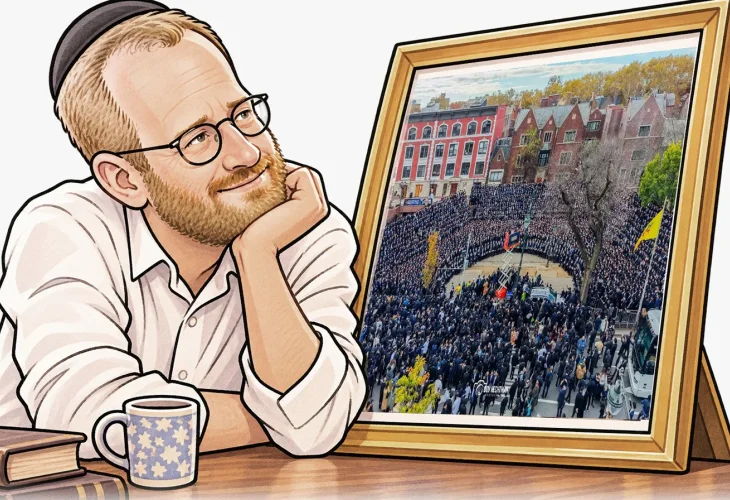
Much of this takes place below the media's radar, unless, like me, you follow the conference obsessively. Then Sunday morning arrives, and suddenly the entire world takes notice. The moment comes when the traditional group photograph is released, showing thousands of shluchim gathered outside 770 Eastern Parkway, the headquarters from which the worldwide Chabad outreach movement grew.
There is something extraordinarily powerful about that photograph, not only because of the sheer number of people it captures, but because of what each person represents. After all, there are few Jews in the world who haven't encountered or benefited from a Chabad shliach (emissary). Most of us have witnessed at least one shliach's dedication and understand the impact of his work. Then, suddenly, we see thousands of them standing together. What a remarkable sight. How grateful we should be for every single Mendy.
Behind Every Face Is a Story
One of those Mendys, Rabbi Mendy Peles of Chabad Beit Hakeramim in Modi'in, shared a beautiful reflection on the photograph. "Like everyone in a group picture, I admit that the first thing I did was zoom in and look for myself. It took me a moment to find where I was standing. Then I zoomed out and simply stared.
"When you zoom in, you can choose a face and discover a story. Look at the shliach standing above me. He once drove four hours just to put up a mezuzah in the home of a single Jew. Or look at the shliach beside me. Just before Shabbat, a traveler knocked on his door. They immediately pulled up another chair at the table and told him, 'We were saving a place just for you!'
"My own story is about a chair that remained empty during prayers last Shabbat. On Saturday night, I called the person who usually sits there to ask how he was doing. Of everything we discussed, one question stayed with me: 'You noticed I wasn't there?'
"Now zoom out again and see just how enormous this picture really is. Behind every face is a collection of small stories from another corner of the world. Together, they form the story of the Jewish people.
"The Rebbe envisioned this picture long before he sent out the first shliach. He taught us that no Jew is too distant and no act is too small. The great picture of the Jewish people begins with one good deed—mine and yours."
You Don't Need to Be a Shliach to Have a Mission
Did you notice the final word in Rabbi Peles's beautiful reflection? "Yours." Not just my good deed, as a Chabad shliach, but yours as well, wherever you happen to be. And that is such an important point. Who says Chabad shluchim have a monopoly on shlichut, the responsibility to reach out to another Jew? That mission belongs to you and me, too.
Granted, most of us probably won't open a Chabad House in Bangkok, or even in Rishon LeZion. But what if we find ourselves sitting beside a Jewish colleague, neighbor, or fellow passenger who expresses an interest in Judaism? Especially since October 7, there are so many Jews searching for a deeper connection to their identity. Why shouldn't we be there for them?
Perhaps we could invite someone for Shabbat, or simply share what Shabbat means to us. We can make our Jewish identity visible and accessible without turning every encounter into an organized outreach campaign. It doesn't necessarily require much. We simply need to recognize how many spiritually thirsty souls surround us. I'm not suggesting that everyone set up a tefillin stand or approach strangers on trains. But perhaps we could bring our tefillin to work and leave them on our desks. You might be surprised what happens next.
Israel's Ambassador: "I'm Only One of Thousands of Ambassadors"
Another moment from the Chabad Shluchim Conference of 5787 that has stayed with me was the address delivered by Israel's ambassador to the United States, Dr. Yechiel Leiter, at the gala banquet concluding the conference.
"I'm accustomed to speaking before large audiences at major conferences," he began. "But this time, I'm not the only ambassador in the room. I'm just one of thousands of ambassadors gathered here."
He then shared a humorous story about his mother. "One of the privileges of being an ambassador is that people often address you as 'Your Excellency.' Apparently, word of this reached my mother, who should live to 120. She's in her nineties. Recently, I visited her to fulfill the mitzvah of honoring my mother. In the middle of our conversation, she suddenly asked, 'Yechiel, is it true that people call you Your Excellency?'
"I told her, 'Mom, I didn't ask for it. It comes with the job.' She thought about it for a few minutes and then said, 'Don't let it go to your head.' So I say to all of you, Your Excellencies, the Chabad ambassadors around the world: Don't let it go to your heads."
A Father's Pain and a Soldier's Final Lesson
Leiter then spoke about the painful challenges his family had endured over the previous three years.
"I want to thank you for your prayers on behalf of my son, Neriya Dov ben Chana. I've come to you directly from Shaare Zedek Medical Center. I landed this morning after spending the past week at his bedside, and I can see with my own eyes that the prayers are beginning to have an effect. So please, continue praying.
"It has been a difficult week. I had to plan the memorial service for my eldest son, Moshe Yedidya, may Hashem avenge his blood, while caring for my second son. Last Thursday marked the anniversary of Moshe's death in Beit Hanoun, Gaza."
Leiter then shared a lesson his fallen son had taught the soldiers under his command before they entered battle. Moshe had trained extensively, served in the Israeli Air Force's special forces, and gained considerable combat experience. Before entering Gaza, he warned his soldiers that the chaos of battle could easily cause them to lose their bearings.
"You enter combat, and suddenly you lose your sense of direction. There's artillery fire, aircraft dropping bombs, and you no longer know where you are. The most important thing when entering a battlefield is to keep asking yourself three questions: Where am I? Where are my friends? And where is the enemy? If you keep repeating those questions, you'll maintain your orientation and won't lose yourself in the battlefield."
Leiter explained that his son's advice carried a message far beyond military strategy. "What I want to share with you today is a very simple message from my son. The questions are: Where are we? Where are our friends? And where is the enemy? But in our present circumstances, we must also keep asking: Who are we? Who are our friends? And who are our enemies?
"You know how to answer the first two questions exceptionally well. That's your mission. You know who you are, and you help Jews who don't know who they are. You also know who our friends are. But the epidemic of our generation is that we've forgotten how to identify the enemy.
"The enemy is out there, and it changes its appearance. Antisemitism is not a single, fixed phenomenon. It is a virus that mutates. We must call things by their names, recognize the problem, and confront it. We will succeed when we know who we are, know who our friends are, and can identify our enemies and call them by their names."
Knowing Who We Are—and Who Stands With Us
I know that a diplomat, particularly someone as thoughtful and serious as Yechiel Leiter, chooses his words carefully. I cannot say whether he was referring exclusively to Arab enemies abroad or whether his remarks also encompassed Arab adversaries within Israel. I don't want to put words in his mouth. So what follows is my interpretation, not his.
How tragic it is when people forget who they are, because once they lose their sense of identity, they can also lose the ability to recognize their allies and adversaries.
Consider what is happening in the political arena outside the Chabad conference. An entire bloc of parties appears, in my view, more willing to form a coalition with those I regard as hostile to Israel than to cooperate with their religious-Zionist brothers. And certainly more willing than they are to cooperate with Netanyahu. They seem to have adopted a new political principle: Anyone but our natural allies.
Why does this happen? I believe it begins with a loss of identity. When people become disconnected from their Jewish roots, their understanding of friendship, loyalty, and shared responsibility can become distorted.
And that brings us back to the ambassador's message.
The Weight of Generations on Our Shoulders
Leiter concluded his address with another moving memory of his son Moshe.
"When Moshe began his military training, the exercises were incredibly demanding. One Friday afternoon, he came home for Shabbat after spending 36 hours in the desert. They had marched approximately 80 or 90 kilometers, carrying enormous packs weighing 50 or 60 kilograms. His eyes were sunken, and he looked completely exhausted.
"I asked him, 'Moshe, how do your knees not collapse under that weight? How do you manage to carry such a heavy load on your shoulders?'
"He told me, 'I have a trick. I've developed a special method.' I asked, 'What's your method, Moshe?' He answered, 'It's very simple. I add more weight.'
"I said, 'Moshe, I'm asking you a serious question.' He replied, 'Dad, I'm serious. I add the hopes, prayers, and dreams of my grandparents and great-grandparents to the weight I'm carrying. I place them on my shoulders, and then I can carry any burden.'"
Turning to the thousands of shluchim gathered before him, Leiter offered a final challenge. "And now I ask all the ambassadors in this room, Your Excellencies, the Chabad shluchim: Add more. Add a little more to the burden on your shoulders.
"You carry that weight not only for yourselves, but also for Jews who have not yet taken on enough of their own Jewish responsibility. You carry it for all the generations who waited for this day and who, once again, face threats like those our people have confronted throughout history.
"To withstand those who seek to destroy the vision of a better world—a world that recognizes the Creator who guides our destiny until the coming of Mashiach—we must add to the burden we carry on our shoulders. Thank you very much."
The ambassador's words captured something essential about the mission of the shluchim and, ultimately, about the responsibility of every Jew. The great photograph outside 770 is made up of thousands of individuals, each carrying the hopes of generations and reaching out to one Jewish soul at a time. Yet the message extends far beyond those pictured.
We may never stand among the thousands of shluchim in Crown Heights, but we can still recognize the responsibility that rests on our own shoulders. Every conversation, every invitation, every mitzvah, and every act of kindness can become part of the larger Jewish story.
And perhaps that is the most powerful perspective to carry with us, even when the political headlines threaten to overwhelm everything else.
Originally published in Olam Katan magazine. For comments: [email protected]