

Personal Stories
Israeli Singer Itzik Kala Opens Up About Faith, Cancer, and the Loss of His Daughter
Legendary Israeli singer Itzik Kala reflects on his childhood poverty, battle with cancer, heartbreaking loss of his daughter, and the unwavering faith that has sustained him throughout his life and musical career
- Avner Shaki
- | Updated
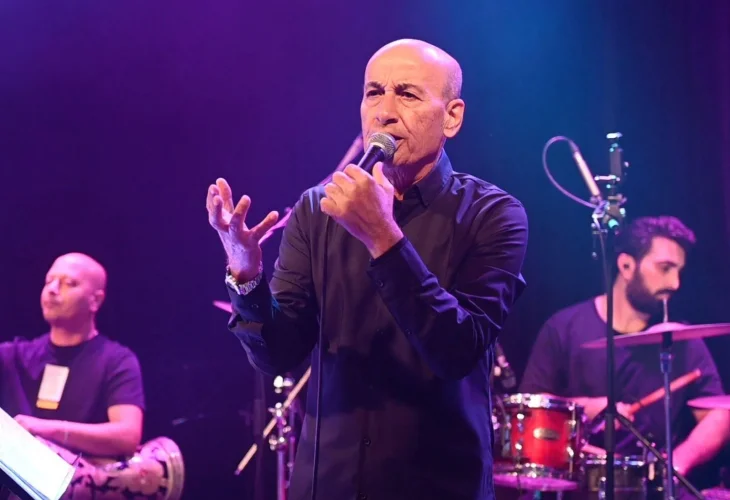 Itzik Kalla (no credit)
With his warm smile and unassuming manner, Itzik Kala is a man whose humility is immediately apparent. Despite a remarkable career spanning dozens of albums, hits that have captivated generations, and performances before thousands of fans, the celebrated Israeli singer remains refreshingly down-to-earth.
Now 73, Kala is touring Israel with conductor Tom Cohen and the East & West Orchestra. He has also recently learned that he will receive the prestigious AMI Lifetime Achievement Award, adding to the Distinguished Citizen of Jerusalem honor he previously received. Yet behind the accolades lies a deeply personal story of poverty, loss, perseverance, and unwavering faith. For Kala, every chapter of his life reflects his belief in Divine providence and his connection to Hashem.
A Childhood Marked by Poverty and Loss
Kala was born into a religious family in Jerusalem's Katamonim neighborhood. The youngest of 13 children in a family that had immigrated from Kurdistan, he was the only sibling born in Israel. His father was a gifted cantor and liturgical poet whose prayers left a lasting impression on those who heard them. "When my father would lead the prayers on the High Holidays, even the birds would sing," Kala recalls. Tragically, his father died of cardiac arrest when Itzik was just three years old.
His father's death plunged the family into severe poverty. "It was an extremely difficult childhood," Kala remembers. "There were no luxuries. We even passed clothes down from one sibling to another. I remember walking in the rain with torn shoes and going to sleep hungry."
His mother became the center of his world. Determined to provide for her children, she worked as a cleaner from morning until night. During summer vacations, young Itzik would wake up alongside her at four in the morning to help wash apartment building stairwells. His devotion to her was so profound that he even gave up a promising future as a soccer player because she feared the sport might lead him to violate Shabbat.
Music, however, had been part of his life for as long as he could remember. Even as a young boy, his classmates recognized his remarkable voice and regularly asked him to sing during school breaks. His life changed dramatically at the age of ten, when a friend persuaded him to visit a synagogue. There, he caught the attention of Rachamim Amar, one of Jerusalem's most respected cantors.
"I thank Hashem that I met him. He became like a father to me," Kala says emotionally. "He discovered me as an orphan, took me under his wing, and taught me everything—cantorial singing, maqamat, and the traditional Jerusalem style of prayer. I received all my foundations from him, without a single false note or anything artificial."
Amar recognized the boy's extraordinary potential and wanted to buy him a mandolin so he could learn to play an instrument. Unable to afford one, he approached Dr. Yosef Burg, then Israel's interior minister, and told him about a talented orphan who needed a musical instrument. Burg wrote a personal check and paid for the mandolin.
Four decades later, Kala, by then a successful singer, was staying at a hotel when he noticed the elderly Burg descending a staircase.
"I approached him and asked permission to kiss his hand. He modestly refused and asked why. I told him, 'Forty years ago, you bought a mandolin for an orphaned boy. I am that boy, and thanks to you, I became who I am today.' We embraced, and I cried uncontrollably. I was so overwhelmed that I couldn't even walk properly that day. I sat there for half an hour, simply watching him from a distance until he disappeared."
A Voice That Crosses Cultures and Traditions
Kala's exceptional mastery of maqamat, the melodic modes used in Middle Eastern music, enables him to perform in numerous languages and musical traditions, including Turkish, Persian, Indian, and classical Arabic styles.
He recalls an encounter at an event in Nazareth attended by a prominent sheikh, who remarked that Jews were incapable of authentically performing the Muslim call of "Allahu Akbar." Kala decided to demonstrate otherwise.
"I asked him and all the Arabs in the room to close their eyes. Then I stood there and performed the call with the precise maqam and ornamentation. When they opened their eyes, the sheikh was completely astonished. He even offered me money to come and sing for them on Fridays."
Kala responded in Turkish, further demonstrating his musical knowledge, before explaining the message he wanted to convey. "When the Holy One, blessed be He, created the world and brought music and prayer into it, He first gave them to the Jewish people. Everything rests on the foundations of our Jewish heritage."
 Itzik Kala (Photo: Uri Eliyahu)
The Illness That Threatened His Voice
Several years ago, Kala faced one of the most frightening challenges of his life when doctors discovered a cancerous tumor in his throat, dangerously close to his vocal cords. As he underwent grueling chemotherapy treatments, he turned increasingly to prayer, often retreating into solitude to cry and plead with Hashem.
"The tumor was just one centimeter from my vocal cords," he recalls. "I couldn't believe I would ever sing again. I begged the Holy One, blessed be He, just to let me live and be able to speak."
After each treatment, he would return home and pray desperately for his life. "Thankfully, my prayers were answered. I was able to speak and sing again. It wasn't only thanks to the doctors. First and foremost, it was thanks to the Creator and the Jewish people, who prayed for me day and night with tremendous faith."
Today, Kala makes a point of encouraging others facing similar illnesses and urges people to seek medical attention promptly whenever they notice concerning symptoms.
But while he was fortunate enough to recover, his family would face another devastating battle with cancer—one that ended in unimaginable heartbreak.
"My Daughter, My Daughter": A Father's Unbearable Loss
Kala's beloved daughter, Maayan, was also diagnosed with cancer. She died at just 36 years old, leaving behind two young children. Throughout her illness, Kala remained beside her hospital bed, sleeping in small armchairs and refusing to leave her side.
Her death shattered him. Overwhelmed by grief, he seriously considered abandoning his musical career altogether. What ultimately brought him back was a final request she had made. "She told me, 'Dad, I know how difficult this is for you, but I'm asking you—keep singing and bringing joy to the Jewish people, even more than you have until now.'"
Those words became his source of strength. "If I hadn't continued, I wouldn't have received the Distinguished Citizen of Jerusalem award or the AMI Lifetime Achievement Award. It's all because of her and for her. I dedicate my success to her."
The Songs That Touched Generations
Over the course of his career, Kala has collaborated with some of Israel's most celebrated songwriters and composers, including the late Ehud Manor and Uzi Hitman, as well as Yossi Gispan and Avihu Medina.
One of his greatest hits, "Ani HaEved" ("I Am the Servant"), was written by Hitman. When the songwriter arrived at the recording studio to hear Kala perform the song, which was recorded in a single take, he was moved to tears.
Kala turned to him and said, "To write words like these, with such soul, they must come from a home filled with Judaism, prayer, and faith." Hitman looked at him and replied in a choked voice, "You have no idea how right you are. My father was a Kabbalist."
The Secret Behind His Humility
Despite his extraordinary achievements, Kala has never lost the warmth and simplicity that have characterized him throughout his life. He says he never refuses someone who asks for a photograph, a video message, or a blessing. Every week, he records personal messages for people who are ill and for couples preparing for marriage. After performances, he remains until everyone who wishes to approach him has received personal attention.
His approach to fame is rooted in words from the morning prayers that accompany him each day: "He brings the proud down to the earth and raises the humble to the heights."
"All my close friends, some of whom are extremely wealthy businesspeople, are people without arrogance. If someone lacks humility, I simply cannot be friends with him," he says with a gentle smile.
Having experienced both extraordinary success and profound personal tragedy, Kala views life through the perspective of a man who understands its fleeting nature. "What are we in this world?" he reflects. "We're all just passing through a short corridor. We enter, walk a little, and then leave. True greatness belongs only to the Creator, and that's something we must always remember."
 MagazineYishai Lapidot: From ADHD Struggles to Jewish Music Pioneer, Faith, and Creative Impact
 History and ArchaeologyThe Lost Melodies of Jewish Prayer: How Ancient Traditions Were Preserved
 Personal StoriesFrom World-Famous Violinist to Baal Teshuva: The Story of Mírel Reznic and the Auschwitz Violin
 MagazineMotty Steinmetz on Music, Pain and Faith

