

Interesting
Madagascar’s Stone Forest: Inside the Extraordinary Tsingy de Bemaraha
Discover how millions of years of erosion created Madagascar’s spectacular limestone towers, hidden forests, and deep canyons, home to rare lemurs and remarkable wildlife
- Tehila Cohen
- | Updated
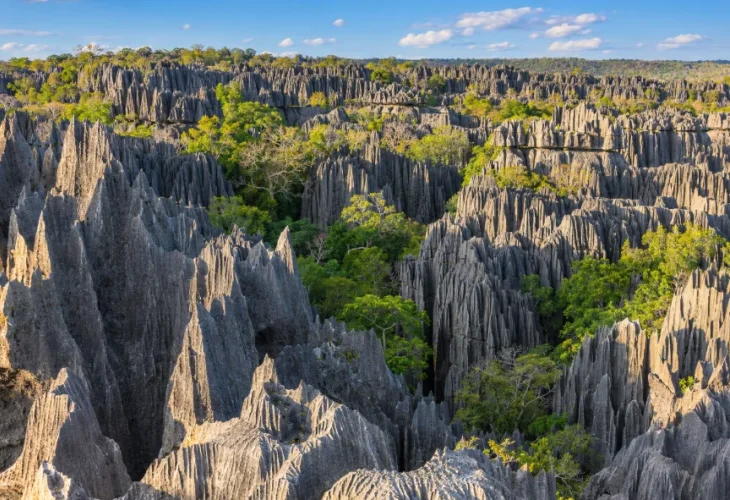
From a distance, it looks like a dense forest of gray stone. But as you approach, the landscape reveals something extraordinary: towering, razor-sharp limestone formations separated by deep crevices, narrow passages, and hidden canyons.
This remarkable landscape is known as Tsingy de Bemaraha, a protected natural area in western Madagascar. Between its jagged rock formations, vegetation flourishes, while forests thrive in sheltered areas far below the towering limestone peaks. How did this unusual landscape form, and what makes it such a unique environment?
How Was Madagascar’s Stone Forest Formed?
Millions of years ago, the area that is now Tsingy de Bemaraha lay beneath the sea. Over time, layers of sediment accumulated on the seabed and gradually formed limestone. Geological processes eventually raised the region above sea level, exposing the rock to the elements.
Rainwater played a central role in shaping the landscape. As it absorbs carbon dioxide from the atmosphere and soil, rainwater becomes slightly acidic, allowing it to slowly dissolve limestone. Over immense periods of time, water penetrating small fractures widened them into deep crevices, while groundwater carved out underground cavities and caves. In some places, collapsing cave ceilings created additional passages and canyons between the stone towers.
This process, known as karst formation, is responsible for the area's dramatic network of jagged pinnacles, steep cliffs, and hidden chambers. What appears to be an impenetrable forest of rock is actually the result of millions of years of gradual geological transformation.
A Hidden World Beneath the Rocks
One of the most surprising features of Tsingy de Bemaraha is the contrast between its exposed rocky peaks and the environments concealed beneath them. The upper limestone formations are exposed to intense sunlight and support vegetation adapted to dry conditions. Deep within the crevices, sheltered canyons, and lower valleys, however, the environment is cooler and more humid, allowing dense vegetation to flourish.
According to Madagascar National Parks, the region contains a remarkable combination of dry forests, lush vegetation in protected areas, drought-resistant shrubs, and underground passages where water may flow seasonally or throughout the year.
Rather than being a barren expanse of stone, the reserve contains several distinct ecosystems. Plants growing in cool, shaded crevices require very different adaptations from those that survive on sun-exposed limestone peaks. This diversity of habitats supports an equally remarkable variety of wildlife.
What Animals Live in Tsingy de Bemaraha?
Navigating the sharp limestone formations can be difficult for human visitors, but some of Madagascar's wildlife is remarkably well adapted to the challenging terrain. One of the area's most fascinating residents is Decken's sifaka, a species of lemur recognizable by its pale fur and dark face. These agile primates can leap between rocky towers, gripping the limestone as they land and moving through terrain that would be extremely difficult for humans to cross.
In the surrounding forests, lemurs feed on leaves and fruit, while numerous bird species and reptiles inhabit the park's varied environments. Chameleons and geckos are among the reptiles found in the area, taking advantage of the sheltered spaces created by the limestone formations.
Can Visitors Explore the Stone Maze?
Despite its seemingly inaccessible appearance, parts of Tsingy de Bemaraha can be explored by visitors. The southern portion of the protected area contains a national park with several hiking routes of varying difficulty. Some trails wind through narrow limestone passages and deep canyons, while others involve climbing, scenic viewpoints, and suspension bridges spanning gaps between the rock formations.
Certain routes are physically demanding and require visitors to navigate steep terrain, making the experience particularly appealing to adventurous hikers. Other trails offer opportunities to appreciate the landscape without undertaking the most challenging climbs. The northern section is protected as a strict nature reserve, helping preserve its fragile ecosystems and unusual geological features.
Tsingy de Bemaraha was originally recognized as a UNESCO World Heritage Site in 1990. In 2023, the World Heritage designation was expanded, and the area became part of the larger site known as the Andrefana Dry Forests.
With its towering limestone pinnacles, hidden forests, and remarkable wildlife, Tsingy de Bemaraha offers a striking example of how natural forces can transform an ancient seabed into one of the world's most extraordinary landscapes.
 InterestingGlowing Mushrooms: The Mysterious Fungi That Light Up in the Dark
 InterestingShampoo Ginger: The Fascinating Plant That Produces Natural Shampoo
 InterestingAustralia's Pink Lake: How Heavy Rain Transforms the Desert Into a Colorful Wonderland
 Wonders of CreationThe Grand Canyon: A Natural Wonder That Leaves You Breathless

