

World News
Iran Rejects US Nuclear Demands, Threatens Wider Conflict in Persian Gulf
Tehran refuses to limit uranium enrichment as tensions with Washington escalate, amid reports of military activity near the Strait of Hormuz and an upcoming diplomatic visit to Oman
- Shlomi Diaz
- | Updated
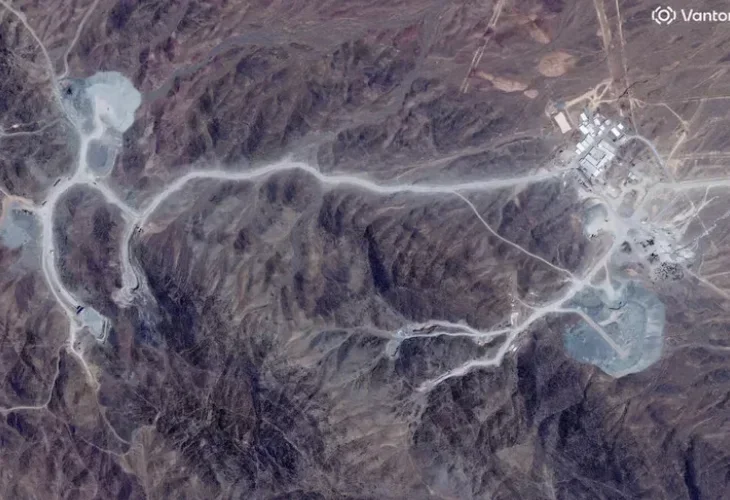 Mount Mokhush in Iran (credit: courtesy of ventor)
Iran has rejected US pressure to limit its nuclear program, insisting that it will neither reduce uranium enrichment levels nor suspend enrichment activities as part of a potential agreement.
In a statement to Iranian media on Sunday evening, Foreign Ministry spokesperson Esmail Baghaei accused Washington of attempting to force Tehran to surrender its sovereign rights, particularly its right to pursue a peaceful nuclear program. "The United States is trying to pressure Iran into giving up its rights, especially its right to a peaceful nuclear program," Baghaei said. "We will not agree to reduce uranium enrichment levels or suspend enrichment to reach an agreement. Iran will not surrender its rights or its sovereignty."
Baghaei also criticized European governments, accusing them of making unfounded allegations against Iran. "Europeans are accustomed to accusing Iran without providing evidence. These allegations are baseless. They should address problems within their own systems. Iran has nothing to do with them," he said, calling on European countries, particularly France, to stop making such accusations.
He further blamed Washington for the ongoing tensions, dismissing any significance in disagreements among senior American officials. "The United States is responsible for everything happening now and everything that happened in the past. We do not care about disagreements between American officials. We see no difference between them."
Meanwhile, amid mounting tensions over Iran's nuclear activities, Tehran announced further developments in its nuclear program. According to Iran's Fars News Agency, the Atomic Energy Organization of Iran claimed that the country is preparing to activate its first advanced nuclear fusion system, intended for applications including medical use and electricity generation.
Iranian Foreign Minister to Visit Oman Amid Gulf Tensions
Iranian media reported that Foreign Minister Abbas Araghchi is expected to visit Oman on Tuesday. Oman has frequently served as a key intermediary in Iran's regional and international diplomatic negotiations. The planned visit comes days after Iranian media reports alleged that the Islamic Revolutionary Guard Corps (IRGC) had attacked a radar installation on the Omani island of Jazirat Tadmur, near the Strait of Hormuz, a strategically important passage for maritime traffic in the Persian Gulf.
Separately, Iranian reports on Sunday evening claimed that the Revolutionary Guards had launched a surface-to-air missile toward an American fighter jet operating over the Strait of Hormuz. Iranian sources also reported that air defense systems had been activated against US drones in the area. These claims have not been independently verified.
Amid the escalating rhetoric, Hassan Ghashghavi, spokesperson for the Iranian parliament's National Security and Foreign Policy Committee, warned that Iran would not allow its adversaries to dictate the timing or scope of any future military confrontation. "We will not fight according to the enemy's timetable," he said. "The geographical scope will be broader. Therefore, conditions have fundamentally changed compared with the 40-day war and the 12-day war, and many surprises can be expected if the enemy decides to act. Logic dictates that our finger must always remain on the trigger."
Iranian Parliament Speaker Mohammad Bagher Ghalibaf echoed the warning, declaring that Tehran would no longer accept a prolonged state of uncertainty between war and peace. "We will not remain in a state of neither war nor peace," Ghalibaf said. "If the Americans accept our seven reasonable conditions, the path to an agreement is open. But if the Americans make another mistake this time, the boundaries of the battlefield will be determined by the capabilities and will of Iran's armed forces, not by American wishes or ambitions."
The statements reflect Tehran's increasingly confrontational position amid tensions over its nuclear program, military activity in the Persian Gulf, and the prospects for renewed negotiations with Washington.
 World NewsIran’s New Pitch: A 15-Year Enrichment Freeze and a Regional Non-Aggression Deal
 World NewsU.S. Military Pushes Back on Iran’s Claim: Strait of Hormuz Remains Open
 World NewsTrump doubles down on Iran: "We expect their economy to collapse under the blockade"
 World NewsTrump: "Hit Them Hard"; U.S. Strikes Iran for the Ninth Straight Night

