

Parashat Vayetze
Rabbi Ovadia Yosef’s Secret to Torah Greatness: A Lesson From Parashat Vayetzei
Discover how Rabbi Ovadia Yosef’s extraordinary dedication to Torah study and a powerful teaching about Yaakov Avinu reveal the true value of perseverance, effort, and lifelong learning
- Rabbi Reuven Elbaz
- | Updated
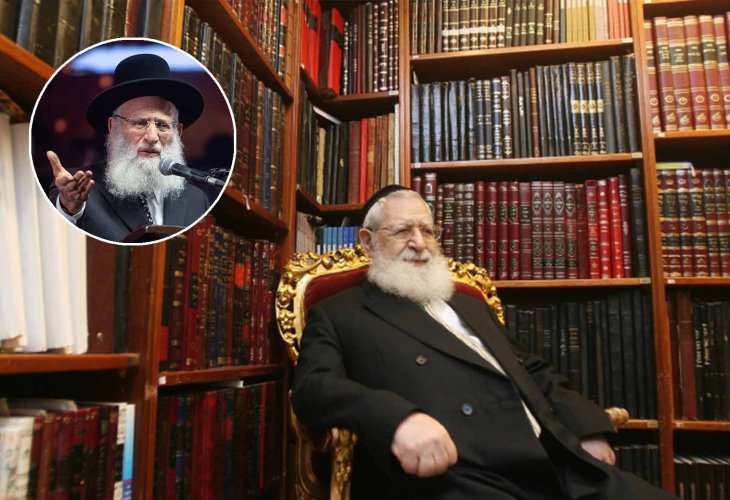 (Photo: Pierre Terdjman / Flash90)
Parashat Vayetzei describes Yaakov Avinu's encounter with Mount Moriah, the site where the Beit Hamikdash would eventually stand: "And he encountered the place and spent the night there, because the sun had set" (Genesis 28:11).
The Gemara relates that as Yaakov passed the place where his father, Yitzchak, had been bound upon the altar, Hashem declared, "Will this righteous man come to My dwelling place and leave without spending the night?" Immediately, the sun set (Chullin 91b). The verse suggests a beautiful insight: Yaakov did not seek out sleep. Rather, sleep came to him.
This extraordinary dedication to spiritual pursuits calls to mind Rabbi Ovadia Yosef, of blessed memory, whose devotion to Torah study continued well into his nineties. He regularly studied and wrote his Torah insights until two or three in the morning. While telling his assistant, 40 years his junior, to get some rest, he himself would continue learning.
One morning, Rabbi Eliyahu Shitrit, who helped record his teachings, arrived to find numerous pages filled with insights written during the night. When he asked whether Rabbi Ovadia had slept at all, the rabbi replied simply, "Sleep never came to me." For Rabbi Ovadia, learning continued until exhaustion finally overcame him, reflecting the extraordinary dedication associated with Yaakov Avinu.
The True Meaning of Wealth in Torah Study
Pirkei Avot teaches, "Whoever fulfills the Torah in poverty will ultimately fulfill it in wealth" (Avot 4:9). Yet the Alshich questions how this can be understood literally when so many great Torah scholars, including Rabbi Chanina ben Dosa and Rabbi Elazar ben Pedat, remained poor throughout their lives.
Rabbi Yitzchak Hutner once offered Rabbi Aharon Kotler a remarkable interpretation: The Mishnah is not necessarily referring to material wealth, but to poverty and wealth of understanding. A person who struggles to grasp the Gemara, who finds every question and explanation difficult, yet continues studying with determination, is fulfilling the Torah in poverty. Through perseverance, that person may eventually attain the richness of deeper understanding. As Mishlei teaches, "The appetite of the laborer labors for him" (Proverbs 16:26). The effort itself becomes the foundation for spiritual growth.
Upon hearing this explanation, Rabbi Aharon Kotler began to cry. When Rabbi Hutner asked why, he explained that Hashem had blessed him with exceptional intellectual abilities, and Torah study had always come relatively easily to him. "I never fulfilled the Torah in poverty," he said. "Had I struggled more in my learning, perhaps I could have reached even greater spiritual heights."
His response reveals a profound truth: The value of Torah study lies not only in what a person understands, but also in the effort invested in reaching that understanding.
The Secret of Rabbi Ovadia Yosef's Extraordinary Knowledge
Rabbi Ovadia Yosef's astonishing command of Torah literature was rooted not merely in his exceptional memory, but in decades of relentless study and review. Even material he knew thoroughly was revisited repeatedly, driven by his concern that he might forget a detail. His concentration was so intense that he could become almost completely unaware of his surroundings.
A man who regularly helped clear a path for Rabbi Ovadia through the crowds following his classes at the Yazdim Synagogue once shared a remarkable experience. One evening, Rabbi Ovadia's driver suggested that the rabbi thank the man for his assistance. Rabbi Ovadia readily agreed and invited him to accompany them home, promising to express his gratitude and offer a blessing.
They arrived shortly before 11 p.m. Rabbi Ovadia immediately removed his robe, hurried to his desk, and became absorbed in writing. The visitor waited respectfully, reluctant to interrupt him. Only at three in the morning did Rabbi Ovadia finally look up.
"Who are you, and what are you doing here?" he asked.
"I'm the person the Rabbi agreed to bless," the man replied.
Realizing what had happened, Rabbi Ovadia apologized profusely. "Please forgive me! I became so absorbed in my learning that I completely forgot. Come, sit with me and have something to drink."
The visitor assured him that no apology was necessary. Rabbi Ovadia then thanked him warmly and gave him his blessing. The incident illustrates the depth of his immersion in Torah study, which could occupy his attention so completely that hours passed unnoticed.
His children recalled a similar intensity each morning. Immediately after reciting the blessings over Torah study, he would hurry to his books and continue learning until it was time to pray. One morning, they noticed him rushing to his desk with particular urgency. When they asked why, he explained, "During the night, I was shown an extensive halachic discussion in my dream, and I want to write it down before I forget any of it!"
Despite his extraordinary memory, Rabbi Ovadia never took his knowledge for granted. His commitment to constant review reflected both his humility and his recognition of Torah's immeasurable value.
What Yaakov's Awakening Teaches Us
Following Yaakov's extraordinary dream of a ladder connecting heaven and earth, the Torah states, "And Yaakov awoke from his sleep" (Genesis 28:16).
The Yalkut Shimoni offers a striking interpretation of the Hebrew phrase "Vayikatz Yaakov mishnato." Rather than reading mishnato as "from his sleep," it suggests mimishnato—"from his Torah study."
Although Yaakov had witnessed angels ascending and descending and received magnificent promises from Hashem, the Midrash emphasizes his unwavering attachment to Torah. Another interpretation connects vayikatz, his awakening, with his eagerness to leave sleep behind and resume learning.
This devotion was reflected in Rabbi Ovadia Yosef's life. For him, Torah study was not simply an obligation or an intellectual pursuit, but a lifelong commitment that demanded his energy, attention, and perseverance. His example, together with Rabbi Hutner's interpretation of the Mishnah, offers an enduring lesson: Whether understanding comes naturally or only through tremendous effort, true growth requires dedication.
The greatness of Torah study is measured not only by what we know, but by how much of ourselves we invest in learning.
 Personal StoriesOne Tear That Shaped a Life: The Story of Rabbi Yitzchak Hutner
 Parashat VayetzeThe Hidden Meaning of Yaakov’s Ladder: A Glimpse Into the Divine Order of Creation
 Parashat Chayei SarahParashat Chayei Sarah: The Secret of Sarah's 127 Years
 Parashat VayetzeFrom Big Dreams to Small Steps: The Life Lesson Hidden in Yaakov’s Ladder

