

Raising Children
Parashat Vayetzei: Before You Change the World, Start With One Person
What can Yaakov's ladder teach us about kindness, inclusion, and meaningful change? A powerful lesson for youth movements on why even the loftiest ideals must begin with everyday acts of compassion and respect.
- Avinoam Hersh
- | Updated
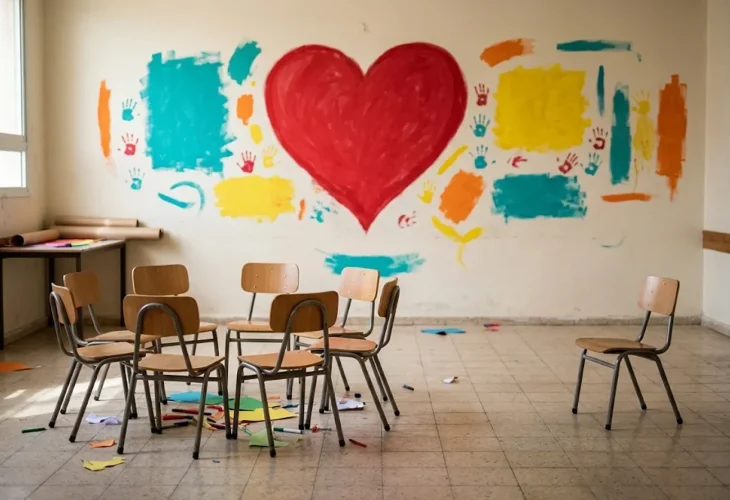
There's something almost magical about youth movement projects. Suddenly, everything comes alive. Children rush around, counselors barely sleep, walls fill with color, and youth movement branches echo with enthusiastic chants. For a moment, you can almost hear the heartbeat of an entire generation eager to change the world. And you know what? It's wonderful. Truly wonderful.
But amid all the noise, colors, and excitement, it's worth asking one simple question: What exactly is the world we're trying to change, and what will remain of that change once the activities are over?
After speaking with several concerned parents recently, I've realized that it's entirely possible to paint an enormous slogan about Ahavat Yisrael—love for one's fellow Jew—on a wall, while leaving one child excluded from the group that very evening. It's possible to shout that we're all brothers and sisters while laughing at someone's embarrassing photograph in a WhatsApp group. We can speak passionately about unity while quietly ostracizing the girl who isn't popular enough.
And we can generate tremendous excitement at two in the morning without giving a thought to the baby who has just been awakened, the elderly woman trying to sleep, or the neighbor who needs to get up for work. Instead, the entire neighborhood shakes with the sound of horns and drums loud enough to rival a departing airplane. When that happens, with all due respect to our lofty ideals, we've missed something fundamental.
The Lesson of Yaakov's Ladder
In the Torah portion of Parashat Vayetzei, Yaakov Avinu dreams of a ladder standing on the earth, its top reaching heaven. The Torah describes an unusual sight: "And behold, angels of God were ascending and descending upon it."
Why were the angels ascending before descending? Angels belong in heaven. Shouldn't they have come down first and only then gone back up?
Perhaps this detail contains a powerful educational lesson: Every great dream, even one that reaches the heavens, must begin on the ground—in the real world, with the person standing right in front of us. A ladder reaching heaven has little meaning if it isn't firmly planted on the earth. And a youth movement that dreams of transforming the entire world has little meaning if it cannot protect the dignity of a single child.
Consider another detail. Before Yaakov experiences this extraordinary vision, he takes some ordinary stones from the place where he is resting and places them beneath his head. Simple stones, nothing impressive. Yet it is precisely there that one of the Torah's greatest visions begins. Great changes don't necessarily begin with revolutions. Sometimes, they begin with a single stone.
Real Change Begins With Small Actions
Interestingly, scientific research offers a similar insight. In 2012, researchers Benjamin Gardner, Phillippa Lally, and Jane Wardle of University College London published an article in the British Journal of General Practice examining how habits are formed. They explained that developing new habits is best approached through small, manageable actions that can be repeated consistently. Simple behaviors tend to become habitual more easily than complex ones, while success with small changes can strengthen our sense of capability and encourage further progress.
Perhaps that's the most important message for this season of youth movement activities. If you want to start a revolution, begin with one child. Start with the boy who is always chosen last when teams are divided. Notice the girl who has begun to believe that she isn't smart enough or good enough because someone made sure to remind her of it. Offer her a kind word. Help her feel that she belongs.
Want to teach Ahavat Yisrael? Set aside the spectacular fire displays, impressive slogans, and thunderous cheers for a moment. Start by refusing to share a humiliating photograph. Don't laugh at a joke made at someone else's expense. Don't stand by silently while another child is being excluded or bullied.
Want to lift the spirits of your youth movement branch? Lift the self-esteem of someone who feels small. Want to fill the night with singing and excitement? Wonderful. Just remember that genuine joy shouldn't come at the expense of someone else's peace and quiet, and certainly not at the cost of depriving others of sleep.
Before Reaching for Heaven, Look Around You
The real measure of a successful youth movement project isn't how loud the cheering was, how impressive the decorations looked, or how many people joined in the excitement. It's how many people felt better about themselves because we were there.
Yaakov teaches us that heaven is a magnificent destination, but the path toward it begins right here on earth—with ordinary actions, simple kindness, and the people whose lives intersect with our own.
This year, alongside all our ambitious slogans, perhaps we should add one more: Before trying to reach heaven, make sure you're not stepping on anyone along the way.
Avinoam Hersh is an educator and founder of the parenting community "Mitbagrim B'Ahava" (Growing Up With Love).
 Raising ChildrenWhen a Good School Does Not Guarantee a Happy Child
 Raising ChildrenThe Hidden Pain Behind the Mask: What Every Parent Must Know About Children and Self-Worth
 Raising ChildrenWhen Your Child Acts Like a Bully: What It Means
 Raising Children“No One Notices the Quiet Child”: The Hidden Pain of Exclusion

