

History and Archaeology
The Forgotten Maccabee Victory: How Judah Defeated Nicanor on the Eve of Purim
Discover the dramatic story of Yom Nicanor, the ancient Jewish holiday commemorating Judah Maccabee's victory over a powerful Seleucid general who threatened to destroy Jerusalem and the Beit Hamikdash—and why the celebration eventually disappeared from the Jewish calendar
- Yosef Yaavetz
- | Updated
In 161 BCE, following the Maccabees' victories over the Seleucid forces, Demetrius, son of the former Seleucid king Seleucus IV, escaped from captivity in Rome. He had been held there as a hostage under the Treaty of Apamea, signed in 188 BCE, which required the Seleucid monarchy to provide guarantees of compliance with Rome.
Following his father's assassination, Demetrius had been denied his rightful place on the throne by his uncle, Antiochus IV Epiphanes. Mockingly nicknamed Epimanes, or "the madman," Antiochus became notorious for his persecution of the Jews, prohibiting Torah study, Shabbat observance, and circumcision. These decrees helped spark the Hasmonean revolt, which ultimately drove Seleucid forces from Jerusalem. Antiochus died in 164 BCE and was succeeded by his son, Antiochus V.
The Rise of Demetrius and the Threat to Jerusalem
After escaping Rome, Demetrius arrived in Tripoli, declared himself king, and ordered the execution of Antiochus V and his military commander. Among those who subsequently approached the new ruler was Alcimus, the Hellenized high priest of Judea, who complained that Judah Maccabee was forcing the population to observe Jewish law. In response, Demetrius appointed his general Nicanor as governor of Judea.
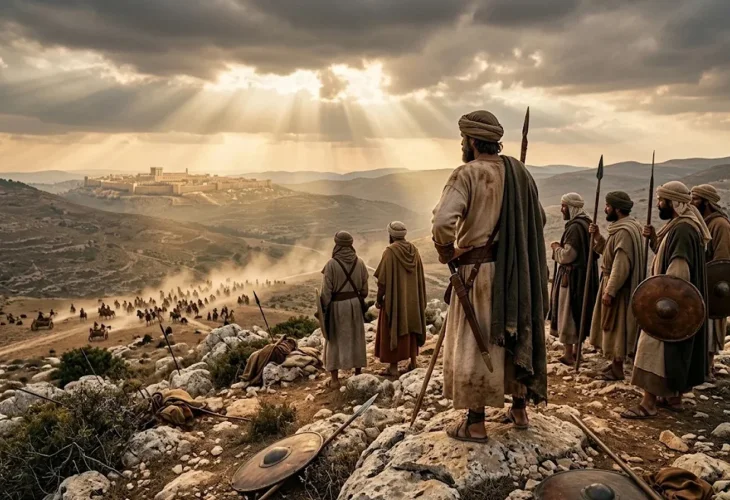
Nicanor arrived outside Jerusalem and requested a meeting with Judah Maccabee. Judah approached cautiously but spotted Greek soldiers lying in ambush. He immediately retreated behind the city gates, prompting Nicanor to threaten the destruction of Jerusalem and the Beit Hamikdash. Rather than attacking immediately, Nicanor withdrew to assemble his forces and await reinforcements.
On the 13th of Adar, he set out to meet thousands of Seleucid soldiers advancing toward Jerusalem through the steep ascent of Beit Choron, a historic passage near present-day Modi'in and Latrun. Recognizing that the narrow route offered an ideal opportunity for an ambush, Nicanor's troops remained on high alert. Yet they passed through the ascent without incident and reached the plateau near modern-day Atarot.
Judah Maccabee's Stunning Victory
According to the dramatic account of the battle, Judah Maccabee launched a surprise attack just as Nicanor's forces believed they had escaped danger. Before the general could issue a command, Judah struck him down with his own sword and turned against his officers.
Raising Nicanor's severed head, Judah cried out, "Who is like You among the mighty, Hashem?"
The familiar battle cry sent panic through the Seleucid ranks. As the soldiers attempted to flee, they encountered Judah's forces positioned around them. According to the account, the entire Seleucid force of 9,000 men was destroyed.
The victory became known as Yom Nicanor, the Day of Nicanor, and was commemorated in Megillat Ta'anit as a festive occasion on which fasting and eulogies were prohibited.
The Fate of the General Who Threatened the Temple
Judah and his men returned triumphantly to Jerusalem, carrying the spoils of battle. According to the account, Judah brought Nicanor's remains as a public demonstration of the enemy's defeat. When the Greek garrison recognized their commander's sword and severed head, its soldiers fled.
Judah also displayed the fingers of the hand Nicanor had raised in defiance against Jerusalem, symbolizing the downfall of the man who had threatened to destroy the Beit Hamikdash.
The account attributes to Judah a powerful declaration: "From the moment I heard him blaspheme and threaten the Beit Hamikdash, I swore in my heart: You will not destroy the Temple. The Temple will bring about your downfall."
Following the victory, Judah immersed himself in a mikveh to remove ritual impurity before the reading of Megillat Esther that evening, as Purim began.
Why Is Yom Nicanor No Longer Celebrated?
For generations, Yom Nicanor was observed as a day of celebration, commemorating the Hasmonean victory. Its significance was preserved in Megillat Ta'anit, which recorded occasions when fasting and mourning were prohibited in recognition of important events in Jewish history.
Following the destruction of the Second Beit Hamikdash, however, the Sages discontinued the obligatory observance of most of these commemorative days. Amid the tragedies of exile and national mourning, celebrations of earlier victories gradually faded from practice.
Although Yom Nicanor is no longer widely observed, its story preserves a remarkable chapter in the Hasmonean struggle: the defeat of a powerful Seleucid commander who threatened Jerusalem and the Beit Hamikdash, and the Jewish victory that was once celebrated on the eve of Purim.
 PurimPurim Made Simple: Understanding the Traditions, Readings, and Mitzvot
 History and ArchaeologyInside the Magnificent Palace of King Ahasuerus: A Journey Through History
 Torah Personalities"Find Yourself a Teacher": The Story of Rabbi Yehoshua ben Perachya
 History and ArchaeologyMordechai and Esther: Archaeological Echoes of the Purim Story

