

Personal Stories
A Bar Mitzvah Beyond the Ordinary: The Moving Story of Shimon Frenkel
Unable to wear his own tefillin, Shimon Frenkel inspires others to fulfill the mitzvah in his merit. His father shares a powerful journey of faith, parental devotion and finding joy amid life's greatest challenges.
- Michal Arieli
- | Updated
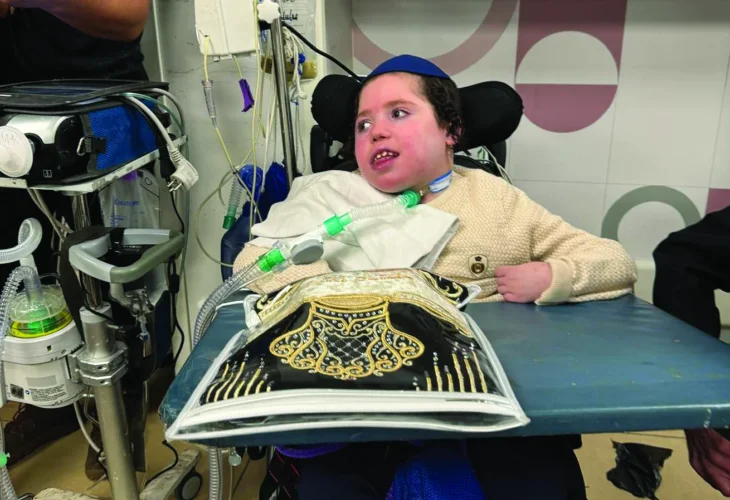
Tears of pain and emotion, but also of immense gratitude, were shed last week as Shimon Frenkel celebrated his bar mitzvah. The festive occasion had everything: an elaborate spread of refreshments, beautifully crafted tefillin, family members who had come to celebrate, and singers and musicians who filled the room with joy. Yet unlike other boys his age, Shimon did not dance or even rise from his chair.
For the past 11 years, Shimon has been living with a complex medical condition that requires him to use a wheelchair. He resides at ADI Jerusalem, a specialized residential care facility that has become his home. There, a dedicated team understands his needs, cares for him and accompanies him through both the everyday moments of his life and significant family milestones.
Life Is in Hashem’s Hands
“Shimon was born with a congenital heart defect,” recounts his father, Aharon David Frenkel. “We knew about the condition before he was born and consulted with doctors. They explained that he could live with it, but that he would need to undergo a series of three operations, the first of which would take place just three days after his birth. Naturally, we were extremely worried. However, as time passed following his birth, the doctors realized that Shimon was managing without the operation and told us that, for the time being, it could be postponed.”
Shimon was discharged from the hospital, and his brit milah took place on time. He grew and developed like any other baby, although his parents were required to bring him for medical examinations every few days to ensure that everything was functioning properly.
“After approximately six months, the doctors informed us that although we had avoided the first operation, it was now time for the second. They would also perform the corrective procedure originally intended for the first surgery. It was an extremely complex procedure for a six-month-old baby, but the greatest difficulty arose when, a day after the operation, the doctors noticed that Shimon was struggling to recover and could no longer breathe adequately on his own.”
Shimon was admitted to intensive care, where he remained for another six months. During that time, he required mechanical ventilation and underwent seven additional operations. For several days, he was also connected to an ECMO machine, and at one point, it appeared that his heart might never function properly again.
“Through tremendous miracles, the doctors eventually managed to stabilize his condition, and he finally returned home. Caring for him at home was not easy because he was cyanotic and required supplemental oxygen, but at least he was home. The doctors believed that, with time, he would no longer need oxygen, and we hoped that would happen soon. Instead, his condition gradually deteriorated, and he required oxygen continuously. We repeatedly consulted doctors, searching for anything that might help. Eventually, they concluded that the only way to save him was to repeat the entire series of operations.”
He would need to undergo all seven operations again?
“Yes. We were told that this was the only option. Initially, they proposed a 12-hour operation that would significantly improve his condition. It was extremely difficult for us to give our consent, but ultimately, we understood that there was no alternative and agreed to proceed.”
It was at this point that the story took a devastating turn.
“The day before the operation, we arrived at the hospital. The medical team prepared us and explained that we needed to return at six the following morning so that Shimon could undergo blood tests, followed by cardiac catheterization and surgery. We arrived on time, but just minutes after his blood tests, he lost consciousness. Instead of taking him into surgery, the doctors began resuscitating him.
“It took approximately half an hour for his pulse to return. Throughout that time, we were being prepared for the possibility that they would not be able to save him. Thank God, after tremendous efforts, his heartbeat returned. However, because his brain had been deprived of oxygen, Shimon suffered a stroke. At the time, we did not yet understand the extent of the damage. He remained hospitalized for several months and underwent the necessary operations that saved his heart, but the neurological damage could not be reversed.”
Do you ever wonder what might have happened if the doctors had operated earlier and perhaps prevented the damage?
“No, such thoughts have never crossed our minds,” Frenkel responds firmly. “We are people of faith, and we believe that what happened was what was meant to happen. We did everything that was required of us and consulted both doctors and rabbis at every stage. We never entertained thoughts about what might have happened had we acted differently.
“However, there is no doubt that Shimon has given me an entirely different perspective on life. We were always people of faith and knew that everything comes from Above, but through him, we learned that life does not necessarily unfold according to our plans. There is One Above who makes those decisions.”
How do you move forward after something like that?
“The first thing we had to do was make a decision regarding Shimon’s care. After several months, the hospital explained that he was medically stable and no longer needed to remain hospitalized. However, because of his complex medical needs, he could not be cared for at home either. We consulted physicians and community advocates until someone suggested placing him in a specialized residential facility called ADI Jerusalem, which at the time was known as ALEH.”
Shimon was two years old when he first arrived at ADI. For his parents, the transition was heartbreaking.
“I must admit that it was not easy for us at all,” his father recalls. “I remember the first day my wife and I arrived there. Neither of us felt capable of leaving our child behind and walking away. The staff understood us completely. They listened compassionately and told us, ‘This child is yours. Although he will be living here, you can come whenever you wish. Our doors are open 24 hours a day, seven days a week.’
“They brought him into his room, and we sat beside his bed. My first thought was, ‘We will stay here and never leave. He is our son. How can we possibly leave him?’ After several hours, we realized that we had no choice. We left with many tears and tremendous pain, but with the understanding that this was what needed to be done. Toward evening, we returned so that he would not be alone on his first night. We came again the following day, and for a long time, we hardly left his side.”
As time passed, the Frenkels witnessed the genuine affection and devotion of the staff and gradually allowed themselves to visit less frequently. Nevertheless, not a single day passed without a visit until the COVID-19 pandemic made in-person visits impossible. During that period, they maintained daily telephone contact, resuming their regular visits as soon as restrictions permitted.
“In addition to our visits during the week, we come every Shabbat. Shimon is so happy when people visit him. You can see it in his enormous smile and through the eye-tracking system he uses to communicate.
“Anyone who comes to ADI today and sits beside Shimon can sense what a precious soul he is,” his father continues. “Unfortunately, he cannot eat orally, speak or walk. Despite everything, he always has a smile on his face. He is alert and aware of everything happening around him, and what is particularly moving is seeing how the staff enables him to participate in ordinary childhood experiences. Together with other children with similar needs, he attends classroom lessons every morning, prays with the children, participates in various activities and enjoys the simple experiences of everyday life.”
Frenkel says that he is often amazed by the thoughtfulness of the staff. “Just a few days after Shimon arrived at ADI, I came to visit him and noticed a note beside his bed. It explained that when Shimon moved his eyes in a certain way, it meant that he was happy, and when he made a particular movement with his mouth, it meant that he wanted something. Later, when the staff realized that Yiddish was the language spoken in our home, they began learning important words in Yiddish themselves and brought him recordings and songs in the language.”
One particularly moving experience remains etched in his memory. “One day, I arrived to visit Shimon and saw one of his caregivers standing beside his bed, dressed in a wedding gown. It turned out that it was her wedding day, and she had felt a special need to come before her chuppah to receive a blessing from Shimon. It was incredibly moving and gave me chills.”
How did you celebrate Shimon’s bar mitzvah?
“When the staff at ADI contacted us and said that they wanted to organize a bar mitzvah for Shimon, I responded enthusiastically. I told them that I wanted to celebrate as well, but that I felt the bar mitzvah should take place within the facility itself, because this is Shimon’s home. This is where he has grown up.”
The celebration was indeed held at ADI. Frenkel’s wife and daughters prepared the entire meal and refreshments themselves, as it was important to the family to feel that this was their own simcha. They arrived with all their children, brought musicians and celebrated together with Shimon and the dedicated staff.
When Frenkel was invited to speak, he shared what was in his heart. “I spoke about how we have been accompanying Shimon at ADI for 11 years, and how every time I arrive here, I feel as though I am entering the Diamond Exchange in Tel Aviv. Just as there is a security guard at the entrance to the Diamond Exchange who checks everyone who enters, and not everyone is permitted inside, this too is a very special place. The children here are extraordinary diamonds who have come into this world with a unique mission.
“Occasionally, wealthy individuals come to examine particularly precious diamonds. They are permitted to see them up close, but only within the exchange itself, because these are not diamonds that are ordinarily displayed in shops. Every child here is a diamond, and Hashem has handpicked the people who work here because they must know how to care for children who are so precious and sensitive.”
The Tefillin That Are Waiting for Shimon
As preparations for the bar mitzvah began, Frenkel knew that he wanted to purchase tefillin for Shimon, just as he had done for his four older sons. At the same time, he understood that Shimon would be unable to wear them, as his medical circumstances did not permit him to do so according to halacha.
“Nevertheless, I invested more than NIS 15,000 in purchasing exceptionally beautiful, high-quality tefillin, written by a God-fearing sofer. I also purchased an elegant tefillin bag with Shimon’s name embroidered on it. We brought the tefillin to his bar mitzvah celebration, and it was evident how happy he was.”
After the celebration, Frenkel brought the tefillin to his community synagogue and attached a note explaining that anyone who had forgotten their tefillin or needed a pair for any reason was welcome to use Shimon’s tefillin and pray that the mitzvah would serve as a merit for him.
Did you tell Shimon about this?
“Yes, of course. I told him, and I saw a tear in his eyes. I am certain that he was moved and happy to hear about it. I believe that the day will come when we merit the complete redemption, and Shimon, together with all the children alongside him, will regain their abilities and be able to do the things that other children do.
“Until then, his tefillin are waiting for him.”
 Personal Stories“When the Sky Falls, Heaven Comes Closer”: A Mother’s Journey Raising a Child With Special Needs
 Personal StoriesRotem Cohen Shares the Incredible Story That Led Him Back to Tefillin
 Personal StoriesOne Small Act of Kindness: The Calendar That Changed Everything
 Personal StoriesThe Lost Tefillin That Miraculously Found Their Way Home

