

Personal Stories
“When the Sky Falls, Heaven Comes Closer”: A Mother’s Journey Raising a Child With Special Needs
After doctors warned that her newborn son might not survive, Malky Barber faced years of medical challenges. Thirteen years later, she shares how raising Shuki transformed her understanding of faith, motherhood, and the blessings hidden within life's greatest struggles.
- Michal Arieli
- | Updated
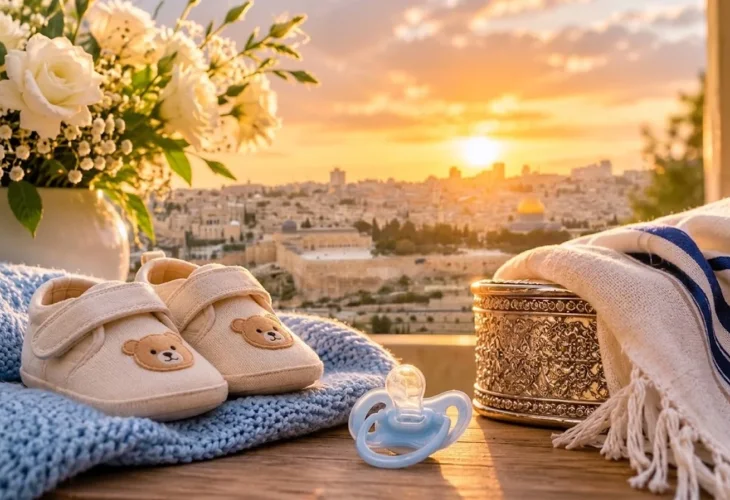
“I will never forget that moment in the hospital, thirteen and a half years ago,” begins Malky Barber, mother of 13-year-old Shuki. “In an instant, I felt as though the sky was falling. Our Shuki had just been born, and already in the delivery room, it was clear that something was terribly wrong. He was missing an ear, had skin tags on his face, and doctors warned that he might be unable to see or hear. There were numerous other medical complications as well.
“I felt as though my entire life had come to a standstill. Shuki was my first child, born when I was 37. I hadn't expected to have a child with special needs. During the pregnancy, we had been told there might be a heart defect, but nothing beyond that. Before we could even begin to process what was happening, Shuki was admitted to the neonatal intensive care unit, and doctors warned us that he might not survive the night.”
Malky pauses, reflecting on the journey her family has traveled since then. “Shuki still has special needs, but he is unquestionably the light of our home,” she says. “Three years ago, when I was 47, we welcomed another son, Yossi, who has been the greatest gift Shuki could have received. Alongside raising my two children, I've earned a master's degree, become an art therapist, and taken on numerous other projects. My life didn't stop. In many ways, I've grown and developed because of my children.”
A Challenge That Became a Privilege
“I'm not denying reality, and I have no intention of pretending that life has been perfect,” Malky emphasizes. “But we are people of faith, and from the beginning, we believed that nothing happens without a reason. Shuki was meant to enter the world at precisely that moment and become part of our family.
“The Chazon Ish said, ‘There is no sadness in the world for one who recognizes the light of truth.’ I've met other parents of children with special needs and seen how faith can help people cope with their pain and uncertainty. Believing that we're part of a larger Divine plan gives me strength. That doesn't mean those first moments weren't devastating. When we discovered that our firstborn had significant disabilities, it felt as though an entire building had collapsed on top of us. You don't recover from something like that overnight.”
What were the first weeks after Shuki's birth like? Were you able to establish any kind of routine?
“Not at all. Shuki remained hospitalized for a long time, and his bris took place in the hospital under medical supervision. A month later, we held his pidyon haben, the traditional redemption ceremony for a firstborn son, in an elegant hall in Bnei Brak. We knew that just two days later, he would undergo extremely complicated heart surgery, and the doctors had already warned us that he might not survive.
“The contrast was overwhelming. There we were, celebrating with a beautifully dressed baby while privately carrying the knowledge of what awaited him. We chose not to tell anyone. But every time someone offered a blessing or good wish, we answered ‘Amen’ with all our hearts, desperately hoping everything would turn out well.”
Malky remembers an encounter with a nurse before Shuki's surgery that profoundly changed her perspective. “Shuki was just one month old when a nurse told me, ‘Prepare him for what's about to happen.’ I didn't understand what she meant, especially because the doctors had advised us not to become too attached, given his poor chances of survival. Nevertheless, I approached him and began speaking to him. That was the first time I truly understood that beyond his limited physical body, he had a soul. When I spoke to him, I was speaking to that soul.”
Determined to communicate with her son despite his disabilities, Malky began looking for ways to make her presence known. “A friend had given me perfume as a gift after the birth. Since the doctors suspected Shuki might be unable to see or hear, I decided to wear that perfume every time I entered the neonatal unit. I thought to myself, ‘He can certainly smell. This way, he'll recognize my scent and know that his mother has arrived.’”
“We named him Yehoshua, following the instructions of our Rebbe. He told us that his father, the previous Rebbe, had always recommended giving children with special needs the name Yehoshua, and he blessed us that we should experience great salvations through him. Sometimes I wonder who Shuki's soul might have been in a previous lifetime. Perhaps he was Yehoshua bin Nun, or the great Torah scholar known as the Pnei Yehoshua. Whatever the case, I feel privileged to have been entrusted with raising him.”
Finding Meaning in the Hospital
Eventually, Shuki was discharged, but life at home was far from ordinary. “During the first three years of Shuki's life, we spent more time in the hospital than at home,” Malky recalls. “My husband used to joke that we should be paying municipal taxes to the hospital. We even had a regular room, which we laughingly called our hotel suite with an ocean view.”
Looking back, Malky can hardly remember a Jewish holiday, apart from Pesach, that the family did not spend in the hospital. Yet those experiences also became opportunities to bring joy to others. “On Sukkot, my husband built a sukkah, complete with decorations, refreshments, and a festive atmosphere. On Shavuot, we organized a large dairy kiddush. Patients from different departments would gather, each carrying their own struggles, and spend an hour and a half sitting together, talking and enjoying the holiday. Those moments made us wonder whether perhaps we had been brought there specifically to brighten the lives of others.”
How did people respond when they met Shuki?
“We heard all kinds of comments, from ‘You've been chosen and blessed’ to ‘What's wrong with him? Have you tried this treatment?’ It's difficult for me to tell people what they should say to parents of children with special needs, because almost anything can be received the wrong way. But I can share the response we received from our Rebbe, the Bobover Rebbe.
“My husband called him on the eve of Shuki's bris and, like a child crying to his father, poured out everything we were going through. The Rebbe didn't interrupt or offer explanations. Every so often, we could hear him sighing, ‘Oy, oy, oy.’ After twenty minutes, he finally said in Yiddish, ‘I don't know what to say.’ Then he repeated, ‘I truly don't know. All I can do is bless you, in the merit of my holy ancestors, that you should have the strength to endure all of this.’
“He didn't tell us that Shuki had an exceptionally elevated soul or promise that we would eventually witness extraordinary things. He simply blessed us with strength. To this day, I feel that we continue to draw strength from that blessing.”
Another source of encouragement came from Malky's aunt, Rebbetzin Nechama Walles, who devoted herself to caring for her husband after he suffered a severe injury. “My aunt and uncle never had children, and her husband was her entire world. He was a tremendous Torah scholar and a study partner of Rabbi Shmuel Auerbach, who continued learning with him even after his injury.
“One day, Rabbi Auerbach came to visit, and my aunt apologized for the tissues scattered on the floor, which she had used while caring for her husband. Rabbi Auerbach told her, ‘These aren't dirty tissues. They're valuable securities. When you stand before the Heavenly Court, these are the papers you'll bring before Hashem.’
“Those words give me chills every time I remember them. Caring for a thirteen-and-a-half-year-old child isn't easy. Feeding him, cleaning him, changing him—these are physically and emotionally demanding tasks. But I constantly remind myself of those ‘valuable securities.’ One day, my husband and I will stand before the Heavenly Court carrying precisely those moments of devotion.”
The Gift of an Ordinary Homecoming
Ten years after Shuki's birth, the Barber family welcomed another child. “We felt the magnitude of the gift even before Yossi was born,” Malky says. “Every normal milestone during the pregnancy brought tremendous relief. The delivery went smoothly, and suddenly I began to understand what it feels like to give birth to a healthy baby. No neonatal intensive care unit, no medical crisis—just the ordinary experience of keeping your baby beside you.
“The most emotional moment was leaving the hospital. I don't think most mothers realize what an extraordinary privilege it is to place your three-day-old baby into a car seat and simply go home. No unusual medical instructions, no consultations or complicated discharge plans. Just home. People traditionally bless a new mother that she should leave the hospital with full arms and a happy heart. This time, I felt the meaning of every word.”
What is Shuki's life like today?
“Shuki has a very structured daily routine, and he loves it. He even gets upset when there's a day off and the school transportation doesn't arrive as usual. He wakes up smiling, and I get him ready, comb his long ponytail—which we've chosen to keep—and send him off to school. When he comes home in the afternoon, the first thing he does is search every room for Yossi. He's incredibly attached to his little brother. I spend time playing with both of them, building towers and playing with blocks, trying not to think about what other children his age are doing.
“Mealtimes can be particularly challenging. Feeding a thirteen-year-old child one bite at a time is no simple task, and the kitchen often looks like a battlefield afterward. By the time I put him to bed, I'm completely exhausted. Yet I love him with all my heart and cannot imagine life without him.”
Shuki has been diagnosed with moderate to severe intellectual disability, but Malky says he sometimes surprises the family with his abilities. “Just this morning, I asked him to take some clothes and put them in the laundry basket in the bathroom. I was astonished when he completed the entire task perfectly.
“Other times, the simplest requests seem impossible. Once, while changing him, I asked him to hand me the baby wipes. He nodded but didn't move. I had a fractured ankle at the time, so getting up was extremely painful. I asked again, and he handed me a hairbrush instead. I kept repeating ‘Wipes, Shuki, wipes!’ exaggerating my lip movements, but nothing helped. It was incredibly frustrating.”
During difficult moments, Malky takes comfort in knowing that Shuki is loved and, in her eyes, content. “He has a sweet, charming personality, and his needs, including his emotional needs, are generally met. He also doesn't spend his life worrying about things beyond his control. He doesn't follow the news, use a computer, or have a cellphone. Perhaps that's part of what allows him to remain so peaceful.”
Shuki also has significant hearing loss. One ear is almost entirely absent, while the other has severe hearing impairment. For years, his parents tried various hearing aids, but he consistently refused to wear them.
“Eventually, we stopped trying and wondered whether perhaps he simply didn't want to hear. I began thinking that maybe, on some spiritual level, his soul doesn't want to hear lashon hara or gossip. Shuki also doesn't speak, and I find it moving to think that he has never uttered a single word of lashon hara in his life.
“Even during the war, when sirens sounded, he remained completely calm because he couldn't hear them. He was simply delighted whenever the family gathered in his bedroom, which also serves as our reinforced safe room.”
Were you able to continue your professional studies while raising Shuki?
“Absolutely. I earned my master's degree during Shuki's hospitalizations, and in the years that followed, I continued attending classes and pursuing professional development. My husband or a babysitter would stay with the children while I went out to study. We debated those arrangements more than once, but today I know how important it was for all of us that I continued building my own life alongside caring for my family.”
For Malky, the years since Shuki's birth have brought challenges she could never have anticipated, along with a new understanding of her relationship with Hashem.
“Over the years, I've realized how accurate the expression ‘the sky is falling’ really is. That's exactly how it feels when you're suddenly confronted with the reality that your child has significant disabilities. But I've also learned something else. When the sky falls, it actually comes closer to you.
“And that's an opportunity worth recognizing, because sometimes, in the midst of life's greatest challenges, you discover that Hashem is closer to you than ever before.”
 Personal Stories“Hashem Sent Us Diamonds”: A Mother Raising Four Children With Special Needs Shares Her Story
 MagazineRaising a Daughter With Down Syndrome: One Family’s Story
 Personal StoriesDiagnosed With Cancer Days After Giving Birth: One Mother’s Story of Faith and Hope
 Personal Stories“Mom, Is That You?”: The October 7 Journey That Changed Everything

