 עברית
עברית

Secrets of the Annona: The Health Benefits of Annona Fruit
Annona: A very delicious, exotic-tropical fruit with exceptionally high nutritional value. However, if you try chewing its seeds, you'll discover they contain a toxic substance. Everything you wanted to know about the Annona fruit.
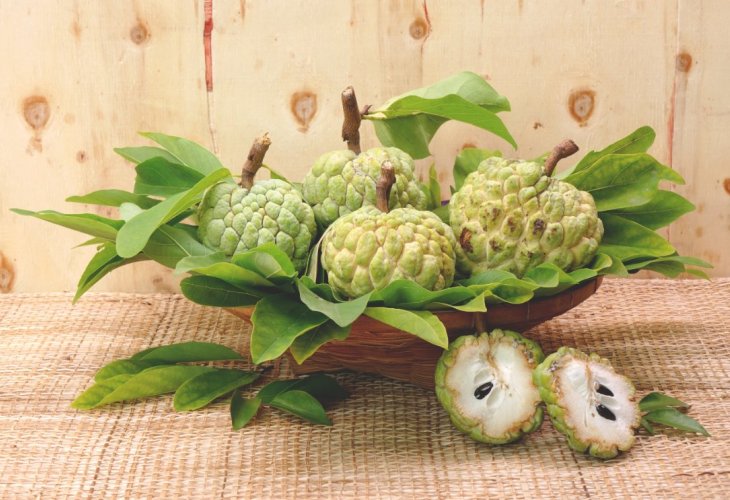 Annona
In the autumn season, the Annona fruit joins us – one of my most loved fruits. It is a particularly sweet fruit, with a very pleasant texture to eat. It is an exotic-tropical fruit with a particularly alluring and intriguing appearance. The edible part is the inner white flesh from which the black seeds need to be separated and removed.
Beyond its delightful taste, the nutritional value of the Annona fruit is exceptionally high, especially in vitamins B, C, potassium, calcium, and magnesium. A small fruit weighing about 100 grams has about 94 calories, 1 gram of protein, and 0.5 grams of fat.
The Annona tree belongs to the Annonaceae family. The Annona (with its 100 varieties) can be found in many areas worldwide – Peru, Brazil, the Bahamas, Bermuda, Africa, India, South Florida, and of course, Israel. The tree is a deciduous tropical type, standing bare in the winter season. Its height ranges from 3 to 6 meters.
The best growing conditions for the Annona tree are in a warm and humid tropical climate. The tree can withstand drought conditions but will suffer significantly in frosty conditions.
It is quite easy to germinate an Annona tree for personal growing purposes using the seeds found inside the fruit – within about a month, you can observe the young sprout that has awakened to life.
It is recommended to plant the Annona in the spring. During the tree's growth process, it is highly recommended to prune its branches during the first three years of its life to support its development and strength. After the first years, it is advisable to continue pruning once a year in spring.
Warning – Do Not Chew the Seeds
The Annona tree begins to bloom in the months of June and July, and until September-October, its fruits fully develop.
In Israel, Annona of a hybrid variety is grown. Most of the Annona orchards in the country are currently located in the coastal plains, where the growing conditions (and humidity) are the most suitable. It is possible to grow the Annona tree in other areas of the country, although its main sensitivity is to frosty conditions, as already mentioned.
After the fruit is picked, it can be kept outside the refrigerator for two to three days until it softens and fully ripens, at which point it is at its juiciest stage for eating. It is not advisable to wait for the fruit to turn black, which occurs quickly, leading to fermentation and decay.
An unripe fruit before softening is very rich in tannins and is not suitable for use and consumption. Therefore, if purchasing a larger quantity, it is recommended to store some of the fruits in the refrigerator for up to two weeks and take out the desired quantity for ripening periodically.
From the young leaves of the tree, a wonderfully scented oil can be distilled, primarily used in the perfume industry. The fruit’s seeds, on the other hand, are not recommended to chew or eat – they contain a significant amount of toxic substance.
In conclusion, a wonderfully creative recipe idea that can be made from the Annona fruit. Ingredients: three Annonas, two bananas, and one mango. Blend the fruits in a blender, creating an interesting texture reminiscent of ice cream with a special tropical flavor.

