

History and Archaeology
The Mystery of Mount Hor: Where Was Aaron Buried?
From Petra to the Negev, scholars have long searched for the true location of Mount Hor. Here's what the Torah, Jewish tradition, and archaeology have to say.
- Yehosef Yaavetz
- | Updated
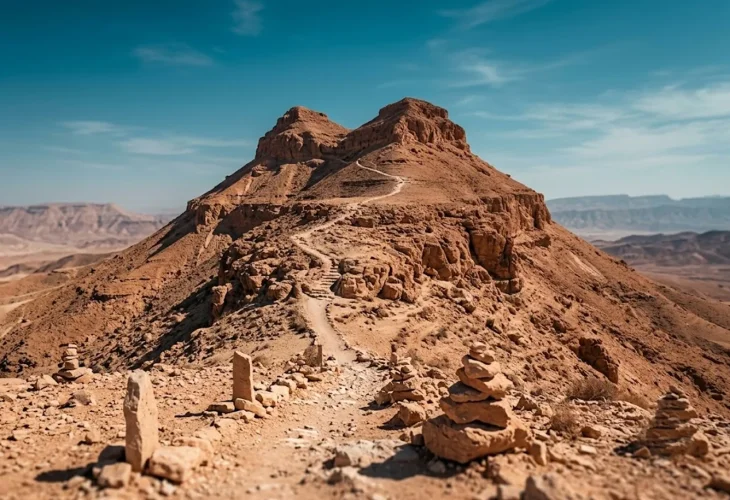
The exact location of Mount Hor, the burial place of Aaron the High Priest, has fascinated scholars, archaeologists, and Bible students for generations. Although the Torah appears to provide several clues about its location, identifying the mountain has proven far more challenging than it might seem. Over the centuries, a number of different sites have been proposed, each supported by historical traditions or geographical evidence.
A Mountain Upon a Mountain
The Torah describes Hor HaHar as being on the border of the land of Edom, after Kadesh and near Tzalmonah and Punon, where the Israelites later continued their journey. Its very name, Hor HaHar, literally means "mountain upon a mountain," suggesting a distinctive geographical formation.
Another clue comes from what appears to be a contradiction in the Torah. One passage says that Aaron died at Hor HaHar, while another states that he died at Moserah.
Rabbi David Tzvi Hoffmann offers a straightforward explanation. He writes that Moserah was the name of the Israelite encampment. Since the people camped at the foot of the mountain rather than on its summit, Aaron's death could be associated with Moserah, while his burial took place on nearby Hor HaHar.
This provides another important clue: Hor HaHar stood close to an encampment called Moserah.
The Traditional Identification
The best-known identification of Hor HaHar is Jabal Harun, or "Aaron's Mountain," located west of Petra in present-day Jordan. The mountain is crowned by a white shrine that has long been associated with Aaron's burial place.
This tradition dates back at least to the first century. In Antiquities of the Jews, the Jewish historian Josephus describes Aaron ascending a mountain near Petra, where he removed his priestly garments, passed them on to his son Eleazar, and died before the eyes of the nation.
During the Byzantine period, this tradition became even more firmly established. Eusebius of Caesarea also identified the mountain near Petra as Aaron's burial place and recorded local traditions connected with the site.
Although archaeological excavations have uncovered evidence of centuries of pilgrimage, they have not revealed a tomb or remains that can be identified as Aaron's burial place.
Could Mount Hor Be in Israel?
Despite the long-standing tradition surrounding Petra, some researchers believe the biblical description points elsewhere.
The Petra region does not lie close to several of the locations mentioned in the Torah in connection with Aaron's final journey. If Kadesh is identified with Ein Qudeirat, a more likely candidate may be Jabal Madarah, located south of Makhtesh HaGadol (the Great Crater) and Nahal Tzin, along the route leading from Kadesh toward the Arava.
Nearby is a stream known as Wadi Haruniya, meaning "Aaron's Stream," while the surrounding area is called Al Madarah. Some scholars suggest these names may preserve the ancient name Moserah. Archaeological remains identified with Tzalmonah and Punon have also been discovered nearby.
If this identification is correct, Aaron's burial place may actually lie within the borders of present-day Israel, near the ancient southern frontier that crossed the Negev.
Another Mount Hor
Interestingly, the Torah mentions another Hor HaHar in an entirely different context.
When describing the northern border of the Land of Israel in Numbers 34, the Torah states: "From the Great Sea you shall mark out Hor HaHar; from Hor HaHar you shall mark out the entrance to Hamath."
According to Rashi, this is not the same mountain where Aaron was buried. Rather, it marks the northwestern corner of the Land of Israel, where a mountain ridge extends into the Mediterranean Sea.
Many identify this location with Rosh HaNikra. Known in the writings of the Sages as Sulam Tzur, its dramatic white cliffs descend directly into the sea. In ancient times, travelers crossed the ridge using ladders or carved stone steps, and in modern times a railway tunnel was cut through the rock.
This unique formation closely matches the Torah's description and suggests that the name Hor HaHar may have referred to mountains with this distinctive appearance.
The Sages also refer to this northern mountain as Turei Amnon. Some commentators connect it with the verse in Shir HaShirim, "Come with me from Lebanon, my bride... look from the top of Amanah."
According to this interpretation, the verse describes a breathtaking view from the heights overlooking the Land of Israel. In that sense, there is a beautiful parallel between the two Mount Hors. The southern Hor HaHar overlooks the land from the south, while the northern Hor HaHar offers a sweeping view from the north, each serving as a symbolic gateway to the Promised Land.

