

Israel News
Netanyahu Calls Trump ‘Senior Partner’ as Iran Options Remain Open
Prime minister says diplomacy, continued pressure and military action were all discussed, while denying he urged Trump to resume strikes
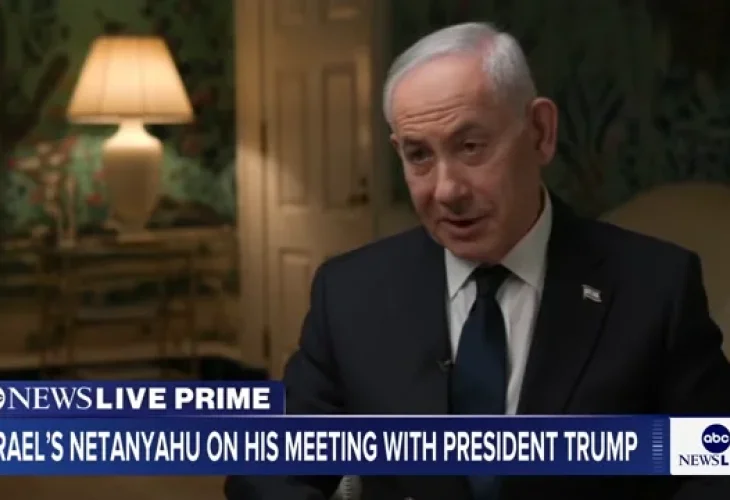 Screenshot/Youtube
Prime Minister Benjamin Netanyahu described US President Donald Trump as the “senior partner” in the US-Israel relationship while insisting that he remains responsible for defending Israel’s security interests.
“The truth is, we’re partners. We’re allies. He’s the senior partner. It’s the United States of America, let’s not forget. And I’m the junior partner,” Netanyahu told ABC News in an interview aired Wednesday. “When I have to stand up for the interests of my country and the security of my country, I do so.”
The comments came one day after Netanyahu met Trump at the White House to discuss the war with Iran and the possibility of returning to negotiations. Netanyahu rejected the portrayal that he had traveled to Washington primarily to persuade the president to resume American attacks.
“Actually not. That’s the caricature or the cartoon picture. That is not true,” he said.
Netanyahu said the two leaders openly examined three possible paths: reaching a diplomatic agreement, maintaining the blockade and other forms of pressure, or taking further military action.
“Anything that will produce the end of Iran’s nuclear program is what we want. That’s our common goal,” he said.
Netanyahu stressed that the decision over the next American step belonged to Trump.
“It’s his decision. It’s his decision,” he said.
Trump has said that Iran wants to reach an agreement, but Netanyahu expressed doubt that Iran would honor any diplomatic arrangement. He accused the Iranian leadership of repeatedly deceiving foreign governments and using negotiations to delay outside action.
“They always lie, they always cheat, and they always play for time,” Netanyahu said.
However, he did not reject further talks. Asked whether sustained diplomatic and economic pressure could change Iran’s conduct, Netanyahu responded: “Give it a try.”
Netanyahu also said his central objective was preventing Iran from acquiring nuclear weapons, rather than directly removing its government. He argued that military and economic pressure could weaken the regime but said political change would ultimately depend on Iranians themselves.
“It’s up to the people of Iran, in the end, to take their own destiny into their own hands,” he said.
Netanyahu acknowledged that the Iranian government remained in power despite months of war, although he claimed it had been weakened. He nevertheless predicted that the widening divide between the government and the Iranian public would eventually lead to its collapse.
“I think this regime will eventually fall,” he said.
The prime minister was also questioned about Vice President JD Vance’s assertion that people within Israel’s governmental system were attempting to influence American public opinion to keep the war going.
Netanyahu said he had spoken with Vance earlier Wednesday and believed they had resolved the disagreement. He separated the views of individuals within Israel’s system from his government’s official position.
“Individuals in our system can have their opinions, but government policy is dictated by me. And that’s not our policy,” he said.
The interview also addressed declining American support for Israel’s government. Davis cited a Pew Research Center survey showing that 32% of Americans viewed the Israeli government favorably, down 15 percentage points from 2022.
Netanyahu said the trend concerned him and blamed foreign manipulation on social media, bot networks and what he described as false portrayals of Israel’s war against Hamas terrorists in Gaza.
“Does it concern me? Yes. Yes, it does,” he said, adding that bipartisan American support for Israel remained a fundamental part of the country’s national security.
Netanyahu and Trump continue to publicly agree that Iran must not obtain nuclear weapons. However, their White House meeting produced no announced decision on whether the United States would pursue another diplomatic effort, maintain economic and military pressure or resume major attacks.
Asked how Israel would react if Iran struck the country again, Netanyahu warned that Tehran would face a severe response.
“They’ll make a terrible mistake, and we’ll respond very, very forcefully,” he said.

