

History and Archaeology
The Jewish Traveler Who Became Vasco da Gama’s Trusted Adviser
Captured by pirates and later recruited by Vasco da Gama, Jewish traveler Gaspar da Gama became an invaluable interpreter, adviser, and guide during Portugal’s voyages to India.
- Yehosef Yavetz
- | Updated
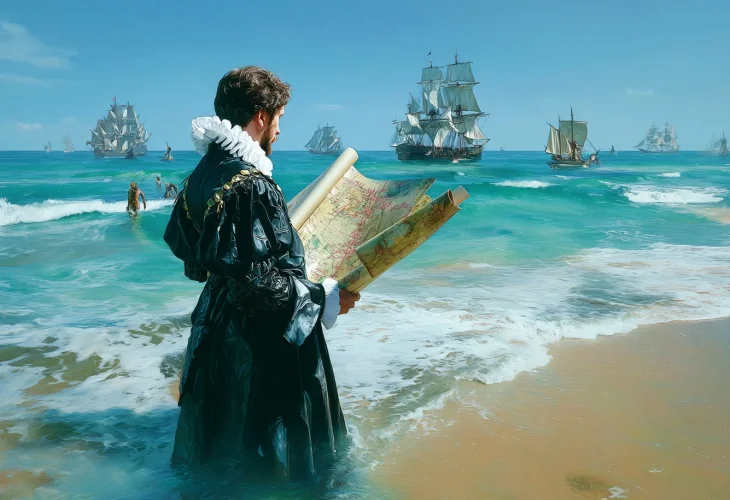
In 1498, the fleet of famed Portuguese explorer Vasco da Gama reached India. As he sailed from southwestern India toward Africa, his ships stopped near the island of Anjediva, close to Goa, for repairs and supplies.
The island was inhabited by local people who spoke various Indian dialects. As a crowd gathered on the shore to watch the unfamiliar ships, one man stood out. European in appearance and dressed in an expensive suit, he stepped forward and addressed the Portuguese travelers in Italian, speaking in a Venetian dialect.
Da Gama’s sailors were stunned. At a place that, from their European perspective, seemed like the end of the world, they had unexpectedly encountered a man who appeared to be European and spoke a language they understood.
The stranger introduced himself as Gaspar. He began trying to persuade the Portuguese to cooperate with the ruler of Goa and establish commercial relations with him. But da Gama’s men soon noticed something suspicious. Gaspar’s eyes seemed to be scanning everything around him. He appeared to be studying the routes of access to the ships, noting the location of the weapons and observing the different roles of the crew members.
They suspected that Gaspar had actually been sent to spy on behalf of Goa’s ruler, who was planning to seize the Portuguese ships and take their valuable cargo.
After a brief interrogation, Gaspar admitted that he had indeed been sent by the ruler of Goa to gather information. But he made it clear that his loyalty was flexible. He was willing to switch sides, and he had something extraordinarily valuable to offer the Portuguese: knowledge.
The Mysterious Jewish Traveler From Poland
Gaspar knew India’s ports, merchants, local rulers, Arab and Gujarati trade brokers, monsoon winds, and sea routes. As was said of Jethro, “and you shall be our eyes,” Gaspar was chosen to become the eyes of Vasco da Gama’s Portuguese fleet.
On October 5, 1498, Gaspar sailed away with the Portuguese, leaving his son Balthazar behind in Goa.
But Gaspar was not originally from India. He had been born in Poznań, Poland, in 1444. Under circumstances that remain unclear, his family emigrated to Alexandria. From there, he traveled among the ports of the world, gaining extensive knowledge and experience and learning several languages.
While traveling through Arab lands, Gaspar was captured by pirates and sentenced to slavery. Thanks to his resourcefulness and experience, however, he managed to escape and board a ship bound for Goa, India.
There, he eventually became the ruler of Goa’s right-hand man on matters involving ships and ports.
When Gaspar encountered the Portuguese fleet, he was forced to conceal his Jewish identity because the Inquisition ruled Portugal during those years. He eventually received the name Gaspar da Gama after his patron, Vasco da Gama.
Upon arriving in Lisbon, da Gama introduced Gaspar to King Manuel I of Portugal. The king recognized his value and granted him a fixed annual allowance of 50,000 reis, an enormous sum at the time.
The Man Who Taught Portugal How India Worked
Gaspar’s importance to Portugal was highly practical. The Portuguese had succeeded in reaching India, but reaching the country and understanding how to operate there were two very different things.
On their first voyage, the Portuguese brought goods that failed to impress local merchants and rulers. Gaspar helped them understand why. India was not a poor market waiting for European products. It was home to a wealthy and sophisticated trading system that required precious metals, high-quality fabrics, diplomatic gifts, an understanding of political alliances, and the appropriate diplomatic language.
In effect, Gaspar provided the Portuguese with a human map of India’s commercial world, giving them knowledge that geographical maps alone could never provide.
In 1500, Gaspar joined the fleet of Pedro Álvares Cabral, the second major Portuguese fleet sent to India. For the first time, he officially served as an interpreter and adviser. He translated letters into Arabic, participated in delegations that went ashore, and helped facilitate contacts with rulers and merchants.
That same voyage would unexpectedly take Gaspar to another part of the world entirely.
Cabral’s fleet reached the coast of Brazil. A letter written by Pero Vaz de Caminha on May 1, 1500, is considered the first document describing the land and its inhabitants for Portugal’s King Manuel I. It became a primary historical document recording the first encounter with the New World and the first European description of the land where Brazil would later emerge.
Gaspar was among the fleet members involved in the first contacts with the local people. He and Nicolau Coelho were the first two white men to set foot on Brazil’s shore. Gaspar did not know the language of the local population, but his experience allowed him to communicate through signs, gestures, and the exchange of objects.
From Brazil Back to the Indian Ocean
After Brazil, Cabral’s fleet continued to India, returning Gaspar to the region he knew best: the Indian Ocean.
He became involved in contacts with Calicut, Cochin, and Cannanore. His previous connections in the region proved extremely useful during Cabral’s first meeting with the Zamorin, the ruler of Calicut, and in the establishment of Portuguese relations with Cannanore and Cochin.
Relations with Calicut, however, quickly deteriorated. Local merchants and groups hostile to the Portuguese opposed the establishment of a permanent Portuguese presence. The Portuguese trading post in the city was later attacked, prompting the fleet to begin working with Cochin, Calicut’s rival.
Gaspar’s understanding of the local political and commercial system became particularly valuable. The Portuguese realized that instead of depending solely on Calicut, they could form an alliance with Cochin and other local rulers interested in weakening their rival.
In 1502, Gaspar sailed to India again on another expedition led by Vasco da Gama. In 1505, he returned to the East with Francisco de Almeida, Portugal’s first viceroy in India.
During this period, Gaspar assumed an increasingly important role. He assisted Almeida, participated in contacts with the ruler of Cannanore, and became involved in relations with Vijayanagar, the great Hindu kingdom of southern India. At one of these meetings, he even encountered his son Balthazar again, who had remained in the East since Gaspar’s first departure.
Under Almeida, Gaspar had two central responsibilities. The first was reporting to the Portuguese crown on the performance of Portuguese agents and representatives in the East. The second was mediating between the Portuguese and various Muslim groups in the region.
The work required an unusual combination of skills: knowledge of languages, trade, local social structures, and the complex tensions among rulers, merchants, and communities.
After Almeida returned to Portugal in 1509, Gaspar remained in the East under the patronage of Dom Fernando de Coutinho. In 1515, he finally returned to Portugal with his son, where he enjoyed a brief period of rest and security. Two years later, he died at an advanced age.
Gaspar was not able to openly preserve Jewish tradition, yet his remarkable life took him from Poland to Alexandria, India, Brazil, and the Portuguese royal court. Through extraordinary adaptability, knowledge, and resourcefulness, he rose from a Jewish traveler who had once been captured and enslaved to a trusted adviser at the heart of Portugal’s expanding maritime empire, demonstrating the ability of the Jewish people to rise and succeed wherever circumstances carried them.

