

History and Archaeology
A 2,000 Year Old Discovery: The Ancient Synagogues of Magdala
Archaeologists uncovered two Second Temple era synagogues at ancient Magdala, offering a remarkable glimpse into Jewish worship, daily life, and ritual observance.
- Yehosef Yavetz
- | Updated
 Illustration
In 2009, construction began on a hotel and visitor center near the shore of the Sea of Galilee. But while excavating the foundations, developers encountered an extraordinary surprise: an ancient synagogue dating back to the Second Temple period.
The plans changed, and the site became the focus of a rescue excavation by the Israel Antiquities Authority. Archaeologists identified the area as ancient Magdala, a Jewish city that once stood along the shore of the Sea of Galilee.
The name “Magdala” is short for Magdala Nunaya, meaning “fish towers.” The city was likely home to a thriving fishing industry, where fish were preserved with salt and sold throughout the Land of Israel.
A 2,000 Year Old Synagogue
The synagogue uncovered at Magdala was a rectangular structure measuring approximately 120 square meters, or about 1,290 square feet. Stone benches were built along the walls, as was customary in ancient synagogues, where worshippers sat around the perimeter facing the center of the room.
Part of the floor was covered with a mosaic featuring a distinctive rosette design at its center. The walls were decorated with colorful plaster and paintings, and archaeologists also uncovered columns, column bases, and other architectural elements.
But at the heart of the discovery was a remarkable artifact unlike anything else found at the site: the Magdala Stone.
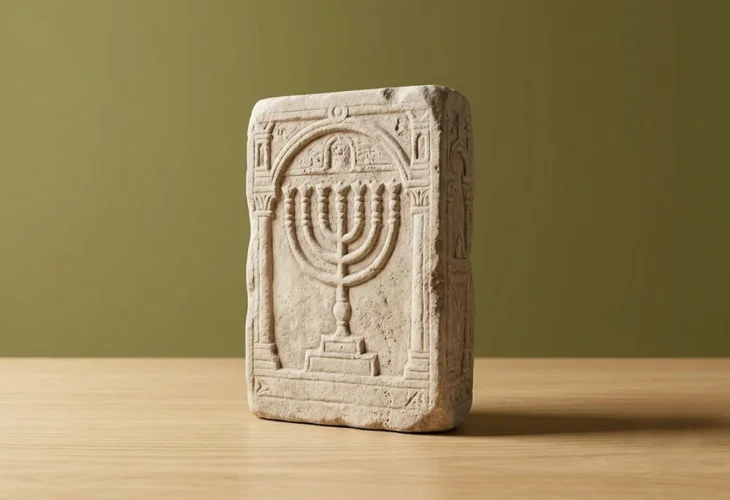
The rectangular limestone block, carved with elaborate reliefs, was discovered inside the synagogue complex. One side features a seven branched menorah alongside vessels and columns.
The depiction of the menorah is particularly significant. It is one of the earliest known representations of a menorah and an exceptionally rare example found in a clearly Jewish setting dating to a time when the Second Temple was still standing. The Israel Antiquities Authority described the menorah on the stone as the earliest depiction from this period discovered outside Jerusalem, as well as the earliest found inside a religious building.
Perhaps most fascinating is the possibility that the artist who carved the image had personally seen the Temple menorah in Jerusalem before the destruction of the Second Temple in 70 CE. At the time the stone was created, the original menorah was still standing in Jerusalem.
Unlike the famous image on the Arch of Titus in Rome, which was created after the destruction of the Temple from a Roman perspective, the Magdala Stone presents a Jewish depiction created in the Land of Israel while Temple life was still taking place.
A Symbolic Connection to the Temple
The other sides of the Magdala Stone contain additional architectural designs, including arches, columns, jars, rosettes, and other decorative forms.
It is believed that the stone may have served as a bimah used during Torah reading. Art historian Rina Talgam has interpreted it as a symbolic three dimensional representation of the Temple, with elements alluding to its inner spaces and sacred vessels.
According to this interpretation, the stone may have brought a symbolic image of Jerusalem and the Temple into a synagogue hundreds of miles away in the Galilee.
Archaeologists also uncovered the remains of a Jewish neighborhood from the early Roman period surrounding the synagogue. Among the finds were private homes, paved streets, industrial installations, pottery, glass, coins, and stone vessels.
The stone vessels are particularly significant because, according to halacha, vessels made of stone do not become ritually impure. Their presence therefore provides another glimpse into the religious life of the community and its observance of the laws of ritual purity.
Together, the discoveries paint a picture of Magdala as an active Jewish city where commerce and industry existed alongside a strong commitment to Jewish religious life.
A City Buried for Generations
The excavation revealed that the neighborhood surrounding the synagogue was abandoned toward the end of the first century CE, likely in connection with the Great Revolt against Rome.
Josephus, the Jewish historian who lived during this period, describes fighting throughout the Galilee and Roman conquests in the region surrounding the Sea of Galilee. Archaeological findings indicate that Magdala was abandoned and destroyed during the revolt, after which its remains were eventually covered by heavy layers of sediment.
That burial helped preserve the ancient neighborhood. For generations, the remains of Magdala lay hidden beneath the ground until they were uncovered nearly 2,000 years later.
Then, in 2021, archaeologists made another remarkable discovery.
During work connected to the expansion of Highway 90, a second synagogue was uncovered in Magdala. It too was approximately 2,000 years old and dated to the period when the Second Temple was still standing.
It was the first time two synagogues dating to the Second Temple period had been discovered within the same Jewish settlement.
The second synagogue was simpler than the first. Built from basalt and limestone, it included a central hall and two side rooms. Archaeologists discovered a stone bench, column bases, and plastered and decorated walls.
A small room at the southern end of the hall contained a stone shelf that may have been used to hold scrolls and Torah texts. Pottery, lamps, glass bowls, rings, and stone vessels were also discovered at the site.
According to researchers, the locations of the two synagogues may offer clues about the organization of Jewish life in ancient Magdala. One synagogue stood in an industrial area, while the other was located near a residential street. This suggests that different groups of craftspeople or residents within the city may have maintained their own synagogues.
The discoveries at Magdala offer an extraordinary window into Jewish life approximately 2,000 years ago. From the synagogues and stone vessels to the remarkable depiction of the Temple menorah, the finds reveal a thriving Jewish community whose daily life, religious observance, and connection to Jerusalem existed while the Second Temple itself was still standing.
Today, the first synagogue is part of an archaeological park open to visitors, allowing the remains of this ancient Jewish community to tell their story once again.

