

Shabbat
A Luxury Limousine on Shabbat? The Halachic Decision May Surprise You
A family's race to the hospital turned into an extraordinary lesson about the limits of Shabbat desecration, Divine Providence, and trusting Hashem
- Rabbi Erez Chazani
- | Updated
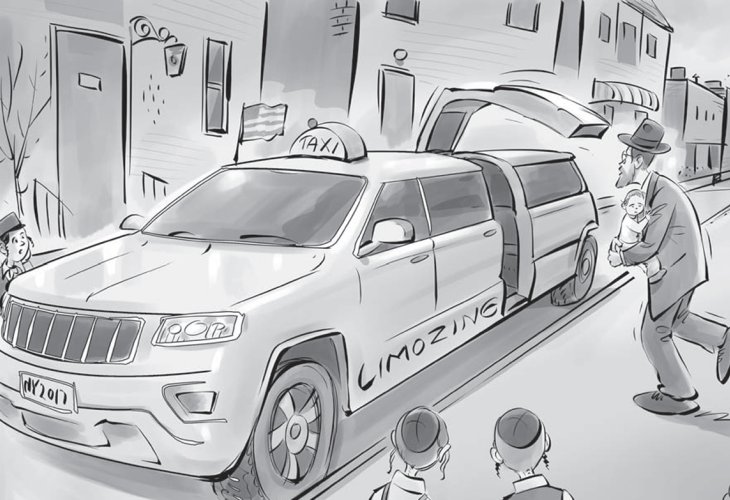
An interesting halachic question was once presented by a Jewish man who related the following story:
On Shabbat, our infant son became ill and needed to be taken to the hospital. I decided to call a taxi to take us to the nearest medical center.
In my haste, I grabbed the telephone directory to find the number of a taxi company. The moment I opened the directory, I noticed an advertisement for what I assumed was a taxi service.
Panicked, I called the number and said, "I urgently need a ride to the hospital."
"I'll send a vehicle immediately," the dispatcher replied. "Please have $400 ready for the fare."
"Four hundred dollars?!" I exclaimed. "The hospital is only a few minutes away!"
The dispatcher then explained what had happened.
"My dear sir, you've reached a limousine rental service, not a regular taxi company. Our luxury limousines are equipped with spacious seating, refreshments, and premium amenities. They are designed for dignitaries and wealthy clients, so naturally the price reflects that. A standard taxi to your destination would cost around $20, but a limousine costs $400."
Should He Make Another Call?
At that moment, I faced a serious halachic dilemma.
Should I cancel the limousine and make another phone call to a regular taxi company? Or would that constitute an additional act of Shabbat desecration?
After all, the limousine company had already dispatched a vehicle that would take us to the hospital. The only reason for hanging up and placing another call would be to save money — not to save a life.
The Halachic Ruling
The Torah permits violating Shabbat only for pikuach nefesh — saving a human life, but not for saving money.
Although the original phone call was entirely justified because it was made for the sake of a medical emergency, that objective had already been achieved. A vehicle was already on its way to transport the child to the hospital.
Making another call would only serve the purpose of reducing the financial cost.
Since that additional act of Shabbat desecration would be performed solely to save money rather than to save a life, it is prohibited.
A Comparable Case
A similar ruling applies when a patient requires hospitalization on Shabbat.
Suppose there is a private hospital nearby and a government hospital farther away where treatment would be free. If the quality of care is the same at both facilities, one may not travel the extra distance on Shabbat merely to avoid medical expenses.
Once again, the principle is clear: Shabbat may be set aside only to preserve life.
Therefore, in this case, the father should not cancel the limousine or place another phone call, but should travel to the hospital in the limousine that has already been dispatched.
An Encouraging Blessing
Rabbi Yitzchak Zilberstein added a beautiful message for the concerned father.
Quoting the verse, "A person's steps are directed by Hashem; how can anyone understand his own path?" (Proverbs 20:24), he said:
"If Divine Providence arranged for your son to be taken to the hospital in a royal limousine, take it as a good sign. With Hashem's help, he will grow to become a distinguished Torah scholar, noble and regal in character — for our Sages teach, 'Who are the true kings? The Torah scholars' (Gittin 62a). May you merit abundant nachas from him."
Adapted from the book Achat Sha'alti, Volume 2, from the treasury of Rabbi Yitzchak Zilberstein.

