

World News
Iran Insists on Controlling the Strait of Hormuz; Top U.S. General Urges an End to the War
Gen. Dan Caine, chairman of the Joint Chiefs of Staff, said the U.S. needs to find an “off-ramp” from the war with Iran. Iran is refusing to reopen the Strait of Hormuz to shipping and has attacked a UAE tanker, while demanding sanctions relief as part of any agreement.
- Shlomi Diaz
- | Updated
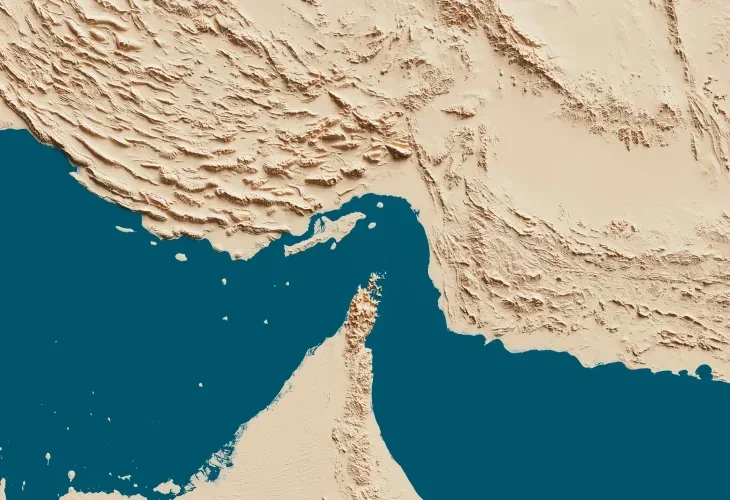 The Strait of Hormuz
Gen. Dan Caine, chairman of the U.S. Joint Chiefs of Staff, said in private conversations with administration officials that the United States must find an “off-ramp” from the war with Iran. CNN reported this today (Saturday night). According to the report, Caine argued that “continuing the campaign could have the opposite effect. Air power is not expected to achieve the president’s stated war aims.”
Iran announced that it is negotiating with Oman over sharing control of transit through the Strait of Hormuz. It said a partial agreement had been reached, but that the strait would not reopen unless the United States lifted the economic sanctions and the naval blockade.
U.S. Vice President J.D. Vance, meanwhile, sounded optimistic about reaching an agreement. In an interview with Fox News, Vance said: “We’re in the middle of the game and using a broad range of tools — diplomatic, economic, and military — to ensure that we get the best possible outcome for the American people. I’m fairly confident we’ll get there. We’re talking with the Iranians and trying to maximize the amount of oil and gas coming out of Hormuz.”
Vance continued: “There are elements within the Iranian system talking about charging transit fees, but the Iranians have told us they have no such plan. But again, we will judge by actions on the ground. They are taking a very hard hit, and they want this situation to end. The only question is whether their system is capable of delivering the conditions necessary for us to be satisfied.”
Iranian President Masoud Pezeshkian, on the other hand, charged that “the American side violated the Strait of Hormuz clause in the memorandum of understanding — and we responded accordingly. The United States is not trustworthy, but we seek to move forward with it and resolve the issues on the table. Every day, we discuss how to manage the diplomatic process in order to emerge from a state of ‘neither war nor peace.’ The fighting cannot continue forever. Ultimately, it must end.”
Meanwhile, the UAE news agency reported today that a vessel belonging to ADNOC was hit by a missile while crossing the Strait of Hormuz. The UAE Foreign Ministry condemned the attack, saying it was a blatant violation of “the UN Security Council resolution emphasizing freedom of navigation and rejecting attacks on commercial vessels or the disruption of international sea lanes.”
The UAE stressed that “attacking commercial vessels and using the Strait of Hormuz as a tool of pressure or economic extortion constitute an act of piracy by the Revolutionary Guards and a direct threat to regional stability and global energy security.” The UAE added that Iran must halt the attacks and commit to ending all hostile actions and to the full, unconditional reopening of the strait. Qatar, Saudi Arabia, and Jordan also condemned the attack.
Iran’s Mehr news agency reported that Iranian Foreign Minister Abbas Araghchi announced that negotiations with Oman over managing and establishing a new route in the Strait of Hormuz were close to an agreement, but that reopening the strait “depends on other conditions.” Araghchi also accused the United States of violating Pakistan’s memorandum of understanding and stressed that Iran’s management of the strait is non-negotiable.
According to him, “The previous traffic-separation scheme in the Strait of Hormuz is no longer acceptable to Tehran, and a new route is needed. This naturally involves technical and legal complexities. Because of these complexities, we are currently discussing a temporary route. Before a new route is established, a temporary route will be adopted.”

