

Personal Stories
The Lost Ketubah: How It Found Its Way Home
A stranger’s ketubah appeared in one of her moving boxes, and weeks of searching led nowhere. Then an unexpected phone call connected all the pieces.
- Inbal Idan
- | Updated
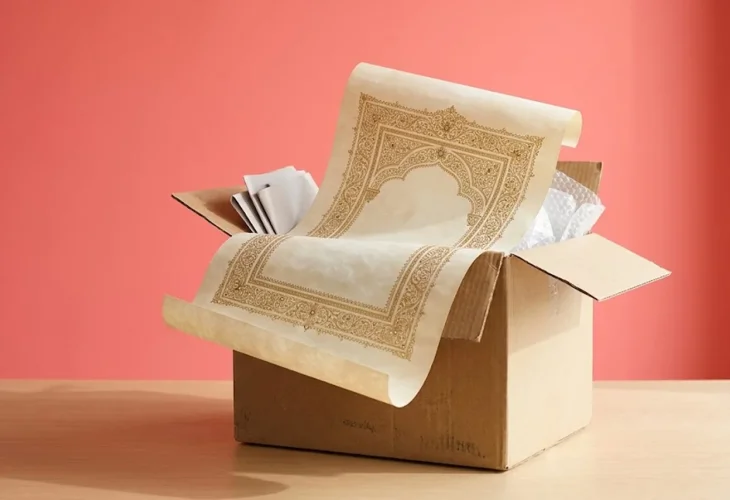
Moving day. Boxes everywhere. Total chaos.
I rush from one carton to the next, deciphering the labels I had written on them and directing each box to its proper room.
“Shira,” my husband calls from the other room.
I go over to see what he needs. He shows me a box that has already been emptied, except for one large piece of parchment lying at the bottom.
I pick it up.
It is beautiful, illustrated and decorated with gold leaf.
It is a ketubah.
And it is not ours.
“What is this? Whose is it?” I ask, trying to make sense of what I am looking at. The names written on the ketubah are completely unfamiliar to me. “How did it get here?”
My husband shrugs.
The moving company we hired had offered several additional services, including providing boxes for packing. Suddenly, I realize that the ketubah probably has nothing to do with us at all. It must have been left behind in one of the boxes we received from the company.
In other words, whoever had lost it was probably another client of the same moving company.
How had the family not noticed that their ketubah was still inside a box? How had the moving company not spotted it? There were no answers. During a hectic move, almost anything can happen.
Still, I wonder whether there could somehow be another explanation. Maybe someone had left a ketubah with us at some point?
Unlikely.
Either way, whoever it belonged to needed it back. The absence of a ketubah can raise important halachic questions, so I decide to call the moving company immediately.
I explain that we found it at the bottom of one of their boxes and ask them to check whether the names belong to any of their clients. Perhaps the owners had already contacted them looking for it.
The representative is very surprised. She asks me for the details written on the ketubah. I give them to her and even send her a photograph.
Then I wait.
The owners were probably fairly recent clients, I reason, since the boxes were being reused regularly.
But the representative calls me back with disappointing news.
No. The names on the ketubah do not match any of their clients.
Searching for the Owners
I study the ketubah more carefully.
It was written about 25 years earlier and appears to have originated in South America. I mention to the representative that perhaps she should look for clients with a strong Spanish accent. She promises to investigate further, and I return to the mountain of boxes still waiting to be unpacked.
The moving company does not get back to us that day, so the following morning I call again.
This time, the conversation is less pleasant. I am passed from the secretary to the owner of the company and back again. At one point, I even ask whether they can give me a list of clients so I can compare the names myself.
Naturally, they refuse. And rightly so.
But at the end of it all, I am still standing there with someone else’s ketubah and no idea where to return it.
At a friend’s suggestion, I post about the discovery in several groups for Argentinians and other South American immigrants, hoping someone will recognize the names.
Nothing.
Not a single inquiry.
Could the owners not even know that their ketubah was missing?
Perhaps.
Eventually, I feel that I have exhausted my options. Life after the move demands my attention: unpacking, organizing the apartment, settling into our new neighborhood, and trying to restore some sense of normalcy.
The ketubah goes onto a high shelf.
And, eventually, I forget about it.
Then the Phone Rang
I am a bridal makeup artist. Almost every day, I find myself at a different address preparing another bride for her wedding, doing everything I can to help her feel beautiful and happy on her special day.
Baruch Hashem, my name has become well known, and I receive inquiries from brides regularly. I employ a secretary who answers calls and organizes my daily, weekly, and monthly schedule. At the end of each day, she updates me about the appointments ahead.
My business number is connected to my personal number, so if my secretary cannot answer for some reason, the call eventually transfers to me.
It rarely happens.
But one day, it does.
On the line is a lovely bride named Michal. She wants to schedule me to do her makeup on her wedding day.
I do not have my calendar with me, so I ask her to call again in a few minutes and arrange everything with my secretary. I do not like ending a conversation with a potential client without knowing that the booking has been completed, so I repeat her name and wedding date in my mind, determined to check later that she called back.
That evening, I meet with my secretary and remember Michal.
“Did she call and book?”
No. She did not.
I find Michal’s number on my phone, and my secretary calls her back immediately.
Michal is delighted. In the rush of wedding preparations, she had completely forgotten that she was supposed to call again.
Fortunately, her wedding date is still available.
My secretary begins entering her details into the calendar while I sit nearby, half-listening to the conversation.
Then I hear her ask Michal to spell her last name.
Letter by letter, the name begins to form.
And suddenly, something about it feels familiar.
I know that name.
“Those Are My Parents!”
It is strange. I remember the surname Michal had given me earlier, but I never would have imagined spelling it the way she does. It contains several additional Hebrew letters, making the written version look completely different from how the name sounds.
I ask my secretary to hand me the phone.
“Sorry for the strange question,” I tell Michal. “Do you happen to know a family whose parents’ names are...?”
I give her the two names from the forgotten ketubah.
“They’re probably Spanish speakers,” I add.
There is a pause.
“Those are my parents!” Michal says in surprise. “How do you know them?”
Suddenly, the entire mystery begins falling into place.
“Did your parents happen to lose their ketubah?” I ask gently.
Now she is even more astonished.
How does this makeup artist she has never met know not only her parents’ names, but that their ketubah is missing?
“Uh... yes,” she answers.
I tell her everything: the move, the box, the beautiful ketubah lying at the bottom, the calls to the moving company, and our unsuccessful attempts to locate its owners.
“We’ve been trying to find them for weeks,” I tell her. “We couldn’t find a single lead.”
And now I understand why.
The spelling of the family surname on the ketubah was so different from the way the name sounded that it had been almost impossible to connect the two. Michal’s parents had indeed moved, and they had indeed used boxes from the same moving company. But in the company’s records, their surname had apparently been written according to how the representative heard it.
No one had connected the two names.
Until now.
The Ketubah They Had Been Searching For
It had taken Michal’s parents quite some time to realize the ketubah was missing.
Anyone who has moved knows that unpacking can stretch on for weeks. As long as boxes remained unopened, they assumed the ketubah was simply inside one of them.
Only about a week earlier, after finally opening the last box, had they realized the truth.
It was gone.
The discovery was deeply upsetting and had led to discussions and halachic questions about what they should do.
And then, seemingly out of nowhere, their daughter called a makeup artist to book her wedding makeup.
A makeup artist who happened to have their missing ketubah sitting on a shelf in her home.
It is still unclear how they never saw any of the notices I had posted. After all, “Found: ketubah” is not exactly something you see every day.
But apparently, Hashem had another way of bringing it home.
A Lost Ketubah Finds Its Way Home
On Michal’s wedding day, her mother hovered around me happily as though I were the bride.
Beyond its halachic significance, the ketubah was exceptionally beautiful and intricately decorated, and it held tremendous sentimental value for her.
And as I stood there preparing her daughter for her own wedding, I could not help thinking about the extraordinary chain of events that had brought us together.
One family moves. A ketubah is accidentally left inside a box. That box somehow reaches another family. Weeks of searching lead nowhere. Then a bride happens to call a makeup artist. She forgets to call back. The makeup artist remembers her. The secretary calls her. She spells an unusual surname aloud.
And suddenly, everything connects.
Baruch Hashem, we had the privilege of fulfilling the mitzvah of returning a lost item.
And not just any lost item, but one connected so deeply to the building of a Jewish home.

