

Magazine
“I Had a Choice”: How Shiri Learned to Walk Again
After years of fractures, treatments, crutches, and uncertainty, Shiri made a life-changing decision: She would teach herself to walk independently.
- Chen Verdiger
- | Updated
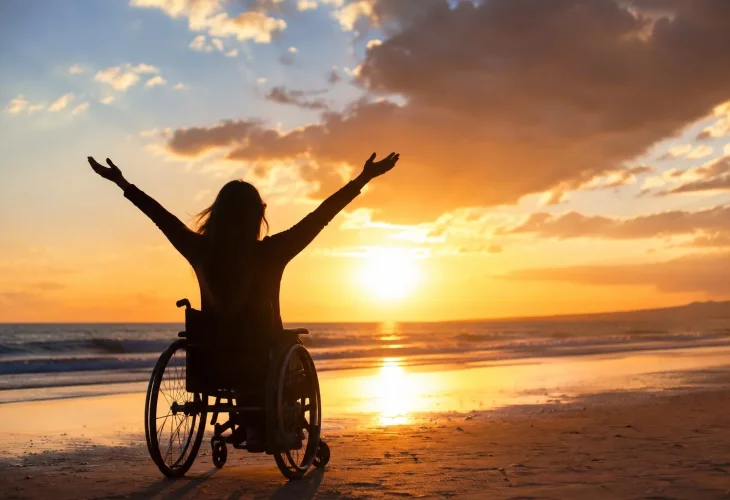
“It’s all about the energy we project.” That is one of the ideas that has guided Shiri Jacobson through a childhood marked by unexplained fractures, years on crutches, painful treatments, and questions no child should have to face. Today, after learning to walk independently and building a career helping others, she looks back on those years with a perspective shaped by determination, self-acceptance, and above all, faith in Hashem.
“The Doctors Were Stumped”
Tell us a little about your childhood. When did your medical journey begin?
“I grew up in a charedi home, the third of five children. I was a healthy, confident, outspoken, sociable, and happy child. Until I was eight, there was nothing unusual that I could point to.
“My story began suddenly—or at least, that was how it seemed at the time.
“When I was eight, my younger brother and I were riding a scooter. We reached a downhill stretch, and he was afraid to ride, so I went down by myself first to show him that everything was fine. Then I convinced him to join me.
“On the last descent, the scooter caught in a crack in the asphalt. My brother fell, and so did I. A piece of the scooter pierced my shinbone, the tibia. I remember the sharp pain. Eventually, my mother arrived and took me to the hospital, where they put my leg in a cast.
“Two months later, the cast came off, and I walked normally. But seven months later, the pain returned.”
What happened then?
“We went to a doctor who said I needed surgery. My mother consulted Rabbi Fisher, who advised us to get a second opinion at Ichilov Hospital. There, they rejected the original diagnosis. After further testing, they found that it was a fracture.”
What did the doctors recommend?
“Honestly, the doctors were at a loss. Looking back, I understand why. They said another cast could weaken the bone, so they sent me to a physical therapist once to teach me how to walk properly.
“But I was eight years old. I didn’t really follow through with it, and I continued walking with crutches.”
Did they continue investigating why the fracture wasn’t healing?
“Yes. For three years, I walked with crutches and underwent countless tests. The doctors couldn’t understand why the bone wouldn’t heal.
“Until I was eleven, I depended on crutches and couldn’t move around without them. I would hop around, which eventually caused my back to curve. During those years, I also injured the already fragile leg several more times. The pain was constant—sometimes better, sometimes worse.
“When I was eleven, they diagnosed me with a bone disease called osteogenesis imperfecta. They believed I was missing a component needed for healthy bones.”
What treatment did they suggest?
“The doctors told us about a medication. I didn’t meet all the usual criteria for it, but they told us that if I was approved, I should take it because it was harmless.
“There was a genetic test that could determine whether my condition was genetic, but it was expensive. My parents trusted the doctors, so I began receiving the medication without genetic confirmation. Every few months, I was hospitalized to receive it intravenously.”
How did you feel during the treatments?
“I remember feeling weaker after them, but I assumed that was simply part of the process.
“After several months, I began experiencing pain in the hip joint of my other leg—the leg that had always been healthy. Eventually, I couldn’t walk at all.
“My mother called the doctor, who told her I needed rest. For two and a half months, I rested. She kept calling, and he kept saying it was weakness and that it would pass.”
The Day Everything Changed
Did the doctor examine you during that period?
“No. My mother described everything over the phone, and based on that, he continued recommending rest.
“Eventually, I got tired of waiting and decided to go back to school. I arranged a stroller and asked friends to help me from the school gate. I thought I had planned everything.
“But I had forgotten that there were stairs.”
Shiri pauses.
“I decided I could do it. I climbed them no matter what. And I did make it to the top—but by then I was crying from the pain.
“The teachers called my parents, and they decided I needed to go home. My father carried me up the three flights of stairs to our apartment and placed me on the sofa.
“From that moment, I couldn’t move.”
Not at all?
“Not at all. I couldn’t lie down or stand up. I stayed in exactly the position my father had placed me in. I even slept sitting up that night, with my mother arranging blankets around me for support.
“Eventually, after speaking with doctors, we realized I needed to be taken to the hospital by ambulance.
“At the hospital, they asked me to climb onto a bed. But when you can’t move, climbing onto a bed isn’t exactly simple. They wanted to X-ray me, but every movement caused terrible pain. I kept yelling, ‘Don’t touch me—it hurts.’”
What did the X-ray show?
“They eventually insisted on doing it, and the X-ray revealed a fracture in the hip joint of my previously healthy leg.
“The doctors gave us three possibilities: traction using weights to straighten the leg, a cast extending up to my waist, or surgery. They decided to try traction first.”
How did that work?
“They positioned my leg so the bone could realign and used weights to keep it in place. I was put under general anesthesia briefly so I wouldn’t experience the pain.
“They managed to reset the bone, and afterward my pain improved. But they didn’t take an X-ray immediately.
“That was the mistake.”
Why?
“Because the bone hadn’t actually returned to the correct position. They only discovered that when they took another X-ray a week later. Had they checked immediately, they might have been able to correct it then.
“I remember that my appetite had finally returned. I asked my mother for Mentos, and she was about to get them when the doctor stopped her and asked to speak privately.
“I immediately knew something was wrong.”
Are you angry with the doctors when you look back?
“No.”
Her answer is immediate.
“I know everything comes from Hashem. I go through what I am meant to go through in life, regardless of who the messenger is. I have no grievance against the doctors. Everything is from Him.”
“The doctor told my mother that the bone had healed incorrectly and that I needed surgery.
“For an adult, surgery is frightening. For a child, it is complete helplessness. I understood that even my parents—the people I trusted to know what to do and make everything better—couldn’t help me.
“They were just as helpless in that situation as I was.
“I understood that I was in Hashem’s hands.”
Learning to Walk Again
Was the surgery successful?
“Thank Hashem, yes. But afterward, everything changed.
“Until then, I had been walking with crutches. After the surgery, I spent four months entirely in a wheelchair. One leg still hadn’t healed properly from its original fracture, while the leg that had once been healthy was now functioning at only about 85 percent.
“For several months, I couldn’t walk.”
What was rehabilitation like?
“Getting back to crutches took a very long time. I underwent physical therapy and hydrotherapy at Alyn Hospital, but nothing seemed to help enough.
“Eventually, they decided I needed braces on the lower parts of my legs. They were plastic braces molded specifically to my body. They helped distribute my weight and retrain me to walk as correctly as possible.
“I hated them because they hurt. I was extremely thin, and the braces pressed against my bones. At school, I would ask the teacher to let me take them off.
“My mother would even bribe me with money to keep them on,” she recalls.
“Gradually, I returned to using crutches.”
“It’s All Up to Me”
Were you able to attend school normally during those years?
“I didn’t attend sixth grade at all. Afterward, I went sporadically.
“Even when I was there, I didn’t feel as though I belonged. I’m naturally very social. I love people, and people generally love me. But I felt that my friends couldn’t understand me.
“I was a little girl who had become far too mature for her age. The things my friends worried about seemed childish to me because I was dealing with such different realities.
“Over time, I learned to recognize people who had also been through difficult experiences, as well as people who were simply mature and empathetic. But as a child, that was much harder.”
What kind of atmosphere did you have at home?
“A lot of warmth and love. My mother never accepted the idea that she simply had a disabled daughter and that was the end of the story. We all thought this was a temporary problem that would eventually be solved.
“But it wasn’t temporary.
“Eventually, I underwent the genetic test that we had initially been told was unnecessary. It came back negative. I did not have osteogenesis imperfecta. I was told instead that I had a calcium deficiency.”
What did you do after that?
“We moved away from conventional medical treatment and began exploring alternative approaches.
“In eighth grade, I received reflexology treatments from Sarah Margalit, of blessed memory, who was 81 at the time. I also had exercises to straighten my back and legs, which were difficult and uncomfortable.
“At the same time, we went to Rabbi Refaeli, who worked with what he described as positive energies. I didn’t really believe in it then, and I still don’t. But something good did come out of that experience.”
What was that?
“He insisted that I could walk without crutches.
“I argued with him.
“After several months, he made me a deal: If I could walk without crutches for an entire week, he would buy me anything I wanted.
“I thought that if I chose something expensive, he would back out, so I asked for a computer.
“To my surprise, he agreed.”
For the next week, Shiri forced herself to move without her crutches.
“I practically climbed along walls to get from place to place. It was unbelievably difficult. But I made it through the week, got the computer—and immediately went back to my crutches.”
Then, several months later, something shifted.
“I was sitting on the porch when suddenly it hit me: Everything I had believed until then was wrong.
“I had a choice.
“It was a limited choice, but it existed.
“Life wasn’t going to remain like elementary school, where everyone asked how I was feeling, brought things to me, and took care of me. If I wanted something from life, I was going to have to go after it myself.
“No one could make my life better for me.
“I wanted to grow. I wanted to study normally. I wanted to get married and have children.
“So I had to act.”
Two Years of Teaching Herself to Walk
“I decided I was finished with the crutches, no matter what.
“It involved unimaginable pain and tears. What kept me going was one thought: ‘I’ve suffered this much already, and now I’m going to quit?’
“I took a cab to seminary, and my friends helped me inside. There were moments of complete helplessness—standing in the middle of the street, wanting to move but having no idea how I was going to take another step.
“But I kept going.
“For two years, I taught myself to walk without crutches.
“At first, I walked crookedly and with a significant limp, but I was walking independently. As the years passed, I became more upright.
“Eventually, I reached a point where I also learned to accept my limitations. I still have a limp, and my back isn’t completely straight. But I have done everything I can.”
Have there been setbacks since then?
“Yes, but nothing like what I experienced before. I’ve had inflammation from overexertion, and once I fell. But those setbacks were relatively short, and I was able to return to my usual level of functioning.”
“Only Faith Sustained Me”
What kept you going through all of this?
“Only faith.
“From the age when I really began understanding my situation, I started exploring my faith more deeply. At first, I was full of belief. I spoke to Hashem constantly and wrote songs for Him.
“Writing is how I cope. For me, speaking with Hashem through writing can feel no less meaningful than prayer.
“Then came anger. There were things I couldn’t understand.
“And from there came growth.
“All of this was happening during some of the most important years of personal development.”
What were the hardest emotional challenges?
“Low self-esteem. So many questions about my own worth.
“How would I ever get married? Could I have children? Could I raise them? Why couldn’t I dream about my future the way everyone else seemed to?
“I would stand in front of the mirror and wonder, ‘Will I ever love the person I see?’
“I looked at the other girls and thought they were beautiful and I wasn’t.
“And beyond all of that, I felt that nobody truly understood me. There was a tremendous loneliness and frustration.”
Those experiences ultimately influenced Shiri’s choice of career.
She became a social worker.
“It feels like closing a circle,” she explains. “I can look into someone’s eyes and offer them the support that I once felt I was missing.
“When I had to decide what to study, I followed my heart. I wanted to take everything I had gained through my own experiences and use it to help other people.”
Shiri’s story is not one of pretending that limitations do not exist. She knows hers intimately. Rather, it is the story of discovering how much choice can still exist within them.
After years of pain, uncertainty, and dependence, she learned to distinguish between what she could not control and what remained in her hands. And through that process, faith did not erase the difficulty—it gave her a way to keep moving through it.

