

Rosh Hashanah
Unetaneh Tokef: The Powerful Prayer at the Heart of the High Holidays
The moving story, meaning, and timeless message behind one of the most powerful prayers of Rosh Hashanah and Yom Kippur
- Yonatan HaLevi
- | Updated
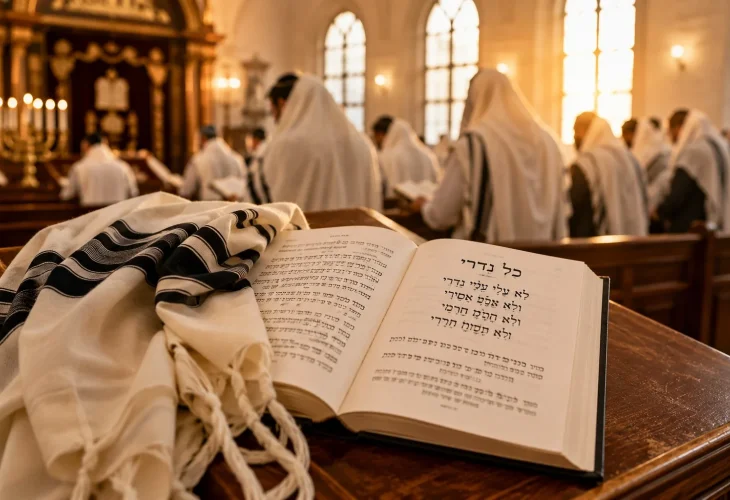
The piyyut “Unetaneh Tokef” is one of the most moving and powerful prayers in the High Holiday liturgy. It is recited during the repetition of the Amidah on Rosh Hashanah and Yom Kippur and expresses the awe of judgment, the experience of standing before God, and the plea for a good life. The prayer captures the profound awareness of human frailty before the Master of the Universe and presents vivid images of the Day of Judgment, when the fate of every living being is determined.
The Author and Origins of the Piyyut
The identity of the author of “Unetaneh Tokef” is not known with certainty, but Jewish tradition attributes it to Rabbi Amnon of Mainz, a scholar and judge who lived in Mainz, Germany, in the 11th century.
According to the account recorded in Or Zarua, the famous story associated with the prayer begins when the bishop of Mainz demanded that Rabbi Amnon, one of the leading sages of his generation, convert to Christianity.
In an attempt to put off the bishop and stop the pressure, Rabbi Amnon said that he needed three days to consider the matter. He immediately regretted his words. He felt that he should have rejected the proposal outright, without giving even the slightest impression that abandoning Judaism was something he might consider.
On the third day, when Rabbi Amnon did not appear at the palace, he was brought before the bishop by force. Rabbi Amnon asked that his tongue be cut out, since it had failed him by not immediately rejecting the proposal. In this way, he hoped to sanctify God’s name and demonstrate that under no circumstances would he agree to convert to Christianity.
The bishop, however, chose to punish Rabbi Amnon’s feet instead, since they had failed to bring him back to the palace. Rabbi Amnon was subjected to terrible torture. His fingers and toes were cut off joint by joint, and salt was placed on his wounds.
This occurred shortly before Rosh Hashanah. When the holiday arrived, Rabbi Amnon asked to be brought to the synagogue. There, before the congregation recited Kedushah, he opened his mouth and recited “Unetaneh Tokef” after which, he passed away.
Three days after his death, Rabbi Amnon appeared in a dream to Rabbeinu Kalonymus ben Meshullam, completed the piyyut, and instructed him to distribute it among the Jewish communities. For approximately a thousand years, the words of this ancient prayer have continued to stir Jewish hearts and connect worshippers with the profound awe of the Day of Judgment.
The Text of Unetaneh Tokef
Let us proclaim the mighty holiness of this day, for it is awe-inspiring and fearsome. Thereon Your Kingship is exalted, Your throne is established with lovingkindness, and You are seated on it in truth. It is true that You are the judge, the one who presents evidence, the knower and the witness, who records and seals, who counts and reckons, and You remember all things that are forgotten. You open the Book of Remembrance and it reads itself; every man’s signature is in it. The great shofar is sounded, and a still, soft voice is heard; the angels tremble, fear and dread seize them, and they exclaim: the Day of Judgment is here! The heavenly hosts are to stand in judgment, for [even] they will not be found meritorious in Your eyes in judgment. All created beings pass before You, [one by one,] like a flock of sheep. As a shepherd examines his flock, making his sheep pass under his staff, so do You cause to pass [before You] every living soul, and You count, reckon and are mindful of [them], and You allocate the fixed portion for the needs of all Your creatures, and inscribe the verdict of their judgment.
On Rosh Hashanah they are inscribed, and on the fast day of Yom Kippur they are sealed: How many shall pass away and how many shall be born; who shall live and who shall die; who shall live out his allotted time and who shall depart before his time; who [shall perish] by water and who by fire; who by the sword and who by a wild beast; who by hunger and who by thirst; who by earthquake and who by pestilence; who by strangulation and who by lapidation; who shall be at rest and who shall wander; who shall be tranquil and who shall be harassed; who shall enjoy well-being and who shall suffer tribulation; who shall be poor and who shall be rich; who shall be humbled and who shall be exalted.
But Repentance, Prayer and Charity avert the severity of the decree.
For as is Your Name so is Your praise. You are slow to anger and easy to pacify, for You do not desire the death of the one deserving death, but that he return from his path and live. And [even] until the day of his death You wait for him; if he will but repent, You will welcome him at once. Truly, You are their Creator and You know their evil inclination, for they are but flesh and blood. Man’s origin is dust and his end is unto dust. He earns his bread at the risk of his life. He is likened to a broken potsherd, to withering grass, to a fading flower, to a passing shadow, to a vanishing cloud, to a blowing wind, to dust that scatters and to a fleeting dream.
But You are the King, the living and eternal God.
There is no limit to Your years and no end to the length of Your days; it is not possible to estimate [the countless angelic hosts of] Your glorious Chariot, nor can one explain Your inscrutable Name. Your Name befits You and You befit Your Name, and You have called our name by Your Name.
Its Place in the Prayer Service
“Unetaneh Tokef” is incorporated into the Rosh Hashanah and Yom Kippur liturgy as part of the central Mussaf service. It is recited during the cantor’s repetition of the Mussaf Amidah. The piyyut is found in Ashkenazi and Sephardic prayer traditions, as well as in some Eastern Jewish communities. Its powerful words, together with the distinctive melodies traditionally used for it, make it one of the emotional high points of the High Holiday services.
The Meaning of the Piyyut
“Unetaneh Tokef” can be divided into several sections, each addressing a different aspect of the Day of Judgment.
The Day of Judgment: The piyyut begins with a dramatic description of the day on which God sits upon the throne of judgment. The Books of Life and Death are opened before Him, and every individual passes before God like members of a flock:
“Let us proclaim the mighty holiness of this day, for it is awesome and fearsome. On it Your sovereignty will be exalted, Your throne will be established in kindness, and You will sit upon it in truth.”
The decrees: The prayer then describes the decrees that are written and sealed on this day: who will live and who will die, who by water and who by fire, who by earthquake and who by plague. Each successive phrase intensifies the sense of urgency and awe surrounding the Day of Judgment.
The call to repentance: Yet the piyyut does not leave the worshipper with fear alone. At the heart of the prayer is the declaration that repentance, prayer, and charity have the power to avert the severity of the decree:
“Repentance, prayer, and charity avert the severity of the decree.”
The Literary and Artistic Structure of the Piyyut
Symmetry and recurring patterns: The structure of “Unetaneh Tokef” is characterized by symmetry and repetition. Each section begins with a broader idea and then develops it through a series of specific examples. The list of possible decrees, for instance, follows a consistent and increasingly intense pattern.
Metaphors and imagery:“Unetaneh Tokef” is rich in metaphors and images that deepen its portrayal of the Day of Judgment. Human life is compared to a passing shadow, scattered dust, a fading flower, and a fleeting dream. These images emphasize the fragility and transience of human existence in contrast to the eternity and greatness of God.
Repetition for emphasis: The piyyut makes powerful use of repetition to reinforce its central ideas. The repeated phrase “Who will…” creates a relentless rhythm that underscores the uncertainty of human life and the gravity of the Day of Judgment.
In conclusion, “Unetaneh Tokef” is a powerful reminder of the significance of the High Holidays. Through its penetrating words, it reminds us of the importance of repentance, prayer, and charity, while inviting us to stand with humility before our Creator on the Day of Judgment.

