

Simchat Torah
The Hidden Connection Between Sukkot and Simchat Torah
Why do we complete the Torah on Simchat Torah? Discover the fascinating connection between Sukkot, Hakhel, the wilderness, and the final words of Moses.
- Yehosef Yaavetz
- | Updated
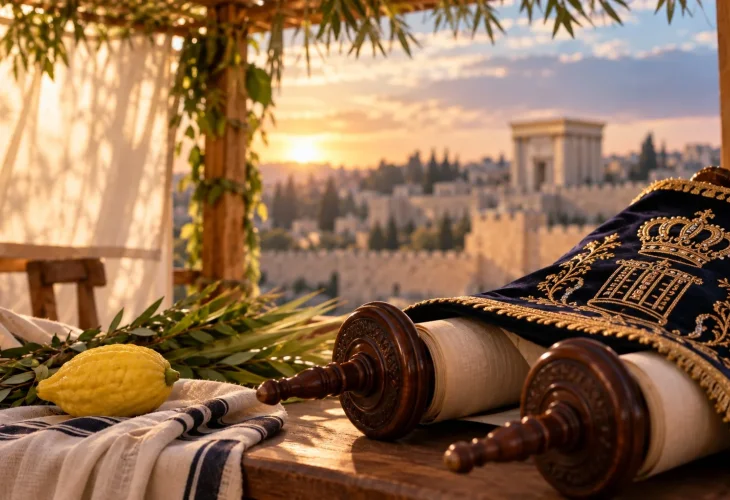
At the end of Sukkot, we celebrate Shemini Atzeret and Simchat Torah. In Israel, they are observed on the same day, while in the Diaspora, Shemini Atzeret is followed by Simchat Torah on the second day. On Simchat Torah, we complete the annual cycle of Torah reading and immediately begin it again.
The celebration of the annual completion of the Torah developed during the later period of the Geonim. In ancient times, however, not every Jewish community followed the same reading cycle. The Jews of the Land of Israel completed the Torah over a period of approximately three years, so they did not celebrate an annual completion on Simchat Torah. In Babylonia, the custom was to read one parashah each week and complete the entire Torah annually. This practice was eventually accepted throughout Jewish communities and gave rise to the Simchat Torah cycle familiar to us today.
Shemini Atzeret is a separate festival from Sukkot, even though it immediately follows it. We no longer perform the central Sukkot mitzvot of dwelling in the sukkah and taking the Four Species. Instead, we pause before Hashem and rejoice in our closeness to Him.
Why Do We Complete the Torah at This Time?
The connection between Sukkot and completing the Torah, particularly the Book of Devarim, did not begin with the Geonim. Its roots can already be found in the Torah itself through the commandment of Hakhel.
Hakhel is the biblical commandment for a public reading of the Torah. The regular public Torah readings throughout the year were instituted by Moses our Teacher and later expanded by Ezra. At Hakhel, however, the king would publicly read from Mishneh Torah, the Book of Devarim, during Sukkot.
Why specifically Sukkot? And why Devarim?
The sages of Kabbalah describe the sukkah as tzila d’meheimanuta, “the shade of faith.” But what makes the sukkah a place of faith?
The Torah commands us “to rejoice before Hashem for seven days,” while also instructing us, “You shall dwell in sukkot for seven days.” At first glance, these commandments seem to point in different directions. Rejoicing before Hashem took place at the Temple, while dwelling in the sukkah meant living in a temporary structure.
The answer lies in what the sukkah represents.
Returning to the Generation of the Wilderness
Part of the purpose of the mitzvah of sukkah is to recreate the experience of the generation that traveled through the wilderness: “For I caused the Children of Israel to dwell in sukkot,” and, “I will yet cause you to dwell in tents as in the days of the appointed festival.”
Imagine seeing a collection of houses built on a hillside. You immediately understand that there is a village there and that people have made it their permanent home. But if you see tents and temporary shelters scattered across a field, you assume that people have gathered there for a particular purpose, perhaps for a harvest or a celebration.
A sukkah is, by definition, a temporary dwelling. Its temporary nature points toward something permanent beyond itself.
When the Children of Israel made their pilgrimage to Jerusalem, they gathered like a flock around the holy city. Although they stayed in sukkot and tents surrounding Jerusalem, these temporary dwellings were secondary to the Temple, the permanent place where the Shechinah dwelled.
By leaving their permanent homes and entering their sukkot, the Jewish people became, in a sense, Hashem’s flock once again. The sukkah was secondary to the Temple. It was tzila d’meheimanuta, the shade of faith, a place of rest and nourishment for those who had gathered from across the Land to rejoice before Hashem and experience the presence of the Shechinah.
This idea can also help explain what we find among the Jews who returned from Babylonian exile, when the people rediscovered the commandment to dwell in sukkot. The commandment had become so closely associated with the Temple and rejoicing before Hashem that after the Temple’s destruction, people apparently believed there was no longer a purpose in observing it.
From the perspective of halacha, this was, of course, a mistake. This is why the verse emphasizes that “they found it written.” That generation came to understand that Jewish observance cannot rely solely on what has become customary or familiar. The Oral Torah exists in harmony with the Written Torah, and what the Torah commands must be fulfilled.
Why Devarim?
With this understanding, the connection between Sukkot and Mishneh Torah, the Book of Devarim, becomes clearer.
On Sukkot, the Children of Israel symbolically return to their identity as Hashem’s flock in the wilderness. They leave behind their permanent homes and live in temporary dwellings, recalling a time when they had neither fields nor vineyards, neither permanent houses nor cities. Instead, they lived in tents surrounding the Mishkan, following Hashem wherever He led them.
And if we are returning to the spiritual experience of the generation of the wilderness, what better time could there be to listen once again to the words of their great shepherd, Moses son of Amram?
This is also a fitting time to celebrate the Written Torah as a whole. On Sukkot, we symbolically return to being the generation that received the Torah. Then, as we reach Shemini Atzeret and Simchat Torah, we celebrate our relationship with the Torah and complete its annual reading cycle.
The Book of Devarim itself contains an aspect of the entire Torah, because it represents the culmination of Moses’ teaching to the Jewish people. After 40 years of learning the Torah and traveling through the wilderness, Moses summarized for the Children of Israel what Hashem asks of them and what they would need to carry with them into their future.
Shemini Atzeret is therefore a continuation and culmination of the joy we have just experienced. We have merited to spend an entire week rejoicing before Hashem, and now we pause for one final festival of closeness to Him. In Israel, this is also the day on which we celebrate Simchat Torah. In the Diaspora, that celebration reaches its height the following day.
But the joy does not end when the festival is over. On Simchat Torah, we hear Moses’ final words, complete the Torah, and immediately return to Bereishit. We then carry the Torah with us into the year ahead, continuing to read it, study it, and bring its teachings into our homes.

