

Shabbat
Why Do We Make Kiddush Over Wine? 7 Facts About the Mitzvah of Kiddush
Discover the deeper meaning of Kiddush, why wine is used, how the mitzvah strengthens faith in Creation, and why women are also obligated
- Yonatan HaLevi
- | Updated
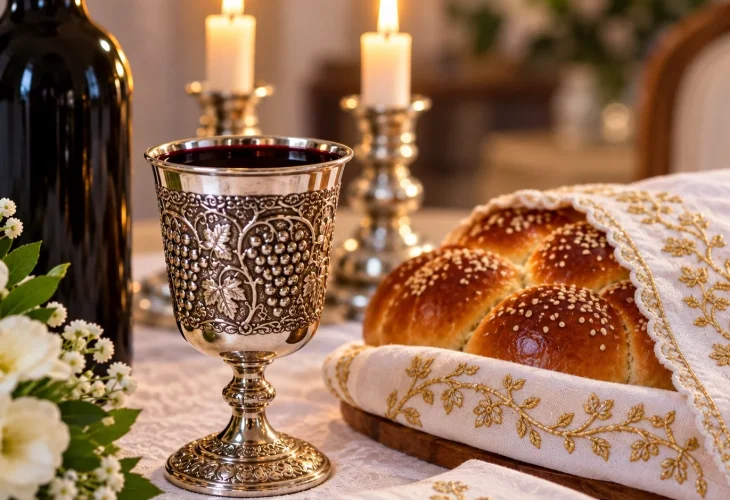
Why do we make Kiddush, and why is it specifically recited over wine? In Sefer HaChinuch, mitzvah 31, the author explains that the mitzvot of Kiddush and Havdalah are powerful tools designed to awaken human emotion through physical actions and to instill faith in the Creator, who created the world and continues to sustain it, through our senses and experiences.
Following are seven important facts about the mitzvah. When Kiddush is observed properly, the Shabbat table can become a source of faith and stability for a lifetime.
1. Kiddush Reminds Us of the Greatness of Shabbat
“It is a positive commandment to speak words at the entrance of Shabbat and again at its conclusion that recall the greatness of the day, its special status, and the way it is distinguished and elevated above the days before and after it. As it says, ‘Remember the Shabbat day to sanctify it’ (Exodus 20:8), meaning: remember it with a remembrance of holiness and greatness.”
Kiddush is therefore not simply a blessing before a meal. It is a declaration that Shabbat is fundamentally different from the rest of the week.
2. Kiddush Is Recited Over a Cup of Wine
Our Sages instructed that the words praising and sanctifying Shabbat should be recited specifically over a cup of wine.
The cup of wine becomes part of the act through which we give expression to the holiness and significance of the day.
3. How the Mitzvah Is Performed
A cup is filled with at least a revi’it of wine, and the traditional Kiddush blessing for Shabbat is recited over it.
The words of Kiddush transform the beginning of the Shabbat meal into an active declaration of faith, holiness, and remembrance.
4. Havdalah
The same principle applies when Shabbat departs. At the conclusion of Shabbat, a blessing is again recited over wine in honor of the day.
This blessing at the end of Shabbat is known as Havdalah.
5. Why Do We Make Kiddush?
Sefer HaChinuch explains: “So that through this act we will be inspired to remember the greatness of the day and establish in our hearts faith in the creation of the world, as it says, ‘For in six days Hashem made…’ We were therefore commanded to perform this act with wine, because human nature is greatly awakened by it, as food and drink bring satisfaction and joy. As I have already explained, according to a person’s awakening and actions, he will always be influenced internally.”
These words reveal a fascinating psychological principle. The Torah does not ask us merely to think about the holiness of Shabbat. It gives us a physical act that awakens the emotions and helps implant belief more deeply in the heart.
Through Kiddush, a person is reminded of the greatness of Shabbat and strengthens the belief that Hashem created the world and continually sustains it according to His will.
6. Why Specifically Wine?
Food and drink naturally awaken the senses and create feelings of enjoyment and celebration. The more a person performs an external action that creates emotional awareness, the more the heart is influenced internally.
Kiddush is not meant to remain an abstract idea. The cup, the wine, the blessing, and the meal all work together to transform belief into a lived experience.
7. Women Are Also Obligated in Kiddush
Sefer HaChinuch states that this mitzvah applies in every place and at every time, to both men and women.
Although Kiddush is a time bound mitzvah, our Sages taught that women are obligated in Kiddush and Havdalah.
Kiddush therefore belongs to every Jewish home. It is not merely the opening of the Shabbat meal, but a moment in which faith, memory, joy, and holiness come together, allowing the message of Shabbat to enter not only the mind, but the heart as well.

