

History and Archaeology
The Synagogue That Survived Kristallnacht: Vienna’s Stadttempel Reopens
Vienna’s historic Stadttempel survived Kristallnacht. Now, 200 years after its founding, it has reopened following a major restoration.
- Shira Davush
- | Updated
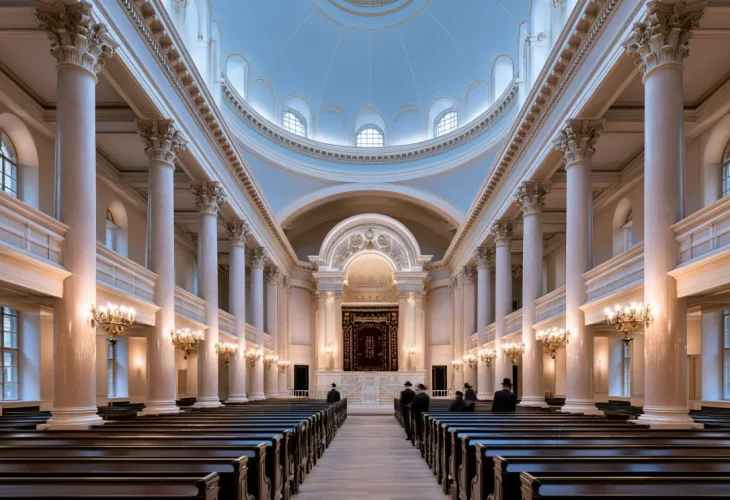
On Seitenstettengasse in the heart of Vienna, behind a façade that gives little indication of what lies within, stands one of Austria’s most important Jewish landmarks: the Stadttempel, Vienna’s central synagogue.
On November 9 and 10, 1938, during the Nazi pogroms known as Kristallnacht, synagogues and Jewish institutions throughout Germany and Austria were attacked and destroyed. Yet the Stadttempel survived. Of Vienna’s many synagogues and Jewish prayer houses, it was the only major synagogue to survive the November pogroms without being destroyed.
Now, as the Stadttempel marks its 200th anniversary, the historic synagogue has undergone an extensive restoration lasting 10 and a half months. The Jewish community returned to the building earlier this month, and on September 16, an official ceremony celebrated its reopening.
Among those attending were Austrian President Alexander Van der Bellen, Chancellor Christian Stocker, Vienna Mayor Michael Ludwig, and representatives of Vienna’s Jewish community.
The Restriction That Helped Save the Synagogue
The Stadttempel was designed by Austrian architect Joseph Kornhäusel, one of Vienna’s leading architects of the Biedermeier period. Construction began in 1822, and the synagogue officially opened on April 9, 1826.
At the time, restrictions governing non-Catholic houses of worship meant that the synagogue could not stand as a prominent monumental building directly visible from the street. Instead, it was incorporated into a larger residential complex.
What began as a restriction would ultimately help save the synagogue more than a century later.
During Kristallnacht in November 1938, the Nazis devastated the Stadttempel but did not burn it down. Because the synagogue was tightly integrated into the surrounding buildings, setting it on fire risked spreading the flames to neighboring properties.
As a result, the Stadttempel escaped the complete destruction suffered by Vienna’s other synagogues.
Today, it stands as both a witness to the destruction of Austrian Jewish life during the Holocaust and a symbol of the Jewish community’s survival and renewal.
“We Are Home Again”
The synagogue’s comprehensive restoration began in the fall of 2025. Over the following 10 and a half months, prayer services were temporarily held in a nearby community center.
The Jewish community returned to the Stadttempel shortly before the High Holidays, with the ceremonial bringing of a new Torah scroll into the restored synagogue. Hundreds of community members participated in the celebration.
For Oskar Deutsch, president of the Israelitische Kultusgemeinde Wien, Vienna’s Jewish community, the moment carried significance far beyond the restoration of a historic building.
“We are home again,” he said. “The Stadttempel was closed, but our community life never was.”
Deutsch thanked the Austrian government, the City of Vienna, and hundreds of donors from Austria and around the world who helped make the restoration possible.
The project preserved more than a 200-year-old building. It restored the spiritual center of a Jewish community that continued to pray, gather, and live even while its historic synagogue was closed.
Two centuries after its doors first opened, and nearly nine decades after it survived the destruction of Kristallnacht, the Stadttempel is once again filled with Jewish prayer.

