

Health and Nutrition
The Surprising Health Connections Behind the Four Species
From the vitamin C in etrog to the willow compounds that helped inspire aspirin, discover the fascinating science and health history behind the Four Species.
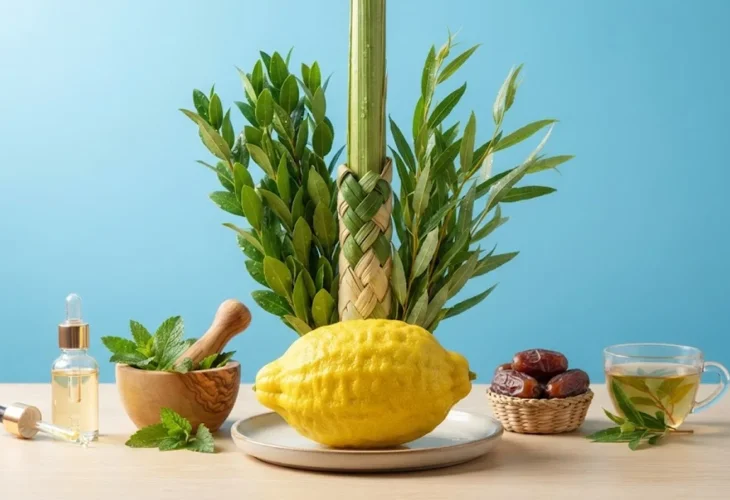
We know the Four Species for their spiritual significance on Sukkot. But the etrog, date palm, hadas, and aravah are also plants with fascinating nutritional and medicinal histories.
Some are foods rich in useful nutrients, while others contain plant compounds that have attracted scientific interest or have been used in traditional medicine for centuries.
So what does science actually tell us about the Four Species?
The Etrog: More Than a Beautiful Citrus Fruit
The etrog, or citron (Citrus medica), belongs to the citrus family and contains a variety of naturally occurring plant compounds.
Like other citrus fruits, etrogim contain vitamin C, although the amount varies considerably depending on which part of the fruit is tested. Research has also identified antioxidants and other bioactive compounds in the fruit and peel.
Vitamin C also plays an important role in helping the body absorb non-heme iron, the type of iron found in plant foods.
The thick peel of the etrog contains aromatic essential oils, which have also attracted scientific interest. Laboratory and animal research has investigated potential biological properties of oils derived from Citrus medica, although this does not mean that etrog essential oil has been proven to treat particular health conditions in humans.
Anyone planning to eat an etrog that was grown specifically for the mitzvah should also be cautious. Ornamental or ritual fruit is not necessarily cultivated according to the same standards as produce intended for eating and may have been treated with pesticides. If you want to turn your etrog into jam or preserves, it is worth checking that it is suitable for consumption and washing and preparing it carefully.
There is also a well-known Jewish tradition of preparing etrog preserves after Sukkot. Eating etrog is associated in some Jewish traditions with segulot relating to fertility and childbirth. These should be understood as traditional segulot, rather than medically proven effects of the fruit.
The Lulav: What About Dates?
The lulav itself is the young frond of a date palm, so we do not eat the lulav. But the tree that produces it also gives us dates.
Dates provide carbohydrates and natural sugars, making them a readily available source of energy. They also contain dietary fiber, potassium, magnesium, and a range of plant compounds.
Their fiber content can support normal digestive function, while potassium plays an important role in fluid balance, nerve signaling, and muscle function.
And what about silan, or date syrup?
Whole dates and date syrup are not nutritionally identical. A whole date retains its natural fiber and other components of the intact fruit, while syrup is a more concentrated source of sugar. For someone looking for the nutritional benefits of the whole fruit, eating dates generally provides more than simply consuming their syrup.
Hadas: An Aromatic Plant With an Ancient History
The hadas, or myrtle, contains aromatic essential oils and a variety of plant compounds, including phenolic compounds.
Myrtle has a long history of use in traditional medicine, and laboratory research has found antimicrobial, antioxidant, and anti-inflammatory activity in extracts and essential oils from the plant.
That makes hadas scientifically interesting—but it is important not to turn preliminary research into medical advice.
Claims that myrtle oil can treat asthma, eye inflammation, fungal infections, acne, coughing, or breathing difficulties are not established enough to recommend it as a medical treatment. Essential oils can also irritate the skin, eyes, and respiratory system, particularly when used incorrectly.
So while the fragrant hadas contains compounds being studied for possible biological effects, anyone with asthma, an infection, eye problems, or breathing difficulties should rely on appropriate medical care rather than inhaling or applying essential oils as a substitute for treatment.
The Aravah and the Surprising Story of Aspirin
Perhaps the most fascinating medical connection belongs to the humble aravah, or willow.
Willow bark has been used for pain and fever for thousands of years. Scientists eventually isolated salicin from willow bark, and researchers later produced salicylic acid from salicin. Those discoveries formed an important part of the scientific path that eventually led to acetylsalicylic acid—the medication we know today as aspirin.
Modern aspirin is not simply willow bark in tablet form. It is acetylsalicylic acid, a distinct compound developed through subsequent chemical research.
Aspirin went on to become one of the world's most widely recognized medications, with pain-relieving, anti-inflammatory, and antiplatelet effects. But that does not mean chewing willow bark or using aravah leaves provides the same dose, safety, or medical benefits as taking a standardized medication.
There is something striking, however, about the history.
The aravah is traditionally described as the member of the Four Species with neither taste nor fragrance. At first glance, it seems to be the simplest of the four.
Yet hidden inside the willow is a family of compounds that helped inspire one of the most famous medicines in modern history.
Perhaps that makes the Four Species even more fascinating. We take them on Sukkot because the Torah commands us to—not because of their nutritional or medicinal properties. But when we look more closely at the natural world, even these familiar plants can contain surprises we might never have expected.

