

Personal Stories
Diagnosed With Cancer Days After Giving Birth: One Mother’s Story of Faith and Hope
Just four days after welcoming her second child, Daniela Schieber learned she had cancer. She shares her emotional journey through chemotherapy, motherhood, recovery, and the miracle of welcoming another baby.
- Moriah Luz
- | Updated
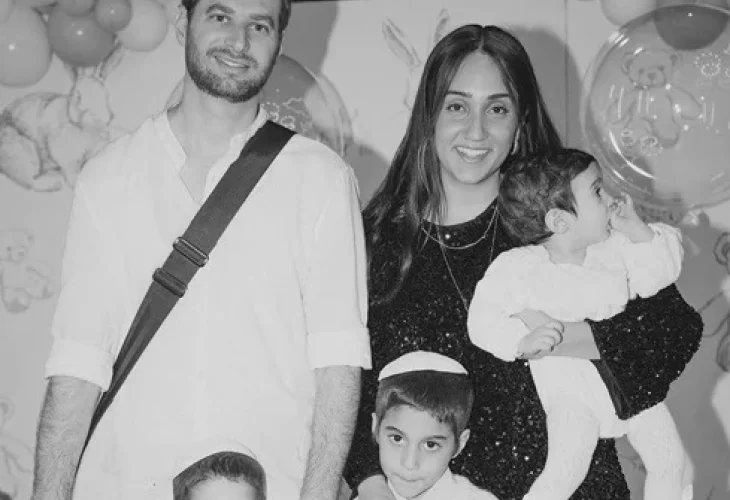
The baby was gently placed on a white pillow and carried to Elijah’s chair for his brit milah. His mother, who had given birth just days earlier, watched with tearful eyes, her lips moving in silent prayer. “I stood there and said, ‘Hashem, I thank You for allowing me to see him born, and I ask You for just one thing: Let me live to raise him.’”
Five and a half years ago, just four days after giving birth to her second son, Daniela Schieber (Golan), now 34, received the devastating news that she had cancer. As we speak, she is putting her sweet two-and-a-half-year-old daughter, Aluma, to sleep, while her two older children, Lavi and Oz, are already tucked into bed. It is an ordinary family moment, yet for Daniela, there is nothing ordinary about it.
“Nothing Can Be Taken for Granted”
Daniela and her husband, Yosef, married young. She was 24, and he was 25. “It took us some time to conceive our first child,” Daniela begins, explaining that their long-awaited pregnancy came after fertility treatments. “Even then, I began to understand that nothing in life can be taken for granted. Many women need time to recover after their first birth, but I remember lying in the hospital after giving birth and announcing, ‘I want another baby!’” she recalls with a laugh.
By the grace of Heaven, just a few months later, the couple discovered that they were expecting again, this time without medical intervention. During the 38th week of her pregnancy, Daniela noticed a small, marble-like lump beneath her skin. Assuming it was simply another pregnancy-related change, she was not particularly concerned. “The next day, I mentioned it to my mother, and she immediately sprang into action.” Appointments with surgeons were difficult to obtain on short notice, but Daniela’s mother refused to give up. “She started calling everyone she knew and using every connection she had. Eventually, she managed to get me an appointment with a surgeon for the very next day.” The examination revealed something unusual. Daniela was referred for an ultrasound, which led to an immediate biopsy. She was told that the results would arrive within two weeks.
You were about to give birth. Were you worried about what the results might reveal?
“I decided to devote all my attention to giving birth. After all, every birth that goes smoothly is a miracle in itself. I pushed the whole issue to the back of my mind and simply waited for someone to call and tell me everything was fine. I assumed that would be the end of the story.”
A few days later, Daniela and Yosef welcomed their second son, a beautiful, chubby baby weighing 4.1 kilograms (just over nine pounds). The day after Daniela was discharged from the maternity ward, just as she was preparing to get some much-needed rest, her phone rang. The number was unfamiliar, and the caller introduced himself as the surgeon she had seen. “He began by asking whether I had given birth and how I was feeling.” Daniela was surprised by the unexpected call, but the conversation quickly took an unsettling turn. The doctor asked her to come to the hospital the following day. “I tried asking him, ‘Doctor, can you please tell me what this is about? I can't wait until tomorrow.’ But he apologized and said he couldn't tell me anything more.”
“I Am Part of Something Much Greater”
The following morning, Daniela and Yosef made their way to the hospital. Daniela's mother stayed home to care for their newborn, assuming they would return within a few hours. “I had just given birth. Everything still hurt, and my body felt completely exhausted,” Daniela recalls. At the hospital, they received the news that would change their lives. “The doctor asked me a few questions and then said, ‘There is no gentle way to say this. You have cancer.’”
Looking back, Daniela remembers something important about the way the doctor delivered the diagnosis. “She told me, ‘This is going to be a difficult year, but you will get through it.’ Those words calmed me. I told myself, ‘Okay, one year. I can do that.’ At that point, I hadn't even undergone all the necessary tests, so I don't know whether she genuinely knew what lay ahead or was simply trying to reassure me. Either way, that sentence gave me hope, and I held on to it.”
The doctor suggested that the couple step outside for some fresh air before discussing the practical details of the treatment plan. “We bought something to eat, but we couldn't taste or enjoy anything. I don't even remember what we talked about. The only thing I remember clearly is one thought that stayed with me: This cancer was a message from Hashem. I had this powerful sense of clarity that everything was being directed from Above, that Hashem was guiding me toward some kind of mission I was meant to bring into the world.”
Three days later, on Shabbat morning, baby Oz entered the covenant of Avraham Avinu. “I stood at his brit milah and cried. I kept thinking, ‘Is it possible that I won't live to see this child grow up?’ But at the same time, the brit gave me a sense of perspective. I realized that I was part of generations upon generations of Jewish women who had brought their sons to the mohel. Throughout every period of Jewish history, including the years of exile and even the Holocaust, the chain of generations continued. That helped me understand that I wasn't here only as an individual. I was part of something much greater.”
The first month after her diagnosis was devoted to fertility preservation. Just days after giving birth, Daniela found herself undergoing hormone treatments. Her doctors had given her only one month to complete the fertility preservation process before she would need to begin cancer treatment. They also warned her that because she had so recently given birth, there was no guarantee the procedure would succeed. Nevertheless, Daniela insisted on going ahead. The process involved two surgical procedures, both of which she paid for herself. She was determined that her family would continue to grow.
“Only Hashem Knows”
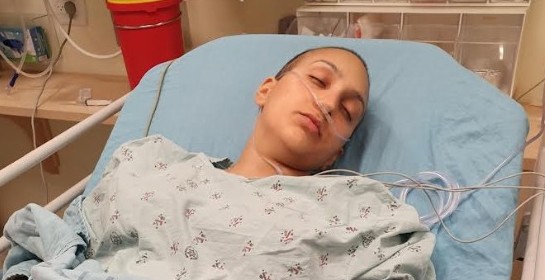
During Chol Hamoed Pesach, the intermediate days of Passover, Daniela began her first round of chemotherapy. When I ask what stands out most vividly in her memory from her battle with cancer, she answers without hesitation: “My hair. Until the very last moment, I had this fantasy that somehow, in my case, my hair wouldn't fall out.”
Her husband, Yosef, was familiar with the experiences of cancer patients through his volunteer work with Zichron Menachem, an organization supporting children and families affected by cancer. “He suggested that we get a wig ready, just in case,” she recalls with a smile. “He kept telling me, ‘Just get one so you'll have it at home.’”
Daniela tried to postpone what she knew was likely inevitable, hoping to hold on to her natural hair for as long as possible. But eventually, her hair began to fall out, and with it came tears. Even so, she has found a deeper lesson in that painful experience. “A bald head sends a visible message to people about what you're going through. I always made sure to dress nicely and look put together when I went to the hospital. From the outside, I looked relatively well. People would see me and say, ‘Oh, you actually look fine.’ And I would think, ‘What am I supposed to do? Show you my bald head or my scars so you'll understand that I'm sick?’” The memory still hurts. “I was ill, and I felt absolutely terrible. The verse says, ‘Man sees what is visible to the eyes, but Hashem sees into the heart.’ Only Hashem truly knows what another person is going through.”
Alongside the physically demanding treatments, Daniela was also caring for a newborn and his older brother, who was just a year and a half old. “Being a mother while you're sick is one of the hardest things imaginable. As a mother, you're supposed to take care of your children. But when you're ill, you simply can't do everything you want to do. Every moment you spend resting comes with guilt. I tried to maintain as much control over the situation as I possibly could.”
Between treatments, her body was extremely weak. Even the simplest movements were difficult. Yet she refused to give up on the things she could still manage. Her chemotherapy treatments were administered every three weeks and accompanied by steroids, which temporarily boosted her energy and made her feel better for several hours. “I decided that on the days I came home from treatment, while the steroids were still working and I had some strength, I would give my son his bath.”
“A Beam of Light”
Daniela's treatment plan included five rounds of chemotherapy, followed by surgery to remove the area where the tumor had been discovered, along with surrounding tissue. “When they removed it, they discovered that there were no cancer cells left at all. The chemotherapy had destroyed them completely.” The following six months were devoted to preventive treatments.
At what point did you realize that your battle with cancer was behind you?
“Nobody throws you a celebration. It doesn't really work that way,” she explains gently. Some hospitals have a tradition in which cancer patients ring a bell to mark the completion of their treatment. But Daniela emphasizes that the reality is much more complicated. “There isn't one particular moment when everything is suddenly over.”
What do you mean?
“For me, at least, the real difficulty began after the treatments ended. While you're undergoing treatment, you're fighting a battle. You have to gather every bit of strength you have just to get through it. It's an intense year. Everyone is around you, supporting you, and you're running on adrenaline. Then suddenly, it's over, and all that energy disappears. At the same time, you're supposedly cancer-free, so people expect you to pull yourself together and return to normal life.”
But the effects of cancer treatment do not simply disappear when the treatment ends. “It affects your entire body, your bones, your muscles, everything. Chemotherapy is almost like undergoing a small death in order to avoid a much greater one. That's what people don't understand.” Daniela also stresses the emotional toll that cancer can continue to take for years afterward. Even long after recovery, seemingly ordinary experiences can suddenly bring back the fear and pain of everything a patient has endured.
Despite everything she has been through, Daniela radiates warmth and positive energy. Our conversation is filled with laughter, and her outlook on life is deeply inspiring. Today, she works as an art therapist and considers raising awareness about cancer screening and early detection among women an important part of her mission.
“Again and again, I realize how much kindness Hashem showed me throughout this journey,” she says. She points to the way her cancer was discovered, thanks largely to her mother's determination. According to the doctor who diagnosed her, had Daniela waited another six months, her condition could have been significantly more complicated. “When cancer reaches stage four and has metastasized, it can become a chronic illness. But when cancer is discovered early, even though the treatments may be extremely difficult, there is still the possibility of a complete recovery. This is a message I feel compelled to share.”
“People are afraid to say the word ‘cancer.’ Instead, they call it ‘the disease.’ I deliberately say the word ‘cancer,’ because I believe that when we magnify our fear of something, we only increase our anxiety. Cancer is something that exists. It is something people can face, and with Hashem's help, it is possible to go on living afterward.”
Toward the end of our conversation, Daniela returns to the subject of her youngest child, her two-and-a-half-year-old daughter. “Cancer treatments often affect fertility. Before I began treatment, I told Hashem that I wasn't willing to give up on having more children. I went through fertility preservation, but Baruch Hashem, I never needed to use it.”
Approximately two years after completing treatment, Daniela began experiencing physical pain that immediately filled her with dread. “I thought, ‘That's it. The cancer has come back.’ But it wasn't cancer. I was pregnant.”
The discovery brought overwhelming joy. The pregnancy itself was not easy, and Daniela struggled with various physical symptoms. At the same time, Yosef was serving in the military reserves.
“And suddenly, there she was, a beautiful, sweet little girl. We named her Aluma. A beam of light after the cancer and in the midst of the war. A little girl whose very existence reminds us that absolutely nothing in life can ever be taken for granted.”

