

Personal Stories
Moran Koors on Faith, Family, and Finding Meaning in Life
Author, lecturer, and media personality Moran Koors shares personal reflections on motherhood, her relationship with Hashem, the importance of Jewish unity, and her lifelong dream of bringing more light into the world
- Moriah Luz
- | Updated
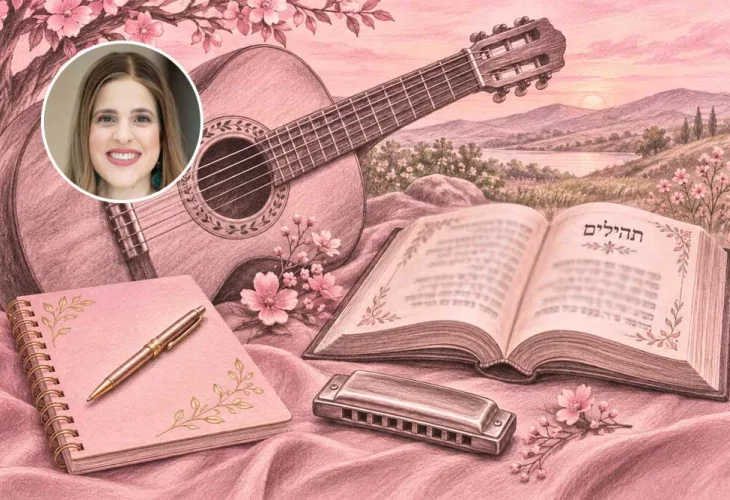 Moran Koors (Photo: Rani Zaranger)
What food takes you back to your childhood?
“My mother's soup and couscous, and bell peppers with cottage cheese—the dinners I used to share with my father.”
What three things would you take to a deserted island?
“A Chitas—the Chumash, Tehillim, and Tanya—so I could pray. Prayer is what allows you to truly connect with your Jewish soul. I'd also take a picture of the Lubavitcher Rebbe to remind me of my purpose in life: helping bring the Redemption.
“And finally, a notebook and pen, so I could sketch the sunset and jot down my thoughts and ideas. Whenever inspiration strikes, I need to write it down, and I prefer doing that on paper rather than on my phone. Cellphones give me headaches.”
What's your guilty pleasure?
“Chocolate.”
How do you recharge after a difficult day?
“Something spiritual—a little Chassidic learning, perhaps a short passage with a particularly powerful message or a letter from the Rebbe. Spending time in nature also helps me unwind. I live in the city, which is challenging for me because I'm someone who really needs to be surrounded by nature. But even something as simple as gazing at the sky or watching birds can restore my energy.”
What's something people might be surprised to learn about you?
“I studied art in high school and used to create beautiful charcoal drawings of live models. I also played the harmonica and guitar, and these days I take a lyrical jazz dance class every week.”
What frightens you most?
“Disunity among the Jewish people. The scenes from Yom Kippur three years ago, when prayer books were thrown and public prayers became a source of confrontation, were deeply painful for me. And then came October 7.
“Disunity weakens us as a people, and I believe strengthening our unity is one of the most important things we can do. I pray that we never have to experience such painful events again.”
When was the last time you cried?
“I'm easily moved to tears. In fact, I find myself crying almost every time my husband or children share a meaningful story at the Shabbat table.
“Last Shabbat, my husband happened to tell us how the custom of Hakafot Shniyot, the second round of dancing with the Torah after Simchat Torah, began. That was the first time I'd heard that the father-in-law of Rabbi Yisrael Meir Lau had established the custom.
“He had arrived in the Holy Land from Europe, and on the night following Simchat Torah, he turned to the people around him and said, ‘Outside Israel, Jews celebrate a second day of Yom Tov. But we have no idea what's happening in Europe—whether there are any Jews left there, or whether they're able to celebrate. So tonight, we'll dance and celebrate for them.’
“And that's what they did. They took out the Torah scrolls and began to dance.
“I found that story incredibly moving. It embodies everything that is so beautiful about the Jewish people: our sense of responsibility for one another, our love for our fellow Jews, and our devotion to Torah and mitzvot.”
What's one thing you'd like to improve about yourself?
“I'd like to become more patient, more assertive, and more deeply grounded in inner peace and trust in Hashem.
“I'm generally a calm person, and thank G-d, I manage to accomplish quite a lot while trying to approach everything with composure. But there are still situations in which I need to strengthen my faith.
“Take the current uncertainty surrounding the formation of the government, for example. We don't know how things will unfold, but I need to remind myself that Hashem is running the world and that the Jewish people are never abandoned.”
What has been your most heartfelt conversation with Hashem?
“I'm constantly talking to Hashem. I simply can't imagine life without those conversations. Speaking to Him is what helps me organize my thoughts and find clarity.
“I'm always turning to Him, whether to ask for help or to express gratitude. My relationship with Hashem is an ongoing conversation, a combination of heartfelt requests and appreciation for everything He gives me.”
What's a childhood dream you've managed to fulfill?
“One of my dreams was to publish a book, and I've been fortunate enough to publish five.
“I also dreamed of making a difference in the lives of other Jews. As a child, I didn't necessarily think of it in those terms, but I was always opinionated and eager to share ideas and meaningful messages. Today, I feel that I'm fulfilling that dream. Of course, there's always more to learn, more to improve, and greater heights to reach.
“But there's one childhood dream I'm still waiting to see fulfilled: the true and complete Redemption.
“Even as a little girl, I was aware of some of life's more painful realities. I didn't have the language to describe what I was longing for, and I certainly didn't call it ‘Redemption.’ But deep down, I always carried an optimistic yearning for peace, for a world in which everything would ultimately be good.”
What quality do you appreciate most in other people?
“I genuinely love people, especially those who are different from me. In fact, the more different someone is, the more curious I become.
“I think I've learned more from people than I have from books. Every person has a story, a perspective, and something valuable to teach us, and I find that endlessly fascinating.
“When I'm invited to speak at women's events, I often tell the audience, ‘I'm the one speaking because I happen to be standing here right now, but what I'd really love is to hear from all of you.’ There's an extraordinary wealth of wisdom to be found in other women's experiences.”
If you could sit down with someone who is no longer alive, who would it be?
“My beloved father. I miss him terribly. No matter what was happening in my life, he always knew how to put me at ease. He would say, ‘Ya binti, everything will be all right. Life is beautiful.’
“There was something rock-solid about his reassurance. It's funny, because his words didn't actually change the circumstances. But the way he said them made everything feel more manageable. He had this extraordinary ability to make me feel safe, and I miss that so much.
“I would also love to sit down with the Lubavitcher Rebbe and ask him, ‘Rebbe, when will the Redemption finally come?’ We're exhausted by this exile, and instead of becoming easier, everything seems to grow more complicated.
“During COVID, I was convinced the Redemption was just around the corner. Then came Operation Guardian of the Walls, followed by October 7, and then Iran entered the picture. Now we're facing elections and uncertainty about the political future.
“Sometimes you simply want to look up to Heaven and ask, ‘Master of the Universe, what is happening here?’”
How would you like to be remembered after 120 years?
“Above all, I want my children to remember me as a good mother—someone who gave them a strong foundation of values and helped them find meaning in life.
“And when it comes to the Jewish people as a whole, I hope I'll be remembered as someone who made a positive difference, brought a little more light into the world, and helped others discover a deeper sense of purpose.”
Which of your accomplishments are you most proud of?
“First and foremost, my children. They come before everything else. They are, without question, my greatest creation.
“I'm also very proud of the five books I've written.
“Another accomplishment that's especially close to my heart is Mitbonenot, my training program. I genuinely believe it offers something unique. We've just launched our fourth cohort, and I haven't come across another program that combines professional, certificate-level training with such an in-depth study of Chassidic teachings.
“And of course, I'm tremendously grateful for the opportunity to create and present my programs on Hidabroot, Not to Be Taken for Granted and Relationships Put to the Test.”
Moran Kors is a media personality, lecturer, author, and founder of Mitbonenot, a center dedicated to training professional coaches.
 For the WomanSearching for Real Values: A Powerful Journey to Judaism
 Behind the NewsYedidya Meir on Faith, Fear, and the Power of Jewish Joy
 Personal StoriesUri Geller on the Lubavitcher Rebbe: “I Still Have His Pen”
 Personal StoriesTeen Injured in Galilee Explosion: A Family’s Story of Faith, Miracles, and Hope

