

Parashat Toldot
Why Did Yaakov Receive Esav’s Blessing? The Abarbanel’s Explanation
In Parashat Toldot, the Abarbanel reveals why Yitzchak intended to bless Esav, why Yaakov fought for the birthright, and what their struggle teaches about Divine blessings and spiritual responsibility
- Yosef Yaavetz
- | Updated
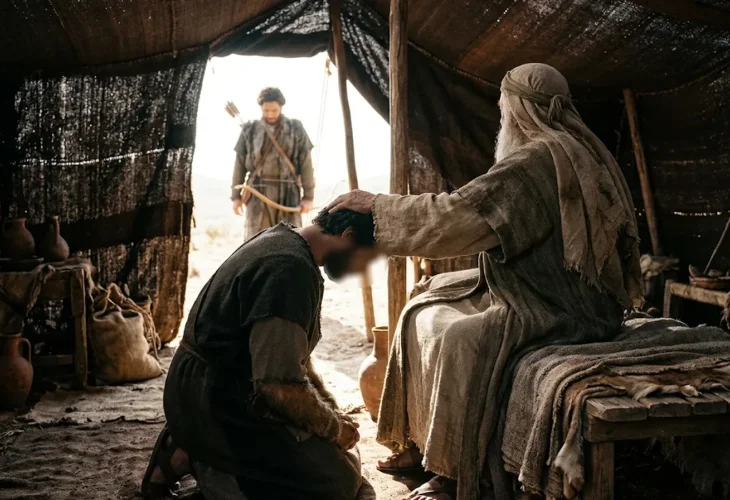
Parashat Toldot introduces one of the Torah's most dramatic family conflicts: the struggle over Yitzchak's blessing. Yitzchak intends to bestow his blessing upon Esav, while Yaakov, with Rivkah's guidance, employs an elaborate strategy to secure it for himself.
The Abarbanel begins his commentary by raising several fundamental questions. The Torah never describes Avraham arranging a similar blessing ceremony for Yitzchak before his death. Why, then, does Yitzchak consider it necessary? And if his intention is to bless his children, why does he summon only Esav? Yaakov would eventually bless all twelve of his sons, and Moshe would bless all the tribes of Israel. Why couldn't Yitzchak simply bless both brothers?
According to the Abarbanel, understanding the answers requires recognizing what was truly at stake. The conflict was not primarily about wealth, status, or paternal affection. It concerned something far greater: who would inherit Avraham's spiritual legacy and become the bearer of Hashem's covenant.
The True Meaning of the Birthright
The most valuable inheritance in Yitzchak's household was the blessing of Avraham: the promise of Divine providence and the Land of Israel. As the Abarbanel explains, this was Yitzchak's true wealth, inherited from his father. The family's livestock and material possessions were secondary to the covenant that distinguished Avraham's household, and Yaakov wanted to become the one entrusted with preserving it.
This understanding sheds new light on the episode in which Esav returns from the field and asks Yaakov for some stew. In exchange, Yaakov demands Esav's birthright. Although the transaction appears to concern inheritance rights, the Abarbanel rejects the idea that Yaakov was motivated primarily by wealth or social status.
Rather, Yaakov recognized the fundamental differences between himself and his brother. He feared that Esav's position as the firstborn might grant him priority in inheriting Avraham's spiritual promises, despite his lack of commitment to them. Yaakov sought to unite the legal standing of the firstborn with the spiritual qualities necessary to carry the covenant forward. He also feared that Esav's conduct might ultimately cause the covenantal inheritance to pass to another branch of Avraham's family.
Esav's Birthright: Privilege or Responsibility?
The Abarbanel offers another dimension to the sale of the birthright. Traditionally, the firstborn was expected to assume responsibility as his father aged, providing for the household, caring for younger family members, and shouldering the burden of leadership.
Yet in the episode of the stew, it is Yaakov who appears to be fulfilling that role. He is at home preparing food, while Esav returns from the field expecting his brother to feed him. From this perspective, Yaakov's proposal becomes a test of responsibility: If Esav is content to leave the practical burdens of the household to his younger brother, why should he retain the privileges associated with being the firstborn?
Esav's response reveals how differently the brothers understand the birthright. "Behold, I am going to die," he declares. As a man of the field, exposed to danger and preoccupied with immediate physical needs, Esav sees little value in assuming the responsibilities associated with Avraham's spiritual mission.
This explains why the Torah concludes the episode with the words, "And Esav despised the birthright." His dismissive attitude suggests that the sale was not merely an impulsive exchange made in a moment of hunger, but reflected a genuine difference in priorities between the brothers.
Why Did Yitzchak Favor Esav?
If Yaakov was better suited to continue Avraham's legacy, why did Yitzchak intend to bless Esav?
According to the Abarbanel, Yitzchak regarded Esav as the natural successor because he was the firstborn. Rivkah, however, possessed information that Yitzchak did not. Before the twins were born, Hashem had told her, "And the elder shall serve the younger." The Abarbanel explains that Yitzchak was unaware of this prophecy, helping explain their opposing decisions.
The Torah's account of Yitzchak's life in the land of the Philistines, which appears between the sale of the birthright and the blessings, provides further insight into his character. When famine strikes, Yitzchak travels to Gerar, where Hashem instructs him not to descend to Egypt, as Avraham had done during an earlier famine. Instead, Hashem promises to remain with him and bless him.
The events that follow demonstrate the fulfillment of that promise. Yitzchak prospers despite the famine, accumulating wealth and influence. His success arouses jealousy, however, and he is eventually forced to leave. Subsequent disputes over wells might suggest that Yitzchak was passive or easily intimidated, repeatedly retreating rather than defending his rights.
The Abarbanel rejects this interpretation. Although Yitzchak left the city, he remained in the region, reopening the wells that Avraham's servants had dug and restoring their original names. In doing so, he asserted his family's established claims without unnecessary confrontation. His conduct reflected wisdom and restraint, not weakness.
The Torah's account therefore establishes Yitzchak as a dignified and capable leader. Nevertheless, when it came to determining which son should inherit Avraham's mission, Rivkah's judgment proved correct.
What Does It Mean to Give a Blessing?
The Abarbanel distinguishes between three meanings of the word blessing. When Hashem blesses a person, He bestows goodness and abundance. When a person blesses Hashem, the blessing expresses praise and gratitude. But when one person blesses another, the act is fundamentally a prayer, asking Hashem to grant goodness to the recipient.
The individual offering the blessing does not independently possess or distribute Divine abundance. Hashem remains its source. This principle is reflected in Birkat Kohanim, where the priests are commanded to bless the Jewish people, yet Hashem declares, "And I will bless them."
In Parashat Toldot, however, the father's blessing carries an additional significance: determining which son will continue Avraham's covenant. Avraham did not need to make this decision regarding Yitzchak because Hashem had already explicitly designated him as the successor. Yitzchak, by contrast, had two sons and believed he needed to establish which one would become the head of the family.
This explains why he could not simply bestow the same blessing upon both brothers. Yitzchak intended to establish one principal heir to the covenant, with the other occupying a secondary position. He believed Esav should assume this role, with Yaakov included under his leadership.
The fact that Yaakov would later bless all twelve of his sons does not contradict this principle. Unlike Yaakov and Esav, the twelve sons would all become founders of tribes within a single nation, collectively continuing the covenantal mission.
Why Did Yitzchak Ask Esav to Prepare Food?
The Abarbanel also addresses Yitzchak's unusual request that Esav prepare a meal before receiving his blessing. According to one explanation, Yitzchak wanted Esav to fulfill the mitzvah of honoring his father, thereby acquiring additional merit and becoming more worthy of the blessing. Recognizing that Esav's conduct was not entirely appropriate, Yitzchak hoped to help him rise to the spiritual position he intended for him.
The Abarbanel also cites the Ran, who explains that the meal was intended to bring joy to the person offering the blessing and prepare him emotionally and spiritually for the occasion.
Nevertheless, the Torah hints that Yitzchak's judgment was mistaken. According to the Abarbanel, the description of his advanced age and failing eyesight carries a symbolic significance as well. Although Yitzchak remained a great and dignified figure, he did not perceive the situation as clearly as Rivkah did.
Rivkah acted with knowledge of the Divine message she had received. She understood that Yaakov was destined to inherit Avraham's covenant and therefore sought to ensure that the blessing reached him. Her confidence rested on a crucial principle: Yitzchak was not the independent source of the blessing. Divine providence would ultimately direct the outcome.
Indeed, Yitzchak blessed Yaakov without recognizing him, and when the truth emerged, he acknowledged the blessing's validity. What initially appeared to be an act of deception became the means through which the intended successor received the blessing.
The Blessing Must Be Earned
The Abarbanel concludes with an important observation about the language of the blessings. They are given in the name of Elokim, a Divine name associated with the attribute of judgment. From this, he derives that the blessings are not unconditional guarantees detached from the recipient's conduct. Their fulfillment depends on the spiritual preparation and actions of those who receive them.
This is the deeper message of the struggle between Yaakov and Esav. The blessing is not an independent possession that can be acquired merely through inheritance, cleverness, or determination. Although human effort plays an important role, Hashem alone determines where His blessings will ultimately rest.
Yitzchak, who offers the blessing, understands that its source is Divine. Yaakov and Esav, who seek to receive it, must likewise recognize that its fulfillment depends on their own spiritual conduct. Ultimately, Parashat Toldot teaches that being chosen to receive a blessing is not simply a privilege. It is a responsibility, one that requires the recipient to become worthy of the extraordinary legacy entrusted to him.
 Parashat ToldotDoes Hashem Love Us for Who We Are? A Powerful Lesson from the Haftarah of Toldot
 Parashat ToldotCan Eating Bring Us Closer to Hashem? A Surprising Lesson from Parashat Toldot
 Parashat ToldotWhy Does Hashem Allow Hardship? A Powerful Lesson on the Purpose of Prayer
 Parashat ToldotWhy Did Isaac Want to Bless Esau? A Powerful Lesson About the Possibility of Change

