Facts in Judaism
The Spiritual Power of Smell: What Judaism Teaches About the Soul
Discover the deeper meaning of fragrance in Judaism, from Havdalah spices and the incense of the Beit Hamikdash to the remarkable connection between scent, the soul, and Mashiach
- Amitai Chanaya
- | Updated
The fragrance of fresh flowers, an etrog, or freshly baked bread can evoke a sense of pleasure and comfort. But according to Jewish teachings, our sense of smell carries a deeper significance, reflecting a special connection between the physical world and the human soul.
The Gemara asks why we recite a blessing over pleasant fragrances and answers by citing the verse, “Let every soul praise Hashem” (Tehillim 150:6). It then asks: “What is something from which the soul derives pleasure, but the body does not? It is the sense of smell” (Berachot 43b).
The Ben Ish Chai (Year One, Parashat Vaetchanan, Halacha 1) explains that although the body also enjoys pleasant fragrances, the soul derives even greater pleasure from them. While physical enjoyment fades when the scent disappears, its impression on the soul can endure.
Our Sages therefore instituted specific blessings over pleasant fragrances, depending on their source. These include Borei Atzei Besamim for certain fragrant trees and woody plants, Borei Isvei Besamim for fragrant herbs, and Borei Minei Besamim for other fragrances. When smelling certain fruits specifically to enjoy their scent, the appropriate blessing is Hanoten Rei'ach Tov Bapeirot, provided the halachic conditions are met (Berachot 43a–b; Shulchan Aruch, Orach Chaim 216).
Why Do We Smell Spices During Havdalah?
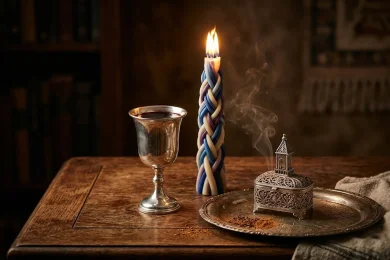
One of the most familiar Jewish practices involving fragrance is the blessing over spices during Havdalah, the ceremony marking the conclusion of Shabbat. The Gemara teaches in the name of Reish Lakish that Hashem grants a person an additional soul, a neshama yeteira, on the eve of Shabbat, which departs when Shabbat ends (Beitzah 16a).
The Rashbam, as cited by Tosafot (Pesachim 102b), explains that the fragrant spices provide comfort following the departure of this additional soul. In many Jewish homes, the spice container is passed around during Havdalah, allowing each family member to recite the blessing and enjoy its scent.
The Fragrance of Gan Eden in Yaakov's Blessing
The significance of fragrance also appears in the Torah's account of Yaakov receiving the blessing from his father, Yitzchak. As Yaakov approached his father, the Torah states: “And he smelled the fragrance of his garments, and he blessed him. And he said, ‘See, the fragrance of my son is like the fragrance of a field that Hashem has blessed’” (Bereishit 27:27).
Rashi raises an intriguing question. Rivka had dressed Yaakov in goatskins as part of the plan to receive his father's blessing. Yet goatskins are hardly associated with a pleasant fragrance. Why, then, did Yitzchak detect such a wonderful scent? Rashi explains that the fragrance of Gan Eden accompanied Yaakov when he entered his father's presence, reflecting the extraordinary holiness of the moment.
What Does the Incense Teach About Jewish Unity?
Fragrance also plays an important role in the Torah's description of offerings and the service of the Beit Hamikdash. After the Flood, Noach offered sacrifices to Hashem, and the Torah states, “And Hashem smelled the pleasing aroma” (Bereishit 8:21). Similarly, the expression rei'ach nicho'ach laHashem, a pleasing aroma to Hashem, appears repeatedly in Sefer Vayikra. These descriptions convey that the offerings are accepted favorably before Hashem, rather than suggesting that He physically requires fragrance.
One particularly meaningful example is the ketoret, the sacred incense offered in the Beit Hamikdash. It contained eleven ingredients, including chelbenah, a substance known for its unpleasant odor. Why would such an ingredient be included in the sacred incense?
The Gemara (Keritot 6b) teaches: “Any communal fast that does not include the sinners of Israel is not considered a fast, for the chelbenah has an unpleasant odor, yet Scripture includes it among the ingredients of the incense.”
Rashi (Shemot 30:34) explains that this teaches us not to exclude those who have sinned from communal fasts and prayers. Just as the incense included the chelbenah, Jewish communal life must make room for those who have fallen short of the Torah's ideals. The lesson is one of belonging and collective responsibility: Even those who have strayed remain part of the Jewish people.
How Will Mashiach Judge Through the Sense of Smell?
Perhaps the most extraordinary connection between fragrance and spiritual perception appears in the prophecies concerning Mashiach. The prophet Yeshayahu describes the future Messianic king with the words: “And he shall be imbued with the fear of Hashem; he shall not judge by what his eyes see, nor decide by what his ears hear” (Yeshayahu 11:3).
The Gemara (Sanhedrin 93b) interprets this verse as indicating that Mashiach will possess an extraordinary ability described as morach veda'in—literally, discerning and judging through smell. Rather than referring to the ordinary recognition of physical odors, this teaching describes an exceptional capacity for spiritual discernment. Mashiach will be able to perceive truth and judge justly beyond the limitations of outward appearances and conventional sensory evidence.
A Sense That Reaches Beyond the Physical
From the spices of Havdalah and the fragrance of Gan Eden to the incense of the Beit Hamikdash and the prophetic description of Mashiach, the sense of smell holds a distinctive place in Jewish thought.
These teachings reveal different dimensions of its significance: comfort for the soul, an expression of holiness, a lesson in communal unity, and a metaphor for extraordinary spiritual insight. Through the blessings instituted by our Sages, even the simple pleasure of enjoying a beautiful fragrance becomes an opportunity to recognize Hashem's presence in everyday life.