

Wonders of Creation
How Trees Water the Soil: The Amazing Science of Hydraulic Lift
Scientists have discovered that some trees redistribute water through their roots, bringing moisture from deep underground to dry soil and even helping nearby plants survive drought
- Yosef Yaavetz
- | Updated
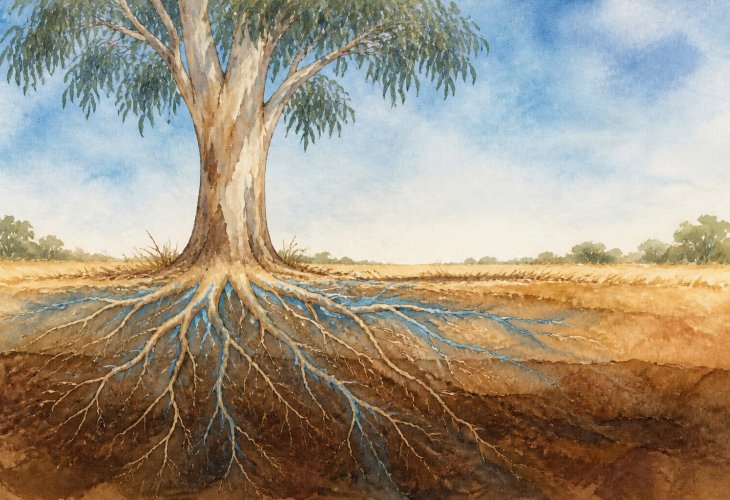
For six months, almost no rain had fallen near Katanning in Western Australia. In April 1997, researchers attached sensors to the trunk and roots of a six-year-old eucalyptus tree growing in an area where a layer of sand, approximately half a meter deep, covered heavy clay soil. Most of the tree's lateral roots spread through the sandy layer, while deeper roots penetrated the clay beneath it.
The researchers monitored water movement through the roots for several weeks, continuing until the first rainfall arrived. What they discovered was remarkable. Before the rain, nighttime measurements showed water moving upward from deeper soil layers toward the surface. After the rain, the direction reversed: Water absorbed by the shallow roots traveled through the tree and down into the deeper roots. Within a single season, the same tree had demonstrated two opposite patterns of underground water movement. How could this happen, and what purpose did it serve?
How Trees Redistribute Water Underground
Scientists call this process hydraulic redistribution. It occurs when different parts of a plant's root system encounter soil layers with different levels of moisture. Water naturally moves from areas where it is more readily available toward areas where it is held more tightly by soil particles. A tree's water-conducting tissues, known as xylem, provide a pathway between these layers, allowing moisture to flow passively through its roots.
When water moves from deeper, wetter soil toward the dry surface, the process is known as hydraulic lift. It often occurs at night, when less moisture is being drawn toward the leaves through transpiration. However, the direction can reverse after rainfall, allowing water absorbed near the surface to move into deeper soil layers. The tree does not actively pump water in either direction. Instead, the movement is driven by differences in water potential between the surrounding soil layers.
The Discovery That Surprised Scientists
The idea that trees could release water back into the soil initially seemed unlikely. After all, roots were generally understood as structures that absorb moisture, not distribute it.
But in 1987, American researchers John Richards and Martyn Caldwell observed something unexpected while monitoring soil moisture throughout the day. Their measurements repeatedly showed increases in moisture beneath the surface during the night, despite the absence of rainfall or another apparent water source.
The researchers proposed that the plants themselves were responsible. Further experiments using water enriched with deuterium, a stable isotope of hydrogen, helped trace moisture as it moved through plant roots and into the surrounding environment. The tracer was subsequently detected in neighboring plants, providing evidence that water released by one plant could become available to others. These findings challenged the conventional understanding of root function and revealed a previously overlooked interaction between plants and their environment.
How Scientists Track Water Movement
To determine precisely when and how water traveled through the roots, researchers developed methods for monitoring sap flow using sensitive heat-based instruments. These sensors detect minute temperature changes associated with water movement through plant tissues, allowing scientists to estimate the direction and rate of flow.
The Australian eucalyptus study offered particularly compelling evidence. By tracking the same tree before and after rainfall, researchers documented a complete reversal in water movement, demonstrating how the root system responded to changing soil conditions.
Why Would Trees Release Water Into the Soil?
At first glance, releasing moisture into surrounding soil might seem disadvantageous, particularly in dry environments. Yet hydraulic redistribution may offer important benefits to the tree itself.
Moistening dry soil can support microbial activity and promote the decomposition of organic matter, helping release nutrients that the tree may later absorb. The additional moisture can also benefit nearby vegetation, particularly during periods of drought. Although neighboring plants may gain access to water redistributed by the tree, the process is not necessarily an act of biological generosity. It can contribute to healthier soil conditions and more effective nutrient cycling around the tree's roots.
A Hidden Network Beneath Our Feet
Since these early discoveries, scientists have documented hydraulic redistribution in more than 60 plant species, demonstrating that the phenomenon is far more widespread than previously believed.
Beneath forests and other landscapes, roots do more than absorb the water needed for survival. They can also redistribute moisture between soil layers, influencing the conditions in which surrounding plants and microorganisms live. These hidden processes reveal an intricate relationship between vegetation, soil, and water—one that usually unfolds entirely beyond our sight.
A tree that appears motionless above the ground may be participating in a remarkable exchange beneath it, helping sustain the environment from which it draws its own nourishment.
"How manifold are Your works, Hashem!" (Psalms 104:24).
 Wonders of CreationPlants That Shoot: Nature’s Hidden Launch Systems
 Wonders of CreationWhy Rivers Flow to the Sea: The Science Behind Water’s Path
 Wonders of CreationHow Do Plants Know Which Way to Grow? The Science Behind Gravity and Growth
 Wonders of CreationNature's Wonders: How Trees Coordinate Their Annual Seed Production

