

Parashat Vayetze
More Than Thank You
We say it every day, but a surprising teaching in Vayeitzei invites us to look again at two familiar words.
- Rabbi Avi Wiesenfeld
- | Updated
In this week’s Parshah Leah gave birth to her fourth child and named him Yehudah. She gave him this name because “הפעם אודה את ה’” – “This time, I thank Hashem.” The Gemara (Berachos 7b) informs us that from the beginning of the creation of the world, there was no one who thanked the Ribono Shel Olam until Leah came and thanked Him. The obvious question is, from Adam ha’Rishon until Leah there were over twenty generations of people – was there no one who thanked Hashem? Did Noach or Avraham Avinu not thank Hashem?
Rav Shimon Schwab zt”l explains that there are two types of “thank you” that we tend to use in life. Perhaps the most common is when people thank Hashem because it hinges on something else. That is, they express their gratitude because subconsciously (or consciously) they want more of that thing, or because they have some other ulterior motive for thanking Hashem. The second type of “thank you” is the sincere, pure form of gratitude that a person feels when he realizes that someone else did something for him.
Leah was the very first person since the creation of the world to thank Hashem in a pure expression of gratitude with no other intentions. To feel and express genuine gratitude for the blessing we have received is a fundamental lesson that Leah taught us.
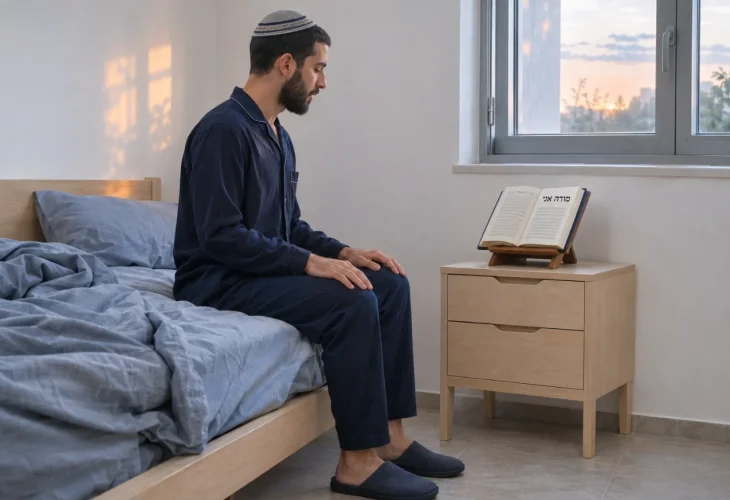
There was a group of top neurologists who had gathered together from around the world for a conference to address various complex issues, and to exchange knowledge in the field of neurology. In one of the seminars, a female neurologist gave a lecture about the phenomenon of people who faint upon waking up in the morning. Her research and investigations found that the blood takes twelve seconds to return to its normal rate of circulation after a person rises from many hours in the supine position. When a person stands up too quickly, the blood circulates and reaches the brain too quickly, which causes a person to feel dizzy and then to faint. She came up with the innovative suggestion that when a person wakes up in the morning, he should first sit for approximately twelve seconds so that the blood circulation can adjust to an upright position, and only then stand up. She received a standing ovation for her research from the top neurologists in the world.
The next speaker was a religious Jew, also a professor of neurology. He stood behind the lectern and said, “We have a tradition from thousands of years ago to recite a prayer as soon as we wake up in the morning. That prayer is called Modeh Ani. We thank G-d for allowing us to have another day alive, to wake up and to be able to fulfill our G-d-given mission in this world. This prayer contains exactly twelve words and takes approximately twelve seconds to say when recited with proper concentration.”
 PassoverPassover Laws: Chametz, Kitniyot, Medicines and Daily Products
 Parashat MishpatimEvery Cry Is Heard: The Torah’s Message About Widows and Orphans
 Parashat HaazinuFrom the Rebbetzin's Shabbat Table - Parashat Ha'azinu
 Parashat VayetzeRabbi Ovadia Yosef’s Secret to Torah Greatness: A Lesson From Parashat Vayetzei

