

Wonders of Creation
Scientists Discover Fire Amoeba That Thrives in Extreme Heat
A remarkable microorganism discovered in California's Lassen Volcanic National Park can reproduce at temperatures of 63°C (145°F), challenging the known limits of complex cellular life and potentially opening new avenues for biotechnology and medical research
- Yosef Yaavetz
- | Updated
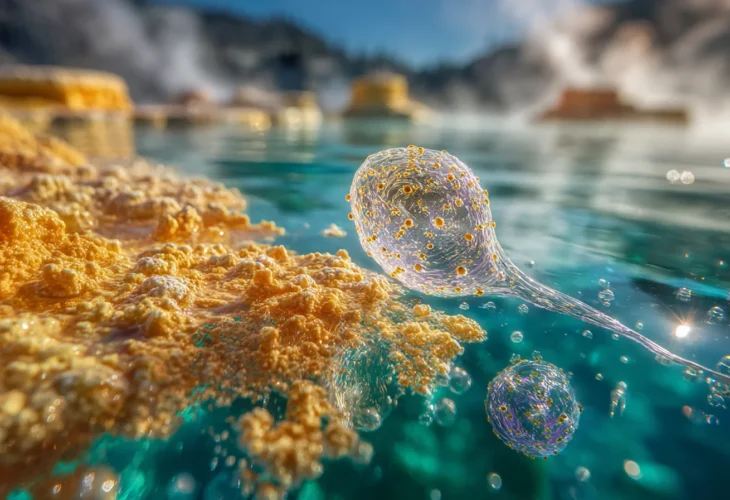
In Lassen Volcanic National Park in northern California, a landscape filled with hot springs and steaming geothermal vents, scientists collected a water sample from a small stream. Hidden within it was a microscopic organism capable of feeding, moving, and reproducing at temperatures previously considered beyond the limits of life for cells of its kind.
Researchers named it the Fire Amoeba of the Cascades, after the mountain range where it was discovered. Remarkably, this tiny organism can reproduce at temperatures as high as 63°C (145°F), setting a new record for heat tolerance among complex single-celled organisms.
The Remarkable History of Heat-Resistant Microorganisms
Some microorganisms can survive at far higher temperatures, and their discoveries have already transformed modern science.
In 1966, microbiologist Thomas Brock and his student Hudson Freeze collected samples from the hot springs of Yellowstone National Park. One sample contained a bacterium later named Thermus aquaticus, which researchers found could grow at temperatures reaching approximately 79°C (174°F).
Why should anyone care how much heat a bacterium can withstand? As it turns out, this discovery helped revolutionize modern biotechnology. One of the most important techniques in molecular biology is the polymerase chain reaction, or PCR, which allows scientists to make millions of copies of specific DNA sequences. The process requires repeated heating and cooling, but many enzymes lose their function at high temperatures, much like the proteins in an egg change structure when cooked.
Thermus aquaticus provided a solution: a heat-stable enzyme known as Taq polymerase, which became an essential tool in PCR technology. Today, DNA amplification plays a central role in genetic testing, disease diagnosis, and medical research.
In 1997, scientists identified another extraordinary microorganism, Pyrolobus fumarii, living near hydrothermal vents on the floor of the Atlantic Ocean. This organism, which belongs to the domain Archaea rather than Bacteria, can grow at temperatures reaching approximately 113°C (235°F), with an optimal growth temperature of around 106°C (223°F). Researchers also reported that cultures survived exposure to 121°C (250°F) for an hour. Yet the newly discovered fire amoeba is remarkable for an entirely different reason.
Why Is the Fire Amoeba So Unusual?
Unlike bacteria and archaea, amoebas are eukaryotes, organisms whose cells contain a nucleus and other specialized structures. The same basic cellular organization is found in animals, plants, and fungi. Eukaryotic cells must maintain several interconnected systems, including their membranes, organelles, proteins, and genetic machinery. Excessive heat can disrupt these structures, and damage to even one essential component may prevent the cell from reproducing.
Before the discovery of the fire amoeba, the highest known growth temperatures for eukaryotes were around 60°C (140°F), recorded in certain species of red algae and fungi. The new amoeba raised that limit to 63°C (145°F).
But finding an amoeba in hot water does not necessarily prove that it can live there. It might simply have been carried into the stream by the current. To verify its abilities, researchers cultivated the organism under controlled laboratory conditions and monitored its activity using microscopy equipment designed for high temperatures.
Their observations confirmed that the amoeba could move, feed, and divide under extreme conditions. They also found that cells exposed to 70°C (158°F) for five minutes could recover when returned to more favorable temperatures, although no recovery was observed after exposure to 80°C (176°F). These findings established an important distinction between the temperatures at which the organism can reproduce and those it can briefly withstand.
How Could This Discovery Benefit Medicine?
The fire amoeba's unusual biology could have implications well beyond setting a scientific record. Understanding how it protects its cellular structures may help researchers develop more stable enzymes and biological systems for laboratory and industrial applications.
The potential is particularly intriguing given the precedent established by Thermus aquaticus. A bacterium discovered in a remote Yellowstone hot spring ultimately provided an enzyme that transformed genetic research and medical diagnostics.
Scientists are now investigating the mechanisms that allow the fire amoeba's complex cellular machinery to function in such an extreme environment. These findings may eventually contribute to biotechnology and medical research, although possible applications in genetic medicine and disease treatment remain speculative.
Redefining the Limits of Life
The discovery also challenges scientific assumptions about the environmental limits of complex cells. Research into the boundaries of life depends not only on what biology theoretically permits, but also on which organisms scientists have actually discovered and successfully cultivated. The difference between 60°C and 63°C may seem insignificant on a thermometer, yet those few degrees can challenge existing explanations of how complex cells function under extreme conditions.
The findings also have implications for astrobiology, the study of life's potential beyond Earth. Understanding the environments in which complex cells can survive may help scientists assess which conditions elsewhere in the universe could support living organisms.
The fire amoeba has joined a remarkable group of microscopic discoveries that have expanded our understanding of life's capabilities. And just as a heat-loving bacterium from Yellowstone helped transform modern genetics, this tiny inhabitant of California's volcanic landscape may one day inspire valuable scientific innovations.
For now, its achievement is already extraordinary: It has demonstrated that complex cellular life can thrive at temperatures once thought to be beyond its reach.
 Wonders of CreationTorah and Science: Why Ancient Jewish Wisdom Anticipated Modern Discoveries
 Wonders of CreationWhy Is Bee Honey Kosher? The Talmud’s Answer Centuries Ahead of Science
 Wonders of CreationWhat Are the Waters Above the Heavens in Genesis?
 Wonders of CreationSecrets Beneath Our Feet: Discovering the Wonders of Earth

