Simchat Torah
Why Do We Dance With the Torah? The Deeper Meaning of Simchat Torah
Discover the profound love for Torah that has united generations of Jews and why this celebration goes far beyond simply completing the annual Torah-reading cycle
- Rabbi Moshe Grylak
- | Updated
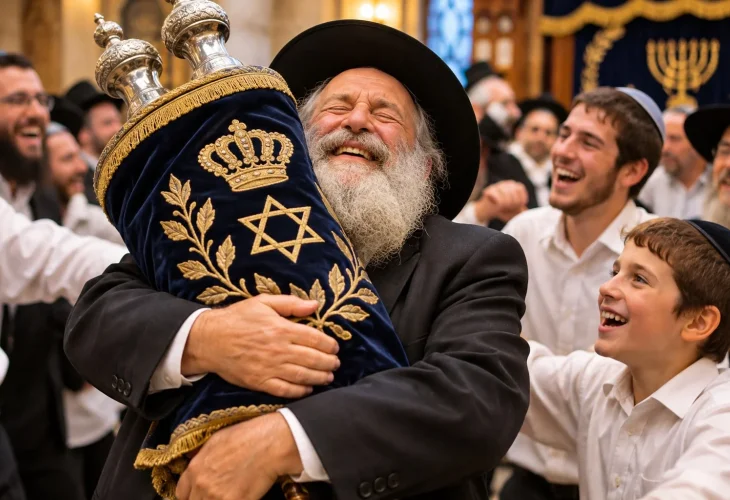
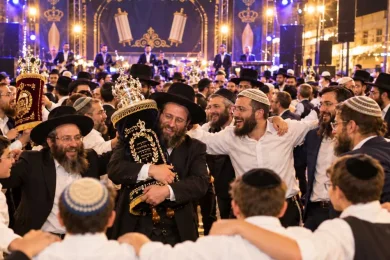
Every year on Simchat Torah, an extraordinary scene unfolds in Jewish communities around the world. Young and old gather in synagogues, embrace Torah scrolls, and dance with boundless enthusiasm for hours. The celebration marks the completion of the annual Torah-reading cycle and its immediate renewal with the opening verses of Bereishit.
What inspires such overwhelming joy? We understand that the Torah is the foundation of Jewish life, the source of our laws, values, and spiritual identity. For thousands of years, it has shaped the Jewish people and given meaning to their existence. Yet the emotional connection expressed on Simchat Torah seems to transcend ordinary logic. What other book or historical document inspires people to embrace it, dance with it, and celebrate it with such unrestrained affection?
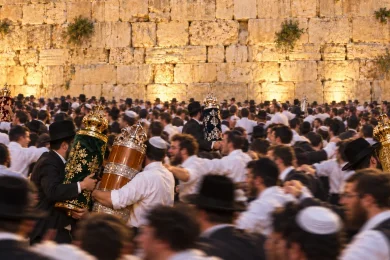
From Tel Aviv to New York, Moscow to Johannesburg, Buenos Aires to Marrakesh, Jewish communities celebrate in remarkably similar fashion. Torah scrolls are carried through synagogues as worshippers dance in circles around them. When the buildings can no longer contain the crowds, the dancing spills into courtyards and sometimes even into the streets. And all this joy surrounds a scroll of parchment.
A Celebration That Survived Even the Darkest Times
Perhaps even more remarkable is that this celebration has endured through some of the most difficult periods in Jewish history. Even under persecution, oppression, and unimaginable suffering, Jews continued to rejoice with the Torah. Accounts from the Holocaust describe Jews marking Simchat Torah in ghettos, forests, hiding places, and even concentration camps.
Another striking aspect of Simchat Torah is that the celebration itself was not explicitly commanded in the Torah or established in its familiar form by the prophets or the Sages of the Talmud. Rather, its customs developed over generations as Jewish communities began celebrating the completion of the annual Torah-reading cycle. In this sense, Simchat Torah represents a spontaneous expression of Jewish devotion, a celebration that emerged from the people's relationship with the Torah rather than from an explicit biblical commandment.
Why Celebrate a Book Filled With Obligations?
The question becomes even more intriguing when we consider the Torah's contents. It contains 613 commandments, encompassing virtually every dimension of Jewish life. Its demands are extensive, requiring discipline, sacrifice, and a lifelong commitment to spiritual growth. Throughout history, the Jewish people's distinctive commitment to Torah observance has also contributed to their separation from surrounding societies, sometimes making them targets of hostility and persecution. The Torah itself contains severe warnings and passages of rebuke, describing the suffering that may follow when the Jewish people abandon their covenant with Hashem.
Why, then, should a book containing so many obligations, restrictions, and difficult warnings inspire such extraordinary happiness? After all, when was the last time anyone danced joyfully while holding a thick volume of tax regulations? And even that comparison hardly captures the scope of the Torah's demands.
The answer can be found in a single word: Love.
The Language of Love
The Talmud connects the verse from Shir HaShirim, “Many waters cannot extinguish love” (Song of Songs 8:7), with love for Torah (Sotah 21a). This teaching offers a different way of understanding Simchat Torah. Love cannot always be explained through practical considerations or rational analysis. It involves a recognition that something is profoundly connected to who we are, providing a sense of belonging and wholeness.
We encounter a similar recognition in the Torah's account of Adam and Eve. In the second chapter of Bereishit, Hashem brings the animals before Adam, but none can provide the companionship he seeks. Only when Eve is presented to him does Adam declare, “This time, she is bone of my bones and flesh of my flesh” (Genesis 2:23). Adam recognizes a connection that answers something essential within him. His words, “This time,” express the realization that he has finally found what was missing.
The Jewish people's relationship with the Torah can be understood in much the same way. It provides spiritual direction, meaning, and identity, becoming an inseparable part of Jewish existence. This is why the Torah is frequently compared in Jewish teachings to a bride and the Jewish people to a groom. The metaphor expresses a relationship that extends beyond obligation to one of profound personal attachment.
When Torah Becomes Life Itself
Anyone who has observed devoted Torah scholars may recognize something of this attachment. Despite spending long hours immersed in study, they often find it difficult to tear themselves away. Even during periods of hardship, many continue learning with extraordinary dedication. For them, Torah is far more than a historical document, a moral guide, or a collection of religious laws. It is a source of spiritual vitality, something they experience as essential to life itself.
The dancing on Simchat Torah is therefore not simply a celebration of completing a book, but the outward expression of a connection cultivated throughout the year through study, observance, and devotion. This sentiment has united generations of Jews across centuries. Despite enormous changes in language, geography, culture, and historical circumstances, the essential relationship has endured. The words used by the Sages thousands of years ago to describe their attachment to Torah continue to resonate with students today.
That is why Jews have danced with Torah scrolls in times of prosperity and in moments of profound suffering. And it is why completing the Torah never marks an ending, but immediately leads to a new beginning.
Ultimately, Simchat Torah celebrates something that cannot be reduced to duty or intellectual appreciation. It is the recognition that the Torah is part of who we are. It is the joy of Adam's declaration, “This time, she is bone of my bones and flesh of my flesh,” and the enduring love that connects generations of Jews to the Torah, wherever they may be.