

Simchat Torah
What Happens to Your Brain When You Dance on Simchat Torah?
From balance and memory to social connection, dancing engages multiple systems in the brain at once. Here’s the fascinating science behind the joy of Simchat Torah.
- יצחק איתן
- | Updated
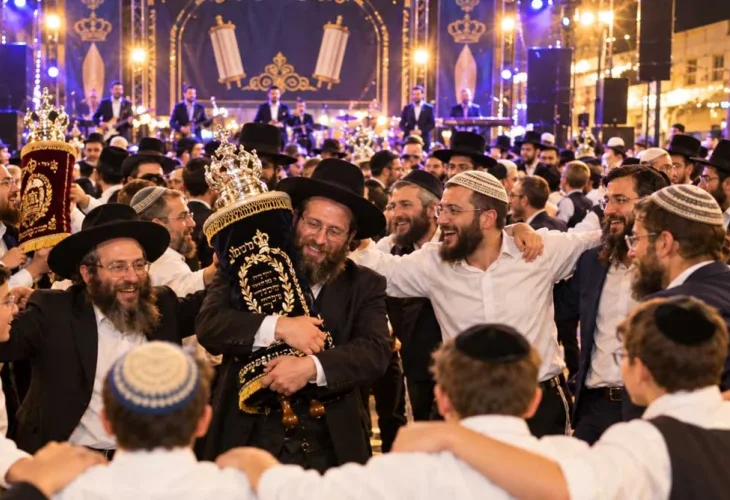
On Simchat Torah, the sight is unmistakable: circles of people dancing together, singing, clapping, and celebrating with the Torah. The hakafot can continue for hours, filling synagogues and streets with movement and joy.
But while we experience the dancing as an expression of spiritual celebration, something fascinating is also happening inside the body and brain.
Dancing is an unusually complex activity. The brain must coordinate movement, maintain balance, follow a rhythm, respond to music, remember patterns, and constantly adjust to the people and space around us. Add the social experience of moving together with a group, and multiple systems are being engaged at once.
Why Moving Together Feels So Powerful
Music and rhythmic movement engage brain systems involved in reward, motivation, movement, and emotion. Dopamine, a neurotransmitter involved in reward and motivation, plays an important role in how the brain responds to pleasurable musical experiences, although the neuroscience of dancing itself is more complex than simply saying that dancing “releases dopamine.”
There may be something particularly powerful about dancing with other people.
Research into synchronized movement suggests that when people move together in time, they may experience a stronger sense of social connection and closeness. Studies have found associations between synchronized movement and increased bonding, cooperation, and feelings of affiliation.
That makes the dancing of Simchat Torah particularly interesting. We are not simply exercising beside one another. We are singing the same songs, following the same rhythm, and moving together in a circle around the Torah.
The experience is physical, emotional, social, and spiritual at the same time.
Dancing Gives the Brain a Workout
Unlike many forms of repetitive exercise, dancing continuously asks the brain to adapt.
You have to maintain your balance, coordinate your steps, respond to changes in rhythm, avoid bumping into the person beside you, and adjust your movements as the circle speeds up or slows down. The brain is constantly receiving information and responding to it in real time.
Research has therefore explored whether regular dancing could have benefits for brain health, particularly as people age.
One German study comparing older adults who participated in dance training with those who took part in conventional fitness training found changes in areas of the brain including the hippocampus, which plays an important role in memory and learning. Both groups showed benefits, while dancing also presented participants with the additional challenge of continually learning changing movement patterns.
This does not mean that a night of dancing on Simchat Torah will transform the brain. But it does illustrate why researchers are interested in dance as a uniquely rich activity: it combines physical movement with music, coordination, learning, balance, attention, and social interaction.
The Joy of Dancing Together
Long before neuroscientists began studying synchronized movement or the effects of dance on the brain, Jewish life made communal dancing an expression of celebration.
On Simchat Torah, that joy has a particular focus. We dance not because we have finished with the Torah, but because we are beginning it again. The Torah scrolls are held close as the congregation circles, sings, and celebrates together.
Modern research can describe some of what happens to us physically when we dance: muscles move, balance systems engage, the brain processes rhythm and music, and moving in synchrony can strengthen feelings of social connection.
But those measurements describe only one dimension of the experience.
When we step into the hakafot, we are engaging body, mind, and community at once. And on Simchat Torah, all of that movement is directed toward something even greater: expressing our joy in the Torah and our connection to Hashem.

