

Personal Stories
Diagnosed With Multiple Sclerosis at 37: A Mother's Journey From Self-Blame to Faith
After a devastating MS diagnosis left her unable to walk, a mother of eight discovered that healing meant more than medical treatment. Her remarkable journey taught her to let go of self-blame, embrace her limitations, and turn to prayer for strength.
- Moriah Luz
- | Updated
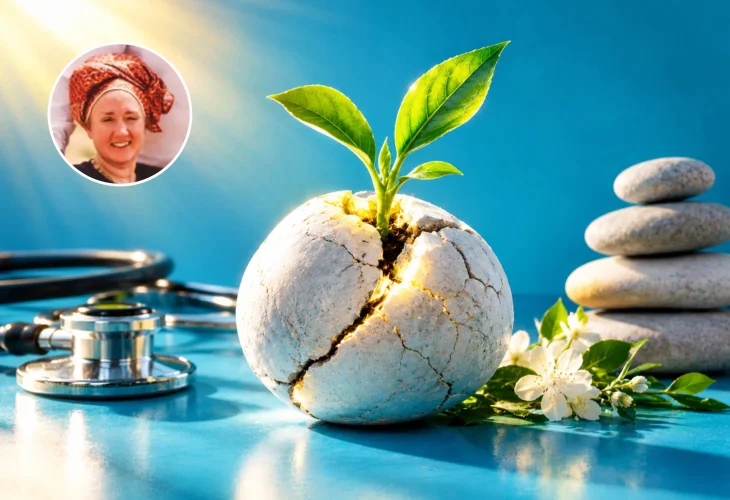
A black-and-white image flickered across the computer screen. Milka Portal sat opposite a solemn-faced doctor who pointed to the scan. “This is a CT scan of your brain. Do you see all these spots? You have numerous lesions in your brain. You have multiple sclerosis.”
Portal had grown up in a home where medications were avoided and white flour was practically forbidden. Her family believed that healthy eating was the key to preventing illness and avoiding hospitals altogether. But at 37, everything she thought she knew about health was suddenly called into question. In an interview with Hidabroot, Portal recalls laughing in disbelief when she received her diagnosis, the terrifying car accident that followed, and the realization that overcoming her relentless self-criticism would require a different approach: learning to turn to Hashem in prayer.
The Diagnosis That Changed Everything
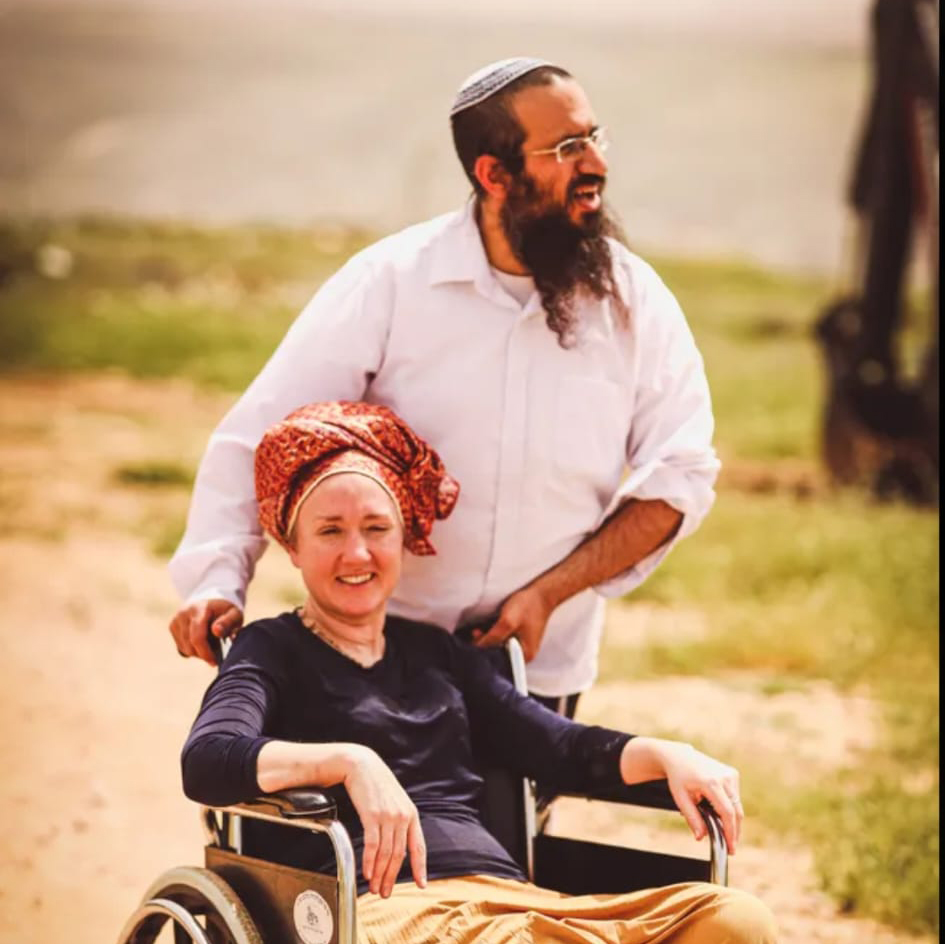
Four years ago, Portal, now 41, was a mother of eight young children and a kindergarten teacher when she began experiencing a mild tingling sensation in her legs. It was the end of Elul, with a busy succession of Jewish holidays approaching, and she initially dismissed the unfamiliar symptoms. “On Rosh Hashanah, I was returning from synagogue with a guest and my baby in a stroller,” she recalls. “As I went down the stairs, my legs suddenly became stiff, and I fell.”
When the sensation persisted after Sukkot, her eldest daughter urged her to seek medical attention. Portal finally visited a clinic on a Friday morning, expecting a routine examination. Instead, the doctor listened carefully and instructed her to go straight to the hospital. “What's the urgency?” she asked, hoping to postpone the visit until Sunday. But the physician insisted that she could not wait.
“At Sheba Medical Center, they immediately began running tests—a great many tests, including a brain scan,” she recalls. Within two hours, she received the diagnosis. Multiple sclerosis (MS) is a chronic autoimmune disease in which the immune system mistakenly attacks myelin, the protective covering surrounding nerve fibers in the central nervous system. The resulting damage disrupts communication between the brain and body and can cause a wide range of neurological symptoms.
“When the doctor told me, I burst out laughing,” Portal recalls. “I said, ‘You don't understand. I'm healthy!’”
Her response reflected a worldview that had shaped her entire life. “When I was young, my parents made a major lifestyle change and became vegan. Today, that's a familiar concept, but back then, we were considered very unusual. We ate incredibly healthy food. No candy whatsoever, not even on Shabbat. White flour was completely out of the question, and we ate only whole-grain bread. We never used medications.”
The family's conviction went beyond dietary preferences. “My parents used to say that if everyone ate properly, hospitals could close because nobody would need them. My siblings and I all went on to establish similarly health-conscious homes. When I received my diagnosis, it shook our entire family.”
“I Was Constantly Attacking Myself”
Looking back, Portal believes her physical illness forced her to confront something she had long struggled with emotionally: relentless self-criticism. “I was constantly attacking myself,” she explains. “MS is an autoimmune disease in which the body attacks itself. So, emotionally, it seemed almost logical to me that this was the illness I had developed.”
This was her personal interpretation of the experience, rather than a medical explanation for the disease, but it helped her recognize a longstanding pattern in the way she treated herself.
To illustrate, she recalls a painful professional experience approximately fifteen years earlier. After several years working as a kindergarten director, she was asked to establish a new kindergarten in a developing neighborhood. The building lacked proper water and electrical infrastructure, its facilities were inadequate, and funding was extremely limited. “I had to fight for everything and build the entire program from nothing,” she recalls. “But none of that bothered me. I loved the work, and I loved the children.”
A year later, a new supervisor took over. “She didn't recognize anything good in what I'd accomplished. One day, she called me in for an extremely difficult conversation. I was pregnant at the time, and afterward, I began experiencing contractions and was placed on pregnancy-related bed rest.”
Even years later, Portal struggles to hold back tears when recalling the incident. She never returned to the kindergarten she had established and subsequently worked only as a substitute teacher rotating between kindergartens. “The experience hurt me terribly, and I went to many therapists because of it. I kept blaming myself, thinking that if only I'd been different in this way or that, none of it would have happened.”
The same tendency appeared in everyday situations. She blamed herself for disorder in the family home, interpreting the ordinary clutter of a household with young children as evidence of a personal failing. “I felt that I was the mess. Wherever I went, I created chaos. It wasn't the children making the house messy—it was me.”
A Terrifying Accident and a Rapid Decline
Portal soon experienced the debilitating effects of multiple sclerosis firsthand. Her initial treatment involved intravenous steroids, after which she was discharged with instructions to return for another infusion several days later. On the day of her next appointment, she felt well enough to drive herself to the hospital.
“I drove there, received the infusion, and everything seemed fine,” she recalls. “My father decided to come and keep me company. He sat beside me while I received the treatment, and we talked.”
Afterward, Portal returned to her car and started the engine. Suddenly, her legs began jerking uncontrollably. “I had no control over them. Instead of pressing the brake, I pushed down hard on the accelerator.” Her car collided with a parked vehicle, which struck another car, setting off a chain-reaction accident. “I sent the car in front of me flying into the one ahead of it. It was a complete chain collision.”
Shaken, Portal attempted to get out of the vehicle but discovered that other muscles were no longer responding properly. She called her father, who immediately returned to help her. “When I finally got home, I collapsed onto the sofa and couldn't do anything. My entire body felt electrified. I couldn't even bear having my hands touch each other or another part of my body.”
“This Has Gone Too Far”
As Portal's condition deteriorated, her husband, Avraham, desperately searched for additional treatment options. “One day, he handed me the phone and asked me to speak with someone. It was a man who introduced himself as a Japanese acupuncture practitioner and claimed he could cure my multiple sclerosis.”
Portal began receiving alternative treatments, experiencing periods of apparent improvement followed by worsening symptoms. Eventually, her condition became increasingly severe. “My nerves seemed to go numb. My abdomen lost sensation, and I no longer felt hungry. I was losing sensation and control over basic bodily functions.”
Frightened, she consulted another alternative practitioner, who prescribed an extremely restrictive diet consisting almost entirely of green smoothies without fruit. “The diet left me unbelievably weak,” she recalls. “I couldn't stand for even a moment, not even with a walker. Eventually, I lost so much sensation that I couldn't even manage to pull a blanket over myself.”
Her father visited every week, each time discovering that she had lost another ability. Finally, he told her, “This has gone too far. At this rate, we're going to have to move you into a nursing facility.” When she asked what he suggested, his response was simple: “Go to the hospital.”
He also sought a blessing from Rabbi David Abuchatzeira, whose advice proved deeply significant to the family. “Both natural medicine and conventional medicine,” the rabbi instructed, “and you will see salvation.”
For Portal, those words represented a fundamental shift in perspective. “It was exactly the wake-up call our family needed. Hashem is the Healer—not natural medicine and not conventional medicine. Our responsibility is to make the appropriate effort: eat well, exercise, and also take medication when necessary.”
Portal returned to the hospital, where she received conventional treatment, including intravenous steroids and a blood-filtering procedure. “For the first time in a long while, I could move again. I could turn over in bed. You have to understand that when I entered the hospital, I couldn't even press the button to call a nurse.”

A New Treatment and an Unexpected Blessing
Determined to improve her condition, Portal consulted another specialist, who introduced her to a biological medication she had never heard of before. “He explained that the treatment would target the immune system, allowing it to rebuild in a different way,” she recalls.
The concept challenged her previous understanding of health. “I had spent my entire life eating carefully and trying to strengthen my immune system. Now I was facing a disease in which my immune system was attacking my own body.” The treatment proved transformative for Portal. “I began walking again and regained my independence,” she says.
Her recovery also brought an unexpected development. When she was first diagnosed, she had been told that having additional children would not be possible. Yet approximately a year after beginning the new treatment, she gave birth to a son, Yosef Daniel.
“Children are the most beautiful thing in the world,” she says. “When I was hospitalized and people asked how many children I had, I would say eight and add, ‘They're the best thing I've ever done.’ Having children means becoming a partner in the work of Creation.”
The baby's brit milah took place on the same day that another of Portal's sons celebrated his bar mitzvah. “We had a brit in the morning and a bar mitzvah in the evening,” she recalls. “We live in a remote community, and everyone joked that since the whole family was already there, perhaps one of our older children should get engaged too.”
At the time, the suggestion seemed ridiculous. Her older children were not considering marriage. But a week later, her son surprised the family by announcing his engagement. Shortly afterward, her daughter became engaged as well. “Within one year, we celebrated a brit, a bar mitzvah, and two weddings.”
Learning to Replace Self-Blame With Prayer
Toward the end of our conversation, I ask Portal whether she has managed to overcome the harsh self-criticism that once dominated her thoughts.
“I went to many therapists, and they all told me, ‘Love yourself,’ ‘Accept yourself,’ and ‘Forgive yourself.’ But I couldn't connect with any of those statements.”
Eventually, she met a therapist who took a different approach. “Instead of asking about me, she asked about my children. She wanted me to describe each child's strengths, weaknesses, and the things I wanted to pray for on their behalf.”
Portal began speaking about her eight children, describing their individual qualities and struggles. When she finished, she suddenly felt compelled to apply the same exercise to herself. “I know my strengths, and I'm an expert at identifying my shortcomings,” she says. “But I'd never prayed about those shortcomings. I'd never asked Hashem to help me overcome them.”
For years, she had believed that everything depended entirely on her own actions. If something went wrong, she held herself personally responsible. “In a way, I made myself into God,” she reflects. “I thought that if I did something, it would happen, and if I didn't, it wouldn't. That's why I was constantly angry with myself.”
She now finds comfort in the words of the blessing Borei Nefashot, which describes Hashem as the Creator of living beings and their deficiencies. “Hashem creates us with our shortcomings,” she explains. “He knows that we're imperfect, and He wants us to find joy in His creation.”
Portal is careful not to present her emotional transformation as complete. “I'm not yet at the point where I can say I fully accept and love myself. But I've moved from self-criticism to prayer. I've learned to say, ‘Hashem, please give me the ability to be more organized. Help me with this.’”
Her illness, she believes, has taught her something she could never have understood through healthy eating or personal effort alone: she does not have to control everything. “From my own body, I have come to recognize Hashem,” she says, echoing the biblical verse Mibesari echezeh Eloka (Job 19:26). “Hashem showed me that I can be small and limited, while He has the power to lift me up, restore my health, and fill my life with blessings and happiness.”
For Portal, the greatest change has not been the disappearance of every challenge or imperfection, but the realization that she no longer needs to face them through blame and self-reproach. She can acknowledge her limitations, take the steps within her power, and turn to Hashem for help with everything beyond her control.
 Personal StoriesGrandma's Recipe: An Unexpected Message From Heaven
 MagazineTurning Diagnosis into Direction: Living with MS
 Personal StoriesIsraeli Singer Itzik Kala Opens Up About Faith, Cancer, and the Loss of His Daughter
 For the WomanFrom Diagnosis to Purpose: One Woman's Journey with Multiple Sclerosis

