Interesting
How Do Cashews Grow? The Surprising Truth About Cashew Nuts and Their Fruit
Discover why cashews grow beneath a colorful fruit called the cashew apple, how both are used in cooking, and why cashew nuts are never sold in their shells
- Tehila Cohen
- | Updated
The cashew tree, scientifically known as Anacardium occidentale, is an evergreen tree native to tropical America. Portuguese traders introduced it to Asia, and today it is cultivated in tropical regions around the world. Under suitable conditions, the tree can grow to approximately 12 meters (40 feet) tall.
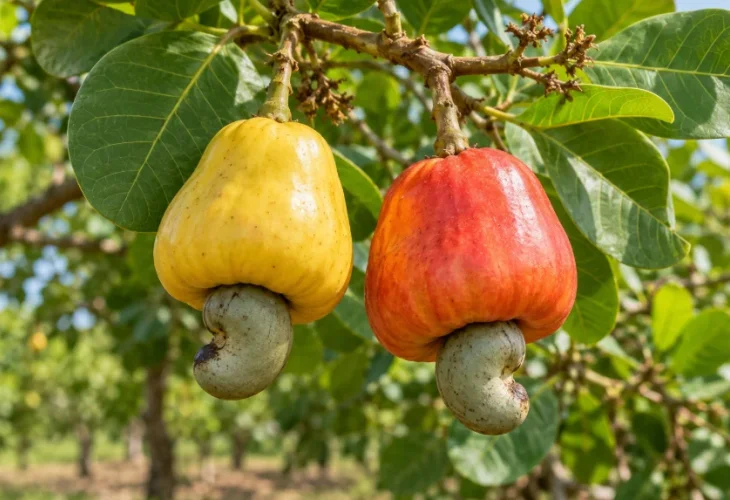
We're all familiar with the cashew's distinctive curved shape, but anyone seeing one growing on a tree for the first time might struggle to recognize it. That's because the cashew grows attached to a fleshy yellow or red structure resembling a cross between an apple and a bell pepper. The cashew itself is enclosed in a hard shell hanging beneath it.
What Is a Cashew Apple?
The colorful, fleshy structure is known as the "cashew apple" because of its appearance, although it is not related to ordinary apples. It develops from the thickening of the flower stalk and surrounding tissues and is botanically classified as an accessory fruit, sometimes called a false fruit.
The actual fruit is the small, hard, kidney-shaped structure hanging from its tip. Inside the shell is a single seed: the cashew nut. In other words, what we commonly call a cashew nut is actually the seed of the cashew tree.
Can You Eat the Cashew Apple?
The cashew apple has culinary uses of its own. Juicy and sweet, with a slightly astringent taste, it can be eaten fresh or used to make juices, jams, and sweets. In regions where cashew trees are cultivated, its juice is also used to produce fermented beverages.
Thus, a single cashew tree provides two distinct food products: the flavorful cashew apple and the familiar cashew nut, which can be enjoyed as a snack, made into a spread, or added to various dishes.
Why Aren't Cashews Sold in Their Shells?
Unlike many other nuts, cashews are generally sold without their hard outer shells, and there's an important reason for this. The shell contains a resinous liquid that can cause significant skin irritation, making its removal a potentially hazardous process that requires controlled handling.
For this reason, cashews are processed before reaching consumers, with their outer shells safely removed.