Magazine
Abandoned in China, She Found a Home Among the Jewish People
Adopted from China at two, Miriam Barker grew up in America, chose Judaism, and made aliyah. She opens up about the family she never knew, the faith she found, and building a home in Israel amid war.
- Shira Dabush
- | Updated
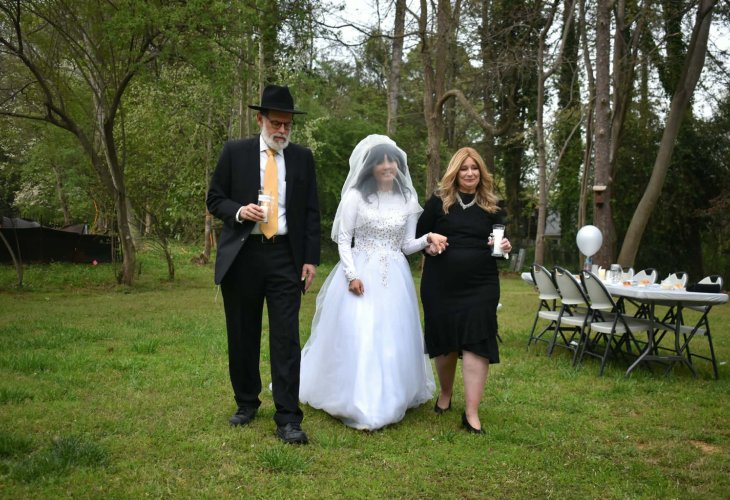 Miriam is escorted to her chuppah
“I will always believe, and tell my younger self, that she was loved, valuable, and special, no matter what.”
These are the words Miriam Barker (27), a married mother of two living in Ashkelon, wishes she could tell the little girl she once was: a baby born in China and abandoned under circumstances she may never fully understand.
Now a mother herself, Miriam still doesn't know why her birth mother couldn't raise her. She doesn't know what time she was born, how much she weighed, or whose features she inherited. Most of us grow up with family photographs, stories about our earliest years, and someone who remembers the day we were born. For Miriam, those details are missing. Over the years, she has learned to live with that absence, drawing strength from the faith that eventually led her to Judaism.
She has wondered whether China's former one-child policy played a role in her abandonment, although she knows there may have been other reasons.
“Not knowing is painful, but I try to leave room in my heart for the pain they may have experienced, too,” she says. “No matter what happened, I will always believe, and tell my younger self, that she was loved, valuable, and special.”
At two years old, Miriam was adopted by a single American mother who had already adopted another little girl from China.
“My mother grew up in eastern Virginia and first learned about adoption through a newspaper clipping about another woman who had adopted a baby girl from China,” Miriam recalls. “She adopted my sister first, and then I came along.”
In 2007, Miriam and her sister were baptized at a small Baptist church in Martinsville, Virginia. Although their adoptive mother was Christian, she made a point of keeping Chinese culture part of their upbringing.
“When I was little, we even attended a Chinese school for a short time. My mother had close friends who had also adopted children, and we had books and photographs that we would look through, and sometimes movies, too. My best friend growing up was also a girl who had been adopted from China.
“But in rural North Carolina, where I grew up, it wasn't common to see people of Chinese descent. I had to get used to the stares and questions about where I was 'really' from. Eventually, I developed a kind of rehearsed explanation, a short version of my life story, and hoped it would be enough for people.”
At home, however, Miriam always knew she belonged.
“My mother encouraged my interests and became one of the most supportive and important people in my life,” she says. “I was always interested in health and medicine. We used to bake together, and we had a special tradition: I would design my own birthday cakes.
“Once, I drew a picture of a cake I wanted her to make. It showed me lying in a hospital bed, simply because I loved hospitals and everything related to medicine. And she actually made it!
“My childhood was my mother, my sister, and me against the world. There was a beautiful combination of struggle and love. I look back on it now with so much gratitude.” She couldn't give Miriam the answers about where she came from, but she gave her the love and confidence to find her own way forward.
Until her early teens, Miriam was a deeply committed Christian. Then, at 14, painful experiences began to change her relationship with God.
“I had a deep love for God and wanted to serve Him, but when I was 14, everything changed. I became angry with God because of things people had done to me. That was why I decided to leave the church, almost as if I were trying to 'punish' Him for what I was feeling.
“Around that time, I became interested in the Holocaust. My mother took me on a special trip to a Holocaust museum, where I bought a book of survivors' testimonies. I read it over and over again. Their stories, and the resilience of the Jewish people, inspired me tremendously.”
What was the hardest part of the faith you grew up with?
“I was taught about God, but mostly about Jesus: that he died for our sins, and that every sin I committed meant he had died in vain. The message I took from it was that as long as I tried to live as a perfect person, I wouldn't need to turn to Jesus as an intermediary.
“It felt as though God was sitting on His throne, leaving us to go through Jesus to reach Him. And because I grew up without a father, it was confusing for me to hear God referred to as 'Father' in Christianity.”
But we also call God our Father in Judaism.
“That's true, but today I feel much more comfortable calling Hashem my Father because I understand that He created me. Just as I now have two children whom I'm responsible for raising and helping shape into the people they will become, Hashem has also allowed things to happen in my life that weren't pleasant, but were ultimately for my good.
“I can be angry with God and still love Him, and know that He still loves me.
“When I was Christian, I felt that God sat high on His throne and wasn't particularly interested in our lives. He sustained us, but I didn't feel that He truly cared.
“Today, I understand that, first and foremost, He cares. His love for us is enormous, for every single one of us. We are part of Him, His beloved creations. And just as a father needs to set boundaries and teach his children, so does Hashem.
“We have to trust that because He created us, He knows what's best for us, and that He gave us the Torah to guide us out of His love for us.
“My rabbi once gave an example. Imagine a father who gives his child an unlimited credit card but never speaks to him, compared with a father who provides for his son but also wants to hear from him every day.
“Even if that expectation sometimes feels burdensome, it shows that he really cares. He isn't simply sending us off into the woods to figure everything out on our own.”
“I Want to Be Jewish for the Rest of My Life”
Miriam met her future husband, Israel, in middle school. He, too, would eventually convert to Judaism.
“His grandfather, whom we called Papa, was Jewish, and he took the first photograph of us together.
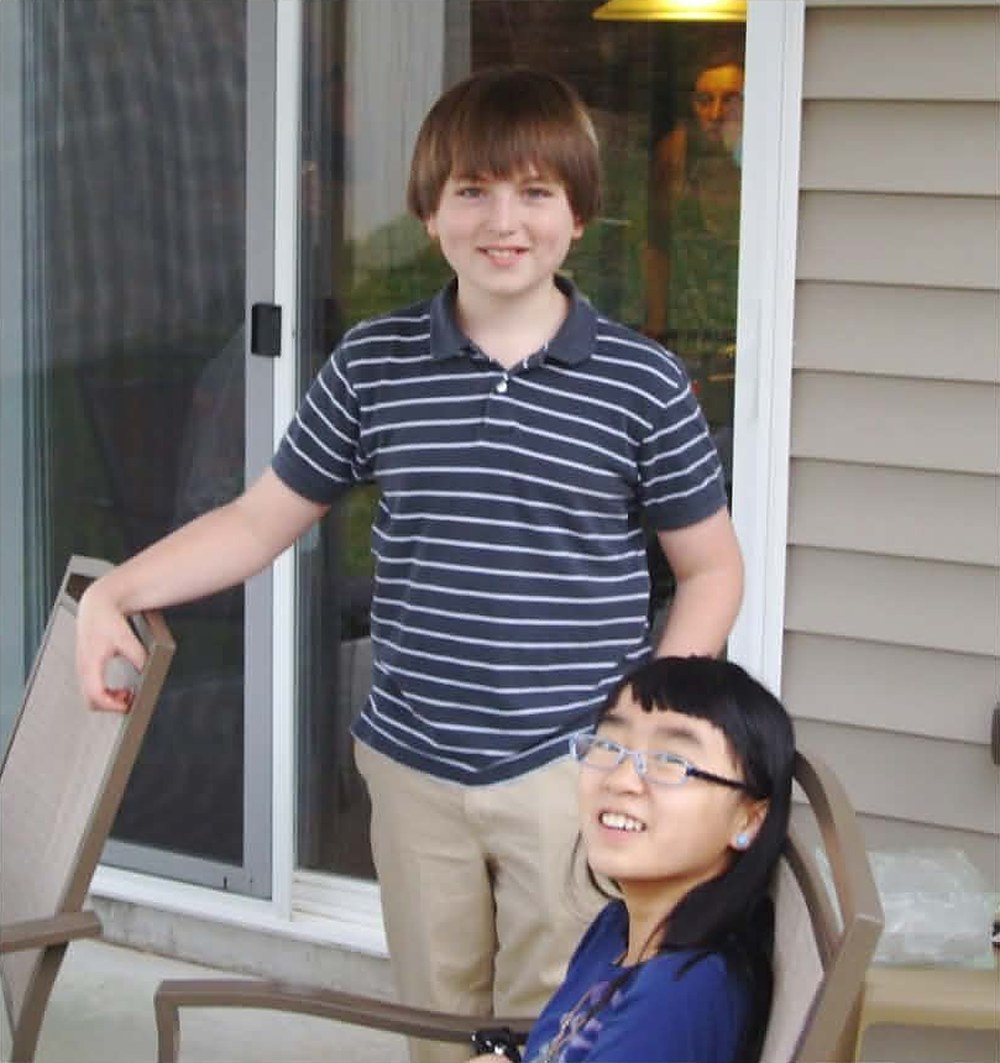 Miriam and Israel as children, years before they met again
“My husband and I stayed in touch on and off. In high school, he discovered Judaism. He spoke openly and proudly about his faith, and I was curious. I would ask him about keeping kosher and other Jewish practices. He would answer my questions, but I would put the information aside and go on with my life.”
Eventually, they lost touch. Several years later, their paths crossed again in college. Miriam was working and saving money for nursing school, while Israel had returned from an internship in Israel.
“We reconnected, and I wanted to pursue a serious relationship with him. But he told me right away that he wasn't interested in dating someone who wasn't Jewish. I asked him to tell me more about Judaism and introduce me to his rabbi.”
That introduction brought Miriam to Rabbi Chanoch Oppenheim, a community rabbi in Charlotte, North Carolina, and his wife, Sarah. They welcomed her warmly but wanted to understand why she was interested in becoming Jewish.
“I have tremendous respect for the resilience of the Jewish people, and I could identify with the feeling of not truly belonging anywhere.
“I shared some of the difficulties I had experienced in my life. I didn't need an answer to why good things happen to bad people. I needed to learn who God was and what He meant in my life.”
On Purim 2020, Miriam attended a class Rebbetzin Sarah gave about Queen Esther. It became a turning point.
“That class made me realize how much I had missed God,” Miriam recalls.
The rebbetzin's love of Torah touched something deep within her. What began as curiosity developed into a desire to belong.
“That night, I told myself that I wanted to be Jewish for the rest of my life.”
Israel, however, didn't want Miriam to convert for his sake. He wanted to be certain that her decision was her own and that she would continue on the same path even if they were no longer together.
But that was already how Miriam felt.
“I wanted the privilege of being part of the Jewish people. I learned that God gave the Torah to the Jews and that the Torah is true.
“God gave the Torah to the Jewish people because He loves His people. And I love God, so I wanted to show Him my love through serving Him, trying to do His will and glorifying His name, because that is our special mission in this world.”
Waiting was the hardest part of the conversion process. Becoming accustomed to the laws of modesty also took time. Throughout it all, Rabbi Oppenheim and his wife were there to support her.
“My rebbetzin's classes about Esther, Purim, and Hashem, and her love of Torah, lit a spark in me. She continues to inspire me to this day.”
“When I Heard the Rabbi Say 'Mazel Tov,' I Was Overwhelmed With Joy”
By then, Miriam had begun nursing school, and Israel was working. Just before they were due to complete their conversions, the COVID-19 pandemic brought everything to a halt.
For Miriam, the restrictions turned out to have an unexpected benefit.
“Everything moved online, but for me, it was a gift. My rabbi was able to give classes almost every day, and I could step away from the distractions of college and focus on learning Judaism.”
About a week and a half before Passover 2022, Miriam traveled to Milwaukee, Wisconsin, for her immersion in the mikveh.
She had finished a night shift at 1 a.m., caught a flight at 6 a.m., and was expected back at work as an emergency room nurse in North Carolina the following day.
Exhausted but excited, she stood in front of the mirror before the moment she had been waiting for.
“Right before I entered the mikveh, I looked at myself in the mirror and thanked God for bringing me all the way to that point.
“I went down to the mikveh with the attendant and could hear my husband preparing for his own immersion. It was beautiful and full of meaning.
“When I immersed and heard the rabbi say, 'Mazel tov, welcome to the covenant of Abraham, Isaac, and Jacob,' I was overwhelmed with joy.
“I prayed Mincha for the first time, and I felt, just as my husband had described it, as though someone was truly listening.
“It was a prayer that connected me to a tradition and a people who have existed for thousands of years. A people beloved by God.”
Two months later, Miriam and Israel were married according to Jewish law at the home of a community member in Charlotte.
“It was amazing. People prepared food, arranged tables and decorations, and the rabbi and rebbetzin's son was in charge of the music. Everyone came together to help. It was so moving.”
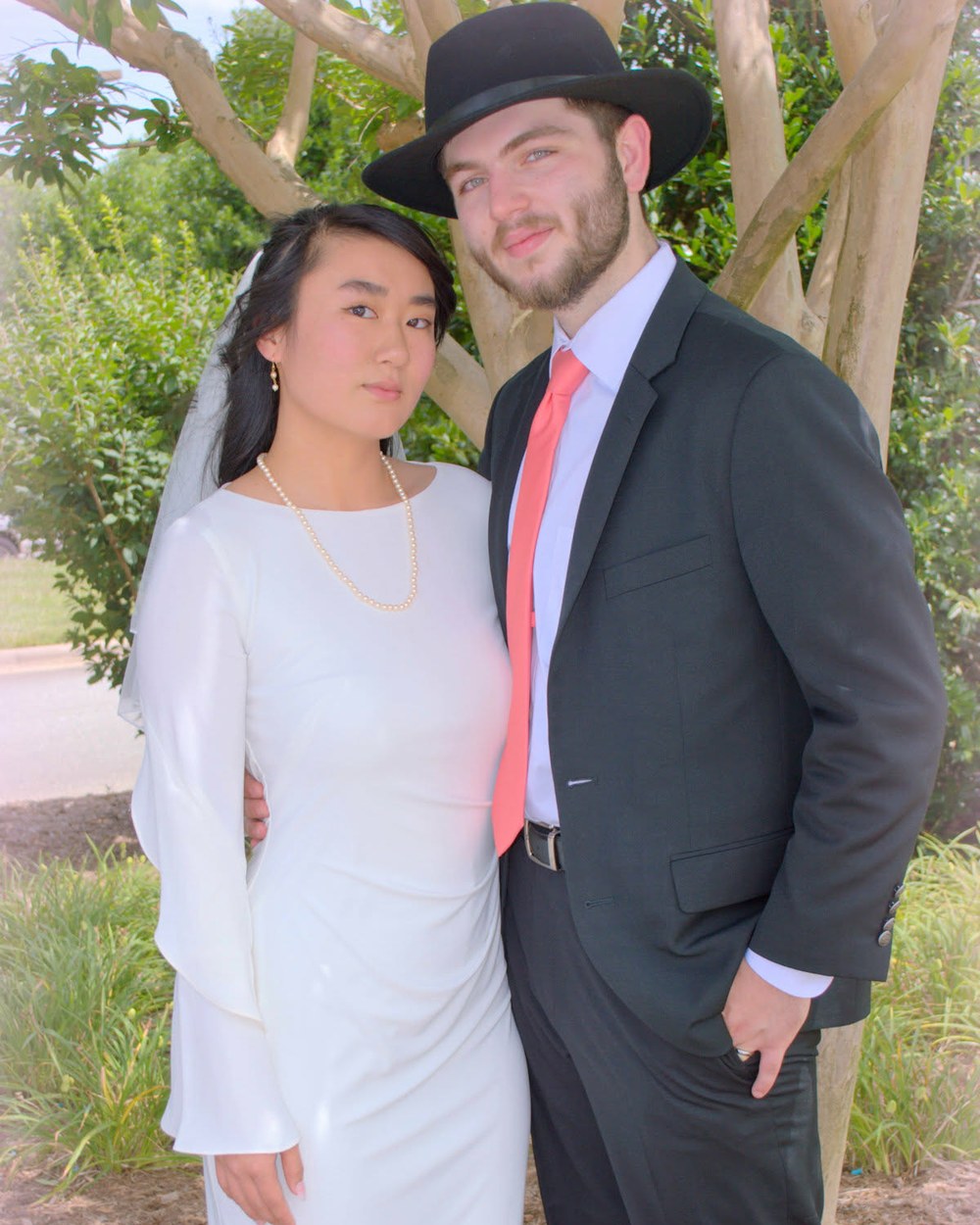 Miriam and Israel on their wedding day
In May 2025, the couple fulfilled their dream of making aliyah and settled in Ashkelon.
Three weeks after arriving, they were already preparing for the possibility of another escalation in the war.
“We knew war was about to break out, so we packed an emergency bag. I lit Shabbat candles, and suddenly the sirens sounded again. We ate that Shabbat meal in the bomb shelter.
“It was incredible to think that if someone had asked me ten years earlier where I would be today, I never would have imagined sitting in a bomb shelter with a boy I once thought was just a friend, and our one-year-old son.
“I felt so fortunate and grateful to be in Israel at that particular time, especially because we had friends whose aliyah plans had been disrupted by the war.”
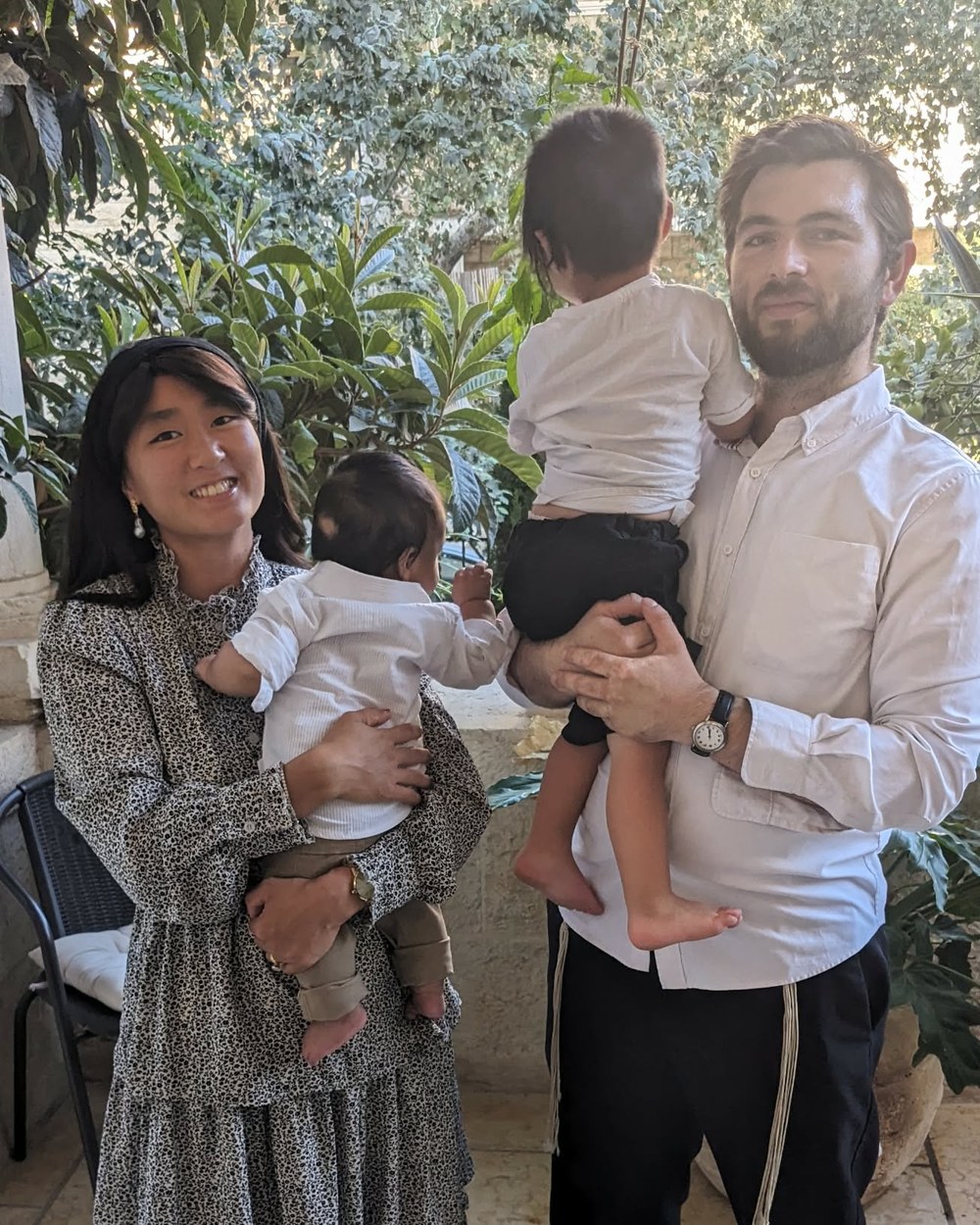 Miriam and Israel with their two children in Israel
Her Biological Cousin Was Also Abandoned and Adopted
Toward the end of our interview, I ask Miriam whether she has ever tried to find her birth parents, and whether she still hopes to discover why she was given up for adoption.
It turns out that her search never really stopped, even after she had built a new life of her own.
In 2012, she submitted a DNA sample to 23andMe. Later, she even paid someone to publish her photograph and personal details in China, hoping that someone might recognize her.
Then, in 2020, something unexpected happened.
A first cousin, about six years younger than Miriam, contacted her. She, too, had been abandoned as a child and adopted by a family in North America.
The two became very close.
“She is the only biological relative I've been able to find so far,” Miriam explains. “But I feel fortunate to have found her.
“I've tried to find compassion and understanding in my heart for my biological family. I know that what happened wasn't necessarily within their control.
“Now that I'm a mother, I understand that from the moment you know you're going to have a child, you worry about that child and care about them.
“So I don't have any anger toward them. I've reached a point where I'm at peace with the possibility that I may never know.
“I hope that one day I'll find out the truth, but if I don't, that's okay too.
“I just hope they always know that I will never be angry with them. I will always be grateful to them, and I wish they could know that I've tried my very best to live my life the right way and make them proud of me.”