Magazine
Two Witnesses in the Age of the Deepfake
A deepfake video call cost one company $25 million. Why the Torah's ancient demand for two independent, accountable witnesses looks wiser than ever, now that seeing is no longer believing.
- Maayan David
- | Updated
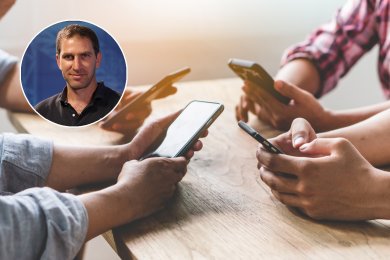
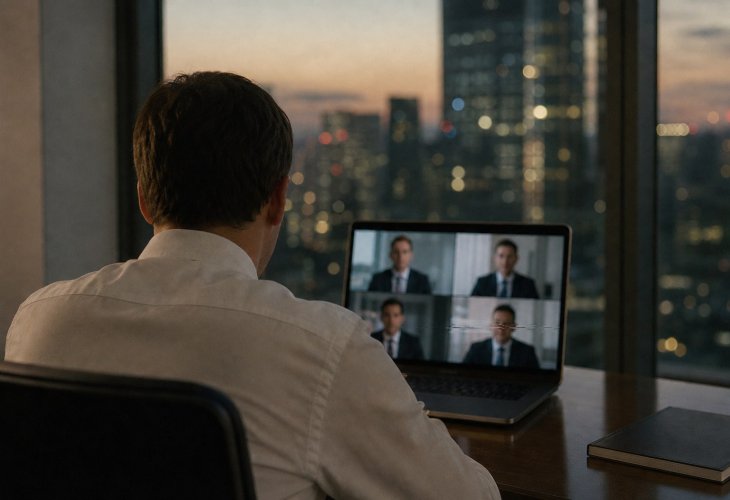 Illustrative image: a video call whose participants may not be real
In early 2024, an employee at the Hong Kong office of a multinational company joined a video call with his chief financial officer and several colleagues. The CFO asked him to make a series of confidential transfers. The employee recognized the faces on the screen and the voices he heard. Everything seemed perfectly normal. So he wired about $25 million to several accounts.
There was just one problem: Everyone else on the call was fake. The faces and voices had been recreated using publicly available footage. The employee was the only real person in the meeting.
It's a disturbing story about deception. It's also an unexpected illustration of a principle laid down in the Book of Deuteronomy thousands of years ago.
“A single witness shall not rise up against a man for any iniquity,” the Torah declares. A matter can be established only through the testimony of two or three witnesses (Deuteronomy 19:15). We tend to think of this as a straightforward legal requirement: You need two witnesses, not just one. But the Sages took the rule much further. Their discussions reveal a sophisticated understanding of evidence, human judgment, and the dangers of being too sure of what we think we know.
More Than a Head Count
The rabbis weren't interested in simply collecting two people who told the same story. That was never the point. Mishnah Sanhedrin, chapter 5, describes a rigorous process during which each witness is questioned separately. Witnesses must specify the year, month, day, and hour of the event, as well as where it took place. They must have seen what happened themselves. Hearsay doesn't count. Neither does a conclusion, however obvious it may seem.
The Talmud offers a striking example in Sanhedrin 37b. Shimon ben Shetach sees a man chase another into a ruin. He follows them and finds the victim dying, with the pursuer standing over him, a bloody sword in his hand. There seems little room for doubt about what happened. Yet Shimon tells the man that he cannot be executed. He has witnessed the scene, but he is only one witness. The Torah requires two.
Maimonides explains the reasoning in a very direct way. It is better for a thousand guilty people to go free than for one innocent person to be put to death, he writes (Sefer HaMitzvot, negative commandment 290). Once judges are allowed to convict on the basis of what seems obvious, the line between evidence and intuition begins to disappear. Eventually, a person's life may depend on a judge's confidence rather than on proof.
The Mishnah makes the same point in Makkot 1:10. A court that executes someone even once in seven years is described as destructive. Rabbi Tarfon and Rabbi Akiva go further still: Had they served on the Sanhedrin, they say, no one would ever have been executed.
Why Two? Why Not One?
The importance of two witnesses isn't that two people are automatically right. It's that two independent accounts offer something one person cannot: a way to check the story.
Two people see an event from different vantage points. They remember different details. They can be questioned separately, and their accounts can be compared. If they have coordinated a lie, careful questioning may expose them. A story that sounds convincing when told once may not hold up the second time.
Of course, two witnesses can lie well. The Bible itself offers a notorious example. In 1 Kings 21, two false witnesses are brought forward to accuse Naboth, paving the way for his judicial murder. The Torah anticipates this possibility. In Deuteronomy 19:16-21, it provides a harsh penalty for witnesses caught conspiring against an innocent person: They receive the punishment they intended for their victim. Testimony, in other words, comes with responsibility. A witness isn't just someone who tells a story. He's someone who can be held accountable for it.
When Seeing Is No Longer Believing
For much of the twentieth century, the camera seemed to solve the problem of unreliable witnesses. A photograph couldn't forget what it had seen. A recording couldn't change its story. Courts, journalists, and the public increasingly treated images and recordings as powerful, sometimes seemingly irrefutable, evidence.
That confidence is now under threat. With today's technology, anyone can create a convincing image of an event that never happened, often in a matter of minutes and at almost no cost. A short recording of someone's voice may be enough to reproduce it convincingly.
Legal scholars Bobby Chesney and Danielle Citron have identified another danger that comes with this technology. They call it the “liar's dividend.” When fake recordings become commonplace, people caught on genuine recordings can simply claim they're fake. The problem isn't only that we can no longer trust what we see. It's that we may soon find ourselves unable to prove that something really happened, even when we have it on camera.
Perhaps DNA will prove harder to fake. After all, it is considered the gold standard of forensic evidence. But even here, the picture is more complicated than it might seem. In 2009, Israeli researchers published a study in Forensic Science International: Genetics showing that they had created artificial DNA samples that could pass standard forensic tests as belonging to a real person. Detecting the deception required additional specialized analysis.
That study is more than fifteen years old. Technology has moved on considerably since then. We have little reason to assume that the tools available to forgers in the 2030s will leave DNA evidence entirely beyond their reach. And even genuine DNA evidence has its limits. It can tell investigators whose biological material was found at a crime scene. It cannot, by itself, tell them what that person did. DNA may be powerful evidence, but it isn't a witness.
Jewish legal authorities have grappled with a related question for years. Many contemporary decisors have been reluctant to treat audio or video recordings as substitutes for live testimony. A recording cannot be questioned about what it captured, what happened just before or after, or whether the apparent evidence is misleading. The Torah's model calls for a person who actually witnessed an event and can answer questions about it.
What the Sages Understood
The two-witness rule reflects a deeper idea about trust. A photograph or a video can be convincing, but it cannot explain itself. It has no memory to test, no account to give, and no reputation to defend. A human witness, by contrast, can be questioned, challenged, and held responsible for what he says. He may be mistaken, but there is a process for finding that out.
The Torah's preference is clear: Trust should rest not on a single piece of evidence, however impressive, but on the testimony of independent people who can be held accountable.
Jewish law, of course, isn't a blueprint for modern courtrooms. Its extraordinary caution in capital cases reflects a deliberate willingness to let guilty people go free rather than risk executing an innocent person. Few modern legal systems would take that approach to the same extent. But the underlying principle has become newly relevant.
In a world where convincing fakes can be produced so easily, we need to verify information through independent sources. That might mean checking a recording against metadata, examining the physical evidence, tracing the chain of custody, or speaking to someone who was actually present. The important thing is not to let one convincing piece of evidence settle the matter. Ask where it came from, how it was produced, and whether something independent confirms it.
The employee in Hong Kong learned this lesson the hard way. He saw familiar faces, heard familiar voices, and had no reason to suspect that anything was wrong. But he had only one source of information: the video call. A quick phone call to a number he already knew could have exposed the deception and saved the company $25 million.
The Sages were worried about what happens when people trust their own eyes too readily. They built safeguards into the law to prevent a confident impression from becoming a death sentence. Today, we face a different version of the same problem. Technology can manufacture the appearance of certainty, even when nothing is as it seems.
The lesson is simple, and increasingly urgent: Seeing isn't always believing. Before we accept something as proof, we should ask whether anyone else can confirm it.